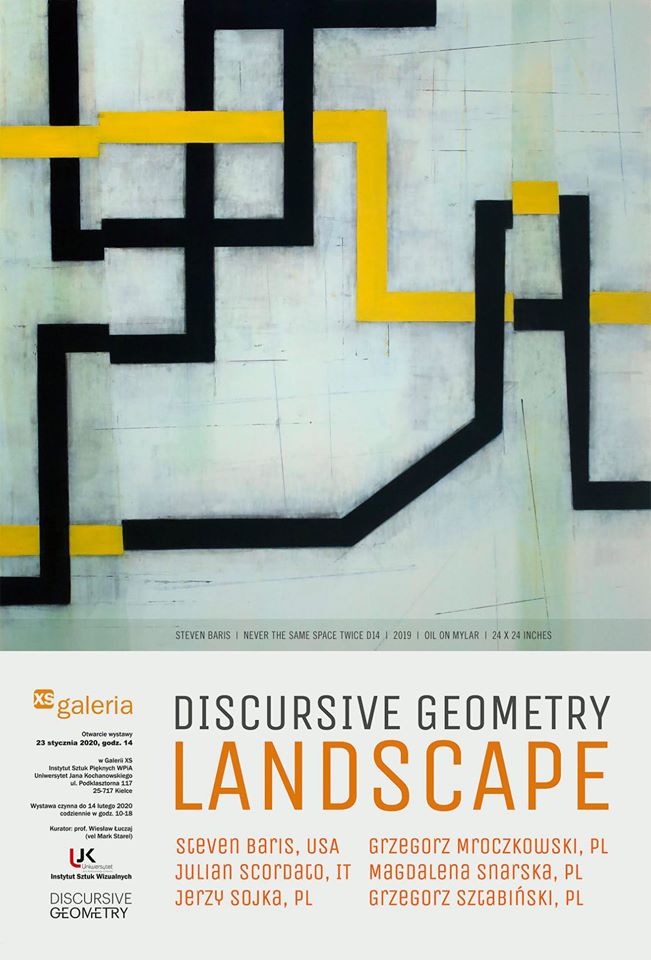
 Steven Baris, Grzegorz Mroczkowski, Julian Scordato, Magdalena Snarska, Jerzy Sojka, Grzegorz Sztabiński.
23/1 – 14/2 2020
Curator | Mark Starel
XS Gallery | Institute of Visual Arts | Jan Kochanowski University | Kielce | Poland
The exhibition opens a cycle of international projects devoted to Discursive Geometry, a conceptual framework that reconsiders how geometry can function as a critical language for understanding landscape today. Rather than inheriting the avant-garde impulse to abstract, reduce or simplify reality, the works presented here treat landscape as a complex system—measurable, traceable and constantly reconfigured by human presence.
Instead of depicting nature as an external view to be formalized, the artists engage with mapping as strategy. Cartographic procedures, data visualization and spatial diagrams replace traditional representation, shifting the focus from image to structure. Geographic space becomes a field of information: coordinates, trajectories, distances and behavioral patterns. Movement—walking, traveling, drifting—emerges as a generative act, inscribing temporary geometries onto lived environments.
Several works register these traces directly, transforming patterns of circulation into visual systems that oscillate between analytical precision and poetic resonance. Lines function not only as compositional elements but as records of displacement; grids operate less as modernist emblems and more as frameworks for organizing experience. Geometry becomes discursive in the sense that it speaks about territory, memory and the politics of space, rather than merely asserting aesthetic order.
A postmodern sensibility underpins the exhibition’s approach to landscape. Deconstruction, recontextualization and the invention of new iconographies destabilize inherited visual codes. The landscape is fragmented, reconstructed or filtered through digital and conceptual processes, revealing how contemporary perception is mediated by technology, data and systems of classification. What once appeared as a unified horizon is now understood as layered, contested and dynamically produced.
As the first chapter in a broader international series, the project establishes a platform for examining how geometric structures can mediate between abstraction and lived reality. Landscape is no longer reduced to a purified form; it is mapped, analyzed and reimagined as an evolving network of relationships—where geometry operates not as closure, but as an open discourse on how space is constructed, inhabited and interpreted.