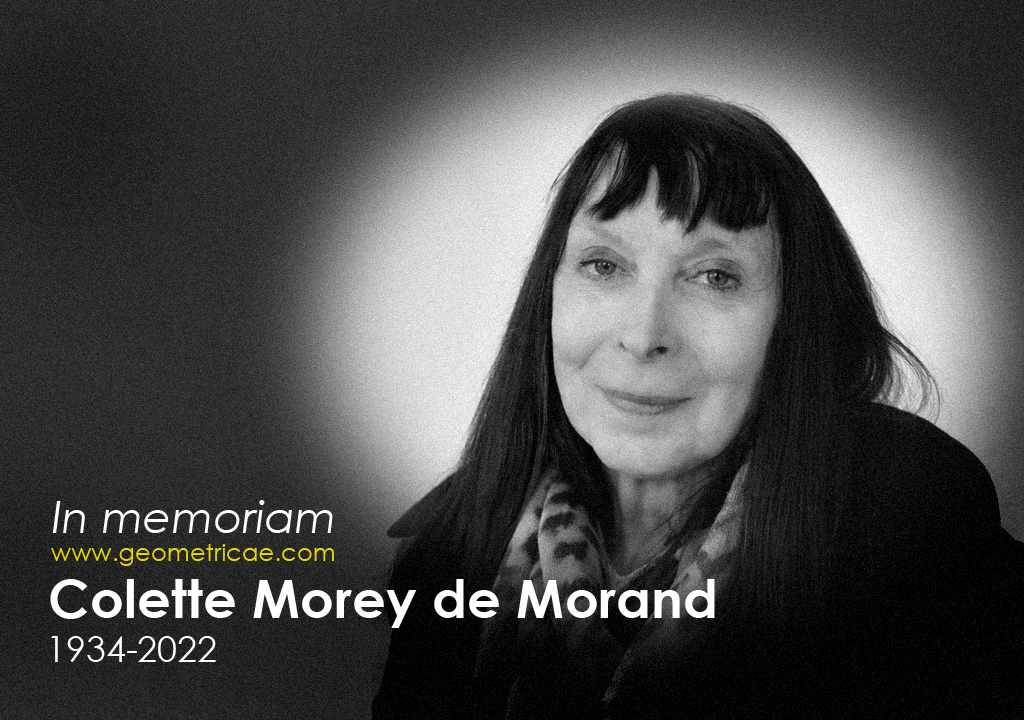
 Colette Morey de Morand | Paris | France | 1934-2022
Colette Morey de Morand (1934–2022), whose artistic career spans more than six decades, creates a body of work that traverses a remarkable range of abstract expression. Born in Paris to a French father and a Ukrainian mother, she spends her early childhood amid the cultural richness and upheaval of post-war Europe before relocating with her family to Canada. These formative experiences instill in her a deep awareness of place, memory, and cultural displacement, themes that subtly inform her early work. She initially pursues studies in science, graduating in Pharmacognosy from the University of Toronto, but her growing fascination with painting leads her to shift her focus toward the visual arts.
In the 1960s, she studies at Queen’s University in Canada and later at Massey University in New Zealand, where her education broadens both her technical skill and conceptual approach. During this period, her early works reflect a sensitivity to landscape, perception, and the metaphysical qualities of environment, earning recognition through exhibitions in New Zealand and abroad. She exhibits in venues such as Christchurch Art Gallery and the National Gallery in Wellington, establishing her reputation as an emerging artist with a unique abstract vision.
By the late 1960s and early 1970s, Morey de Morand’s work evolves decisively toward non-figurative abstraction, influenced by encounters with figures such as Clement Greenberg and Len Lye. A Queen Elizabeth II Arts Council Grant enables her to travel to New York, London, and Paris, where she engages with international contemporary art movements and artists, expanding her understanding of abstraction as both intellectual and emotional inquiry.
Settling in London in 1975, she becomes an integral part of the international art scene while maintaining a highly personal and independent voice. Her work in the late 1970s and early 1980s emphasizes expressive gesture, color, and surface rhythm, often using loose grids and structural frameworks to organize perceptual and emotional energy. She describes her practice as a negotiation with the canvas, in which intuition and logic coexist to create compositions that are both cerebral and emotive. During these years, she forms enduring friendships with artists such as Patrick Caulfield, Anthony Caro, Paula Rego, and Sheila Girling, relationships that sustain her creative trajectory and contribute to her engagement with the broader art world.
In the 1990s, she engages more systematically with geometric abstraction, introducing grids, intersecting planes, and layered structures while maintaining the gestural dynamism and lyrical quality of her earlier work. She experiments with materials such as pigments, gels, and marble dust, giving her canvases physical presence and depth. International residencies in India, Turkey, Bulgaria, Russia, the United States, Ireland, and Spain enrich her work, fostering hybrid approaches that integrate structure, rhythm, and cultural visual references.
Throughout her career, Morey de Morand exhibits extensively, presenting over forty-five solo exhibitions across nineteen countries and participating in numerous group exhibitions in Europe, Asia, and North America, including frequent invitations to the Royal Academy Summer Exhibitions in London. Her work enters prestigious public and private collections worldwide, including national galleries, civic museums, university collections, and hospital art trusts. She receives multiple awards, grants, and prizes, including Arts Council support and the Europe Prize for Painting (Bronze Medal, 1986), recognizing her contributions to contemporary painting.
In the 2000s and 2010s, her work synthesizes prior explorations, balancing structured geometric fields with perceptual lyricism. Series such as The Love Affair – Becomes a Mind Dance and The Lewes Suite reveal a refinement of compositional rigor and expressive subtlety, while later projects like Becoming, Not Being explore philosophical notions of process, transformation, and the continuum between form and perception. Even in her final years, she continues to innovate, exploring scale, colour, rhythm, and materiality with meticulous care and sustained intellectual curiosity.
Morey de Morand’s oeuvre exemplifies a lifelong engagement with abstraction in all its dimensions. From early landscape-inspired and metaphysical works to gestural abstraction and sophisticated geometric systems, her paintings embody a profound dialogue between perception, intellect, and emotion. Geometry and abstraction serve as expressive and poetic languages, capable of conveying memory, thought, and the subtle rhythms of human experience. Her legacy endures in the breadth of her work, in the collections and exhibitions that continue to display it, and in the lasting impact she leaves on the international discourse of modern and contemporary abstraction.