
First published in 2014 in Geoform, a curatorial project by Julie Karabenick, and republished with permission.
Interview by Julie Karabenick
Dan Ramirez was born in Chicago in 1941. He received a BA from the University of Illinois at Chicago in 1975 and an MFA from the University of Chicago in 1977. Ramirez taught at Columbia College, Chicago from 1977-78, the University of Illinois at Chicago from 1978-87, and the University of Wisconsin-Madison from 1987-99 where he is currently Professor Emeritus. He was awarded a Pollock-Krasner Foundation Award in 2005. Ramirez’ work has been exhibited in the US as well as in Spain, Scotland, Mexico, Germany and Italy. It has been featured in over 30 solo exhibitions since 1974 and may be found in numerous private, corporate and public collections. Public collections include: in Illinois, the Art Institute of Chicago, the Museum of Contemporary Art, Chicago, the David and Alfred Smart Gallery at the University of Chicago, the National Museum of Mexican Art, Chicago, the State of Illinois Collection at the James R. Thompson Center, Chicago, Illinois Benedictine College, Lisle, and Moraine Valley Community College, Palos Hills; in Arkansas, the Arkansas Arts Center, Little Rock; in Indiana, the Indiana Museum of Art, Indianapolis; in Missouri, the Daum Museum of Contemporary Art, Sedalia and the Museum of Contemporary Religious Art, St. Louis; in Nebraska, the Sheldon Memorial Art Gallery, Lincoln; in Texas, the San Antonio Museum of Art, San Antonio; in Wisconsin, the Madison Art Center, Madison; and in Spain, the Llorens Artigas Foundation, Gallifa. Ramirez now resides in Madison, Wisconsin.
Your creative process relies on a great many sources of inspiration—issues you’re contemplating, texts you’re reading, music you’re listening to and so on.
I’ve never been someone who can begin a painting by saying, “I’ll begin with a couple of circles.” I’ve always had to have something to investigate, something to explore and get me started. It might be an essay or poem I’ve read, architecture or painting from another era, or a piece of music that moves me.

Through my work I’m always exploring the possibility of creating metaphor and narrative through geometric abstraction. I love storytelling even though I recognize that few viewers will fully appreciate how it plays out in my work. And it’s certainly not necessary to understand all the issues I’m dealing with to respond to my paintings.
As we explore your many series, we will see how your emotional and intellectual responses to the things that inspire you get your creative juices flowing.
Quite often the issues I explore in my work have something to do with the unknown—with issues of faith or mystery, with things that lie beyond our knowledge or defy certainty.

You’ve been interested in the unknown since childhood.
My father was a devout Catholic, and growing up I was taught that there are things we cannot know, things we have to accept on faith.

And the very fact that we can even think about the unknown fascinated me. I love science and can recall as a young child lying in bed and pondering the limits of what could be known. I could imagine there was no Earth, no solar system, no universe—and it would really scare me that I could think beyond this to—well, to nothing! What could nothing be? How could I even think about it?

Today I’m still preoccupied with knowing—with how we know things, with the boundaries of our knowledge, with the unknowable. The subjects that fascinate me may come from philosophy or science, religion or mysticism, literature or music, and I create visual metaphors for them through my art; I aestheticize them. I pose questions for myself, but I’m not really seeking or expecting definitive answers. Rather through my art I’m paying tribute to these subjects of contemplation.
And there’s always a very strong emotional component to how I work. I try to capture my sense of wonder, awe or uncertainty, and the finished painting is my tribute to the thoughts or experiences that initiated it.

I love to paint, and for me there’s also mystery in the process itself. When I paint I experience a constant back-and-forth between ideas and feelings, materials and techniques. Something comes to mind that leads me to make a literal move on the canvas. As I add more elements, the painting becomes more interesting to me. New things arise, there are surprises, and I discover more and more implications of my original thoughts and intentions. It’s a continual process of creation and discovery.

The process involves controlling, then letting go, then controlling again. The element of play is very important to me—being flexible and staying open to possibilities, to making changes and taking risks. I’m not afraid to be wrong, to make mistakes, to be criticized, and this allows me to work freely. In addition to exploring ideas, I experiment with materials and techniques, trying to continue to make paintings that seem in some way new or fresh to me and thereby broadening my range of visual tools.

Hand in hand with your interest in knowing and its limits is your fascination with the process of perception. And by this you mean perception as we currently understand it—not an automatic, passive recording of incoming sensory information, but an active process that involves conscious awareness. When we perceive, we organize and interpret sensory experience in order to represent and understand our environments.
Yes, and what we perceive is greatly influenced by our perspective—meaning both our vantage point and our point of view. Perception is affected by our expectations, our knowledge and beliefs, our times and culture. It’s a highly complex process.

In your paintings you often like to challenge viewers’ perceptions, including, for example, their perceptions of how lines and shapes behave in your paintings.
Many of the formal techniques I use help convey a sense of mystery or uncertainty. For example, I often juxtapose gradated washes that imply a deep or ambiguous space with areas that appear shallow or impenetrable. I contrast lines and shapes that appear to melt or disappear with those that proclaim their objecthood. Needless to say I love illusion.


You often paint the sides of your panels or canvases.
The sides are crucial to my work. I want—as I like to think of it—to slide planes of light and space behind the surface plane, another technique to create illusory space as well as expand the painting’s possible interpretations.
You’ve always worked abstractly and have generally based your work on simple geometric forms.
I’ve worked geometrically pretty much since I first began to paint, though in some series I do incorporate representational imagery. The freedom to use representational elements when it suits me is far more important than being consistent or predictable.


However, I’ve found that it’s primarily through abstraction that I can delve most deeply into the issues that fascinate me. The abstract geometric elements I use have a kind of universal openness that allows them to be interpreted in so many ways.

As an undergraduate I was struck by the beauty of Minimalist art, and 40 years later I still find its forms inspiring. But even as a student I rejected the idea that Minimalist art referred to nothing outside of itself, to nothing beyond its literal presence. I accepted that those who followed these ideas truly embraced them, but I felt that human perception was far too complex for works of art to be spoken about in such limited and absolute terms. To me a work of art is about much more because it is both made and perceived by human beings.
How important is it to you that viewers are aware of the particular source materials that have inspired your work?
To me there’s a big difference between communication and expression. I’m not trying to communicate anything to anyone. There’s nothing to “get.” I try to aestheticize ideas about the unknown, the spiritual, the sublime. If a painting of mine feels “right,” if it excites and pleases me, I want to share it. If I believe it has the power to sustain the viewer’s interest for whatever reason, then that’s enough.

The titles of your works may provide viewers with clues as to what was on your mind when you created them.
Certainly titles can be helpful to viewers, but more importantly, titles are helpful to me. I like to explore, to stumble upon things as I work. I like surprises. Sometimes when I finish a painting, I see that I’ve arrived at a different place than I’d anticipated when I began, and I embrace that. It feels good to be able to put into words what I’ve found through the process of painting. So titles help me to both understand what I’ve done and move on to the next project. I may also change titles—sometimes even years after a painting has been completed—because I recognize implications in the work that I hadn’t earlier. Once again, I welcome surprises.

Do you do any preliminary sketching for your paintings?
In the past I used a sketchbook to develop ideas, but for the past 10 years I’ve used the computer almost exclusively to do this. When not working with my hands, I’m doing a lot of reading and configuring things in my head. I find I can really hold compositions in my mind for a long time, so that when I do go to the computer, I pretty much know what I want to see. When I begin to paint, I do make changes and adjustments, and the surface in particular may change quite a bit as I work. As I’ve said, I like to stay open.

Where did you grow up?
I was born in 1941 and grew up in an Irish-Polish Catholic neighborhood on the South Side of Chicago. My father was Mexican, my mother Croatian. My father drove a cab, though most of his side of the family were truck drivers.
You developed quite a precocious appreciation of both visual art and music.
As a child I was always around art of some kind. My mother sang opera on the radio. My father and his youngest brother and sister could draw representationally very well. My parents always encouraged me to draw, and I soon found that I was pretty good at it. I recall being mesmerized as a child walking into the Art Institute of Chicago and looking at Dutch still lifes, wondering how someone could make a painting look so real. I was also an alter boy, and I loved being in church because of all the rich sensory experiences—the smells, the colors, the sights, the sounds—things that didn’t have much to do with theology.When I was seven or eight, I took classes at the Art Institute. As in church, the sights and smells of the studios excited me. One of the classes I took was life drawing, and we worked from the nude. When I was 11 or 12, I took a course by mail from the Cartoonists’ Exchange in Pleasantville, Ohio. I received a drawing board, an instruction book and a pipe cleaner manikin for a model. I really enjoyed the course and thought I might one day become a cartoonist.
You also were involved with music.
When I was six or seven, my mother bought me a plastic saxophone. I used to play it and fantasize about becoming a musician. An uncle played guitar, and I tried that as well. In retrospect I see that I was able to emulate a kind of polyphonic sound; it just came naturally to me. I got more serious about music as I got older, and in my late teens I bought my first Fender Bass. I played with a rock band, later a jazz quartet.I never did much formal music study. I read some books, but I just seemed to understand how music works. I took up the double bass, played jazz professionally, and through that I met a lot of very creative people. For example, I got to meet and talk to Miles Davis as well as the renowned bassist Ray Brown.I played a lot of music from the early 60s through the mid 70s, but by the late 70s I was becoming very excited about painting and all the fascinating questions you could explore visually.
How well did you do in school when you were growing up?
Basically I didn’t like school. I was always drawing rather than paying attention in my classes. When I was young, I didn’t get into serious trouble, but I would argue with my teachers over things I was passionate about. I attended several high schools, played football, baseball and basketball, and was around a lot of rough kids. I frequently ditched school to hang out with my friends, and when I was 16, I quit school and went to work driving a truck for a florist.
It sounds like a life of contrasts: an altar boy with an appreciation of art and music versus a boy who disliked and got into trouble at school, was often truant, and failed to graduate from high school.
I think all these different kinds of experiences plus the freedom my parents gave me allowed me to be very flexible and to realize that I have a lot of different sides. It gave me a great sense of freedom. I still like to play, to explore, to ask questions, and I’m very comfortable making mistakes. In my art, this allows me to experiment, to try multiple approaches to problems and to always keep moving forward.
When you were old enough, you enlisted in the Marines.
I enlisted at 18, but I was injured after only four or five months. Most of the men in my family drove trucks. When I turned 20, an uncle taught me how to drive his semi tractor trailer, and I hauled steel for 15 years. I worked hard by day and played music at night. But I also envied my friends who went off to college. I finally grew tired of driving a truck, and hauling steel was a very dangerous occupation. I knew I could draw figuratively and thought I might become an illustrator. I had gotten a GED through the Marine Corps, so I was able to enroll in a Chicago city college where I did very well and got an Associate Degree.
From 1972-75 you attended the University of Illinois at Chicago.
I couldn’t have picked a worse school given my youthful ambition to be a cartoonist! I wanted to make commercial art, but the Art department at that time was centered around a Bauhaus ideology, and many of the instructors had been taught in that tradition. It was an intellectually exciting environment that would have a lasting impact on me. I was introduced to powerful ideas, and I began to read a lot. Of course I learned about color and composition, but I was also quite affected by what I discovered about the more spiritual members of the Bauhaus—Kandinsky, Itten, Klee. I learned that abstraction could be about a lot more than design—that you could use it to explore ideas about spirituality and the unknown.
My first class was a design course taught by Robert Nickle, a collagist who was very well known in Chicago. He recognized that I was an older student who was hungry for information, and he took me under his wing. I was incredibly inspired by his commitment to his art. I think I still carry the effects of his teaching in the areas of scale and the power of the transformation of materials, as well as the depth of his appreciation of beauty. He was probably the most inspiring of my undergraduate mentors.
Nickle had taught at the New Bauhaus in Chicago and was known for his subtle, elegant collages made from common materials and street detritus.
Yes. He had a strong commitment to both his art and his teaching, and I learned a lot about how to deal with space from him. I was deeply struck by the way he worked. He would pick up torn pieces of paper and very deliberately move them around with his finger—kind of like a conductor conducting a symphony. It seemed almost mysterious how he could make his work look just right. My first time in an art gallery was when I went to see one of Bob’s exhibitions, and I was totally blown away by how he transformed materials into something totally different. That was the first time I felt really confident that I wanted to be an artist.

Another major influence during that time was my teacher Martin Hurtig who introduced me to Minimalism and how to think about contemporary art. When Tony Smith’s steel cube—this large slab of steel called Die—was presented to me as a work of art, I was initially shocked. This was considered art? I thought, “This is more like what people do in steel mills!”

Gradually I found that I did respond strongly to the Minimalist visual aesthetic. But I refused to believe that this type of artwork reflected nothing more than “the thing itself.” I felt sure there was far more to it. And I knew that if I was going to make art, it had to be meaningful to me. I’m a dreamer. When I make art, I need things to inspire me, ideas or experiences to explore.
If we look at your early paintings, we can see a remarkably rapid development taking place both in how you painted and how you thought about your work.
My first paintings were basically spatial studies. I had never painted with a brush on canvas before, but I knew that Minimalism was all straight edges, and I felt that I could work like that. I could put down masking tape and make straight lines with no fuzzy edges.
In the case of Space Study #1, we had to work from a still life—a group of bottles arranged on a table—and I had to find a way to make one thing look like it was in front of another. I focused on solving a purely visual problem in a highly abstract way.
Working with abstract geometric forms, your aesthetic goals continued to develop very quickly.
With Space Study #2 I was depicting something that I actually experienced. It’s a phenomenological narrative, though I wouldn’t have thought about it in those terms at the time. The painting is a story about how I would walk to class through broad, open areas of campus carrying large canvases and battling the wind. I used tape to make lines and flat areas of color to create my own version of a stick figure tilting against the wind.
With Space Study #3 you began to explore abstract ideas.

I had read about and greatly admired Barnett Newman and Mondrian. Both had worked with geometric line and form to address spiritual issues. When I read what they felt about their art—their spiritual aspirations for it—I realized that I had similar sensibilities.

I was thinking a lot about religion at that time. I had been raised a Catholic, had been an altar boy, and my father had been obsessed with religion. In Space Study #3 I decided to give line and form symbolic meaning. I used form to represent the body and line the soul. I outlined the shapes, then changed the colors and angles of the outlines and moved them away from their associated forms. In this way I imagined that I was “releasing” the lines from the forms—like releasing the soul from the body. This romantic notion allowed me to use abstraction to begin to focus on the spiritual. And in truth my mindset hasn’t changed a lot to this day. I continue to use Minimalist composition to fictionalize, to metaphorically explore the wide variety of ideas that intrigue me.
You also did exercises in paint handling in which you learned techniques that you would carry forward into your mature work.
Looking back I realize how much I was influenced by my Bauhaus-based courses. I took a color class from Eugene Dana who was a student of Joseph Albers and was familiar with the teachings of Johannes Itten. In a typical Bauhaus exercise, Dana had us make studies of 12 stages of gradated value from light to dark. Then we would do gradations in color, for example from orange to blue. I began I to refine this technique, and I use a variation of it in my paintings to this day.


You began to have solo exhibitions when you were just an undergraduate.
Dennis Adrian was an art historian and important art critic in Chicago. He visited my studio and offered me a show. At the time of the visit, I didn’t really understand who he was and subsequently was told he was the art critic in Chicago! In 1974 I had an exhibition at Don Roth’s Blackhawk, a popular restaurant in the Chicago Loop area. That was the beginning of a series of solo exhibitions and favorable reviews in the press.
In 1975, you briefly attended the Art Intitute of Chicago.
I wanted to go to graduate school, and the Art Institute had a great reputation. The Chicago Imagists were associated with it, and as a young child I had taken classes there. I was admitted, but I had an instructor who made it pretty clear that he didn’t believe in me. I discussed the situation with my close friend Vera Klement who was an art professor at the University of Chicago. Vera helped me get a fellowship there. I received a great stipend and studio space. Vera—a friend to this day—has had an enormous influence on me. She believed in my work, and perhaps more importantly, she instilled in me the importance of believing in yourself.
The University of Chicago would turn out to be a wonderful environment to nurture and support your developing aesthetic concerns.
Yes, it was a perfect fit. My first contemporary art history class there was taught by art historian Richard Shiff. He had us read and write a lot and introduced us to artists like Richard Serra and Tony Smith. So once again I was confronted with Minimalism. I had to write about Tony Smith’s sculpture, Die. At that point I had a much more sophisticated response to it than I’d had as an undergrad. I could appreciate this work as a thing unto itself—and as so much more. I recognized, for example, that the steel would rust and the color and surface of the work would change—as would something organic. This, in turn, suggested to me ideas about impermanence and ambiguity.
Shiff was my mentor and MFA thesis reader, and we spent a lot of time together. He would listen to my ideas, discuss my work, and he gave me the freedom to go my own way. I also audited classes taught by art critic Harold Rosenberg. There I came to understand more fully how literature could open up avenues for me in visual art.
Among your varied readings, one book in particular, Robert Rosenblum’s Modern Painting and the Northern Romantic Tradition: Friedrich to Rothko, resonated strongly with your sensibilities.
I was very attracted to the work of David Caspar Friedrich and to the idea of the pathetic fallacy, which means anthropomorphizing or attributing human emotions to Nature. I found that as I got better at manipulating space in my work, this allowed me to bring more and more ideas and references into my paintings.
In 1976-77 you painted a very large and seminal work, one of several early works that are in public collections.
In TL-P 6.421 I was combining Friedrich’s Romanticism with what I’d taken from Minimalism.
I liked illusion and decided to make some of my lines disappear into a mysterious environment, an apparently empty space that was physically large enough to invite entry. I was continuing to develop gradated wash techniques. I used a wide brush to apply white acrylic across the top of the canvas, adding lavender and then iridescent silver that has a sparkle to it as I darkened the paint toward the bottom of the canvas. I couldn’t completely control the color and value transitions, and the overlapping strokes led to a rolling, cloud-like effect that I liked. The painting was luminous, and I began to use this technique to explore a variety of ideas.

The painting was inspired by Friedrich’s work, Wanderer Above the Sea of Fog, with its singular figure gazing out into a vast openness.

We will encounter this Friedrich figure as well as abstract references to him again and again in paintings and prints across your career.
As an undergraduate you’d begun to read the work of Austrian-born philosopher Ludwig Wittgenstein, specifically his early book Tractatus Logico-Philosophicus. Wittgenstein argued that the logical structure of language limits our ability to sensibly discuss many important issues—for example, religion, ethics or aesthetics—and that there are many things that cannot really be spoken about, only shown. You titled many of your paintings from the numbered logical propositions in this book, as in TL-P 6.421 above.
I was fascinated by the Tractatus. To be brief, contrary to many scholars of the time, I believed Wittgenstein to be fundamentally concerned with spiritual and mystical ideas despite the fact that he was dealing with logic, mathematics, and language. For example, Wittgenstein spoke of the possibility of things being “other than what they are,” and I found this a far more intriguing statement than the Minimalists’ “What you see is what you get.” I found Wittgenstein’s courage, sensibility and lack of certainty about the very things he was writing about to be very poignant. This resonated strongly with my own desire to explore and ask questions and to accept ambiguity and uncertainty in my own work. It was inspiring and very liberating to me.

Here’s another very large painting from this time.
Again I’m using gradated washes and lines that seem to disappear into an ambiguous atmosphere or void. The vertical strip may have come from thinking about the work of Barnett Newman.

In 1978 I was awarded a fellowship to complete a Ph.D. at the University of Chicago in the area of the History of Culture. I pursued that for about six months, but soon realized that what I really wanted to do was paint. During that period I had the opportunity to talk extensively with philosopher Stephen Toulmin who had been a student of Wittgenstein. He agreed with my interpretation of the Tractatus as bordering on the mystical. This experience added to the growing confidence of someone who had driven a truck for many years while his peers had gone straight to college after high school.
My successes and wonderful experiences in college helped me trust myself. In my art they allowed me to follow my interests wherever they might take me. This sense of great freedom was—and still is—tremendously important to me.
Drawing played a key role in your next series. This body of work also foreshadows how you would continue to experiment with materials throughout your career.
I have done many paintings with this trapezoidal shape. In these works from the late 70s, I painted the canvas with a coat of black latex. Next I covered the entire piece—except for the two black triangles in this painting—with horizontal strokes made with a soft pencil.

In the case of TL-P 6.4211, the entire shape was again covered with black latex paint. To make the central and right-side panels I used a t-square to striate hundreds of lines in pencil. The detail shows the lower right side of the large central rectangle. In the darker area I made fewer horizontal lines, allowing more of the black latex to show through from beneath.
These works are very responsive to light in the environment, and I burnished areas of the graphite to make the surfaces glow.

You’ve worked with a number of different types of printmaking over the years. In 1980 you completed a suite of black and white etchings that continued some of the formal devices of the latex- and drawing-based work. The prints were inspired by the music of the 20th century French composer Olivier Messiaen and were exhibited at and later acquired by the Art Institute of Chicago.
These 20 prints were an homage to Messiaen who in 1944 wrote 20 solo piano pieces called Vingt Regards sur L’enfant Jesus or Twenty Contemplations on the Infant Jesus. Messiaen said that he was looking for a musical language of mystical love. I tried to develop a series of visual metaphors in these prints that befitted the sublime nature of the subject.


For example, in the Contemplation of the Terrible Unction I used a dark gradation on each side of a truncated pyramid to create an atmosphere of foreboding in the face of death. At the same time a black line disappears as it moves to the right, leaving an opening—like a passageway to the unknown.
Messiaen had a type of synesthesia; he could see colors in his “mind’s eye” as he listened to music. Do you have similar abilities?
I do have this type of sensibility. I’m a musician and played jazz professionally for many years. I find I can see a color or shape when I listen to a musical piece, or I can sense how thin or thick a line should be as I follow music’s rhythm or duration. In my paintings I try to create a sublime visual statement of what I “saw” and felt it as I listened to the music. I often find inspiration in the titles of music as well.
I believe that music—perhaps even more than visual art—can bring the listener close to a state of ecstasy. Certainly the devout Catholic Messiaen thought so. I’ve used Messiaen’s music for many years to help me into paintings, but unlike him, I’m not trying to communicate a specific message through a precise one-to-one relationship between visual elements and meanings. I work in a more open, fluid way.
One of Messiaen’s Contemplations—Kiss of the Infant Jesus—inspired an etching and a large painting. In the painting you used strips of wood to mimic the actual depth found in your embossed print.
At the top left of the painting, a thin piece of wood sits on top of the canvas flush with the picture plane. As the wood moves toward the center of the work, it protrudes about an inch forward from that plane. The line down the center of the painting is also a piece of wood that moves outward toward the viewer as it moves down the canvas. The wood helps call attention to the painting as an object in contrast to the nature of the metaphor it suggests—the kiss as both a physical and a spiritual experience.


Let’s look briefly at a second suite of prints inspired by the Duino Elegies written by the Austrian poet Ranier Maria Rilke. His emotionally charged lamentations contemplate the angst and isolation of the human condition.
In my family angels were always considered beautiful and protective, but in Rilke’s poems, they are beautiful, but remote—even frightening. I called my prints Where Are the Angels Now?
To this point you’d created actual depth with embossing and with wood. Here you create depth using collage.
In these museum board and tempera collages, many of the apparent lines are created by light hitting the edges of the collaged surfaces. Once again I’m juxtaposing real and illusionary depth.


You continued a religious theme in your series Celestial City—a term often used to refer to heaven.
In this work I’m giving visual form to my responses to Gothic architecture and to the heavenly city that Gothic architecture is aligned with. These paintings also reflect my continuing interest in the religious music of Olivier Messiaen, in this case his 1963 work, Couleurs de la Cité Céleste.


Certainly Gothic cathedrals are one of the greatest achievements of medieval technology. Based on geometric proportions, their soaring vertical interiors and large stained glass windows create luminous environments—as you do in these very large paintings.
I drew hundreds of variations on these forms, feeling my way through the kind of space I associated with churches and developing a structure to elicit deep space. I focused in particular on one of the structures found in Gothic churches—the tierceron-star vault.
With these paintings I was creating spatial maps of linear and curvilinear architectural space filled with light. To me these spaces represented something of the unknown, something you’re drawn to explore physically and emotionally.
I continued to explore the form of the tierceron-star vault in a large commissioned work in glass.

Unfortunately due to strong differences of opinion between you and the board of directors who commissioned the work as to how the work should be illuminated, you chose to have your name removed from it.
They wanted to light it from behind with 150 fluorescent tubes, and when I saw it with all the lights on, all I could think was, “Jukebox!” Because much of the glass was broken when the work was stored, I never had it returned to me.

Inspired once again by the music of Messaien, you returned to right-angled forms.
In the very large work, Contemplation of the Father, a title taken from Messiaen’s Twenty Contemplations of the Infant Jesus, I used a format borrowed from music to deal with religious subject matter. I introduced a graphing element—the staff ledger lines from musical notation—that continues across and visually links the five canvases. A black vertical bar moves from one canvas to the next and increases in size with each one. The white areas are painted on gessoed canvas, while the other elements are painted directly on the raw canvas.

It feels like we go from a fairly closed to a very open space as we move across the canvases. It also looks as though we begin with window openings in an otherwise opaque white plane and end with an unidentified object hovering in deep space.
In the first panel these “windows” are actually small versions of several of my previous paintings. They are also like notes going up and down a musical staff. The small image in the upper left is based on my earlier print, The Contemplation of the Father. It functions like a musical key signature, and its title becomes the title of the entire work. The black bar that changes across the canvases can be thought of as a developing musical and visual theme. By the fifth canvas, the black bar is large and frontal—as if it’s about to leave the space.


Perhaps a metaphor for transcendence? —appropriate to Messaien’s religious beliefs.
Your next series, Veritas/Lumen/Res or Truth/Light/Object, is filled with ambiguities of form and space.
I have always loved the Necker cube illusion, and how its planes appear to occupy different spatial positions as we gaze at it.
The cube pictured in the middle, the Necker cube, will alternately appear to us like the image to its left or the one to its right. You frequently present the viewer with diverse kinds of spatial ambiguities, making us question the nature of your forms, where they are located in space and how they function in the composition.

For me the spatial illusions and ambiguities I use are ultimately metaphors for point of view. Our multiple points of view challenge ideas about what is real, what is true, what can we know with certainty.
In Veritas/Lumen/Rex IX, the apparent nature of the forms changes according to where we direct our focus. For example the atmospheric area to the top right of the large green shape is seen as located behind the shape, but at the bottom of the canvas, this insubstantial area becomes solid and textural and is seen as in front of the large shape. A thin vertical line appears to enclose the side plane of the green form. Yet it continues down to help create a shadow box at the bottom of the canvas, an area that suggests possible entry into deep space.

The word lumen—or light—is often used as a metaphor for knowledge or truth. Yet in these paintings their “light” does not give us certainty about their natures.

In your 1989 series Las Crucis—or The Cross—you used a variety of materials to help you create visual metaphors.

The Las Crucis series deals with the crucifixion and resurrection. On one hand, I am dealing fairly literally with the ideas of crucifixion and burial by using lengths of wood and thick layers of dirt. Yet I also incorporate gradated washes that lighten towards the top of the canvas. These create atmosphere and an illusory space that might suggest salvation or passage into another realm.
And the painting from this series titled simply b?

I’m dealing with the idea of being—what does it mean, “to be?” If you look at this work from the side, the painting literally resembles the small letter “b.” The rounded, protruding form to me represents a pupae, which is a metaphor for transformation, in this context through the resurrection.
With Nox Volatus or Night Flight I’m treating the idea of the crucifixion and resurrection more abstractly. The wood and bolts are clearly earthly objects, yet the bolts also glimmer like stars in the night sky. This painting is intended to suggest the possibility of leaving this realm for another.

In 1995 you made a series of self-portraits that are rich in metaphor and double entendre. And once again you confront the idea that a Minimalist painting represents nothing beyond its literal presence.
I also continued to explore perception and how your point of view helps determine what you perceive. Really at their core, these self-portraits reflect my own personal concerns about how I’m perceived or understood—both by myself and by others.
In this series large digital prints were mounted onto very thick museum board and laminated with a thin matte film. In Snow Blind the monochromatic image has several hand-colored elements while the right side is painted white with a large red stripe.
There are many references and possible interpretations in the Self-Portraits. The idea of simultaneity has always been important in my work, and I enjoy juxtaposing one thing against another. In Snow Blind I am the musician who holds the instrument—a bass—the instrument that I have played for many years. The bow I hold is painted like a blind person’s cane. Does the cane suggest limits to what we can perceive or understand or perhaps taking things on blind faith? Am I rendered snow blind by the large expanse of white with its vertical red stripe that together read like a Minimalist painting? I even thought of the stick as a magic wand, perhaps a source of creation!

And the self-portrait B Flat?
This work deals with perception, illusion and touch. B flat is, of course, a key signature in music. Is the painting flat as well? It doesn’t appear to be so. The musician holds his bow—again a blind person’s cane—and the sense of touch is especially important for the blind. The image of the b flat is actually flat, the painted areas giving the illusion that it is raised, perhaps like braille. In my work I like to provide many possible interpretations for both myself and the viewer.

You created several large installations through which you continued your exploration of perception. Let’s examine the one that you created in 1996 for the Madison Art Center in Wisconsin. In this installation observers were able to participate both from outside on the sidewalk and from inside the space. Central to the installation is the solitary figure from Caspar David Friedrich’s painting, Wanderer Above the Sea of Fog, a Romantic’s painting of a man standing on a rocky precipice, walking stick in hand, looking out over the vastness of the natural world. However, instead of looking out at a mist-covered landscape, your Friedrich figure faces a horizontal bank of six television monitors.
Yes, and the figure is reduced to a cutout made of black laminate adhered to the window. His walking stick is painted to also resemble a blind person’s cane. Inside, the floor was covered with two tons of crushed stone that crunched under visitors’ feet.
So they simultaneously experienced elements of two types of environments—naturalistic and technological. And a video camera faced the window and recorded people who looked at the figure or peered into the exhibit space.
Each of the tv monitors showed the identical view: the silhouette of the figure and passersby gazing at it. The title, Survoyeur, combines the idea of a figure surveying what he beholds—brought into question since his walking stick doubles as a blind person’s cane—and “voyeur” as the camera recorded viewers outside on the street who may not have realized they were being recorded. Those who came inside were often frustrated by the fact that they could not see the front of the silhouetted figure—only the figure seen again from the back.


I was fascinated by how people responded to seeing and being seen, by all the different ways they tried to interact with the figure, and how they would try to adjust themselves to the information they gained as they both experienced and actually became part of the installation.
This installation led to a series of related prints. For example the serigraph entitled diptych, diptych continues your juxtaposition of Romantic imagery and Minimalist painting, once again raising questions about perception and interpretation.
To enhance the contrast between the Romantic image and the reference to Minimalism, I printed the figure on plastic laminate, a substance aligned with the industrial materials of Minimalism. To my surprise and great pleasure, I discovered some fascinating things about this work after I’d finished it. The sides, top and bottom of this piece are also covered with laminate. Looking straight down at the top edge of the work, you see a strip of white laminate that ends in a small red strip. It looks just like the walking cane held by the figure. This led me to realize that the sojourner could also be seen to be holding a small version of the entire work—we just see its top edge. I love the fact that more and more possibilities emerge as I work and may even remain to be discovered some time after the work is complete.


The Belisarius series was in part inspired by the story of one of the greatest generals of the Roman Empire, Flavius Belisarius, and the legend that he was blinded by the Emperor Justinian, the man he served, and thus reduced to the status of a beggar.
Whether apocryphal or not, the story of the blinding inspired many painters, including Jacques-Louis David in the late 18th century. Belisarius was also rumored to be part of a love triangle with his unfaithful wife and their adopted son.
The paintings in this series are primarily quiet. I’m using geometry in a simple, classical way. Due to the large scale of the painting titled Belisarius and its atmospheric passages next to the opaque white rectangles, all three large rectangles can be read as doors that might be entered.

Again in this series, I often used the image of the white and red cane to raise questions about perception. In Belisarius: Mr. Magoo and Me, I’m remarking primarily to myself how—like Mr. Magoo who is nearsighted and constantly stumbles over things—I often stumble along in my work. Yet also like Mr. Magoo who somehow emerges from his predicaments smelling like roses, I often make unanticipated and rewarding discoveries. At times the process of making a painting feels almost magical to me.

The Songs Out of Sight series reflects your love of music as well as the synesthetic experiences one can have when listening to music or looking at art. Let’s look at one painting from this group—A Kind of Blue: In C.
As both a musician and a painter, I sometimes work from a synesthetic experience I have among the elements of sound, form and color—as I did here. The title of this painting refers to Miles Davis’ celebrated album, Kind of Blue. The words in the title “In C ” refer both to the musical key signature and the color of the paint I used in this work—”c” for cobalt blue. The painting reflects my deeply felt experience of the music.

In the summer of 2002, you began what would become a series of artist residencies in Gallifa, Spain, a small town in the mountains about 25 kilometers north of Barcelona. There you worked at the Josep Llorens Artigas Foundation that was created in 1989 by Josep’s son, Joan Gardy Artigas, in his father’s honor. Josep was a world-renowned ceramicist who had collaborated with many artists, most importantly with his friend Joan Miró.
Joan is also a ceramicist as well as a painter and sculptor, and he worked with Miró for twenty years. When in Gallifa in 2002, I had a large studio and beautiful apartment up in the mountains. I was greatly inspired by the landscape and the quality of the light.
During my first residency, I produced three suites of acrylic paintings on paper that led of a series of paintings made when I returned home. The paintings were named for the musical composition Nuages—or Clouds—written by guitarist/composer Django Reinhardt.
Looking at the incredible view out my Gallifa studio window, I decided to work in a more traditional landscape style. In Nuages La Luz: Dos, I actually created a horizon line, making the top of the painting atmospheric and the bottom very tactile through thick brush strokes.

In another work from this group, the title Nuages Ebm is a play on the key signature E flat minor. An atmospheric strip is contrasted with more opaque areas—especially the highly textural wide black bar. So again I’m questioning the nature of the space in these paintings.

_Majestat_Batllo_-_Museu_Nacional_d'Art_de_Catalunya.jpg/1920px-(Barcelona)_Majestat_Batllo_-_Museu_Nacional_d'Art_de_Catalunya.jpg)
A second residency in Gallifa led to series of tall vertical paintings inspired by a 12th century crucifix in the National Art Museum of Catalonia in Barcelona. Called Batlló Majesty, this crucifix is thought to symbolize Christ’s triumph over death.
I was struck by the beauty and physical presence of this crucifix, by its verticality, its objecthood. In response I painted a series of tall, thin works and called them La Luz or The Light. I was continuing to explore the color blue, trying to get as much light from it as I could. And of course blue suggests a celestial realm. I was also continuing to play with the idea of light as a metaphor for knowledge and its contrast with faith, which is based on belief.

You created a third series, La Duquesa de la Luz—The Duchess of Light—during another residency in Gallifa in 2005.
This series was inspired in part by one of the paintings of the 13th Duchess of Alba done by Spanish painter Francisco Goya.

Once again you combine representational elements with a few large minimal forms.
I was moved by the color and the contrasts of light and dark in this work as well as by the beautiful paint handling of the white dress—its texture and brilliance. In my painting, La Duquesa de la Luz en Gallifa, I used the red, black and white of the portrait. I let some of the paint bleed into the canvas, suggesting the black of her hair.
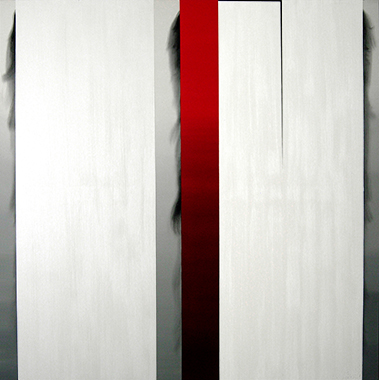
This series also includes some small works composed partially or wholly from digital prints. Let’s look at a few of them.
In #5, the section that looks like a standing figure is actually derived from a photograph I took of hair on my forearm. I cropped the photo and combined two copies to create a mirror image, thereby inserting myself into the story. In Desnudo (Nude) I incorporated a tree outside my studio window and dressed it in red to create a sensual figure-like image.


You also made some ceramic works during this residency.
I worked under the direction of Joan Artigas who had collaborated with Joan Miró on his ceramic works. The work ¡Oh! Goya! Can you hear her now? resembles the parts of the ear. Goya was deaf when he visited his muse, the 13th Duchess of Alba. Joan liked this work because he felt it had some of Miró’s playfulness.


You seem to have been very inspired by the times you’ve spent in Spain.
When I first went to Barcelona in 2000, I felt remarkably at home both culturally and as an artist. I had grown up in an Irish-Polish neighborhood where I was the only Latino kid around. My father’s side of the family was mainly truck drivers as I myself had been for 13 years. By the time I went to Spain, I had developed a strong identity as an artist. I had read a lot about the history and culture of Spain, and I was very moved by the art and architecture I saw there. I loved the Romanticism I saw in the work of Goya. In Spain I felt that I was connecting with a more gentle, polished side of myself.
The Cathedral of Saint Mary in Toledo, Spain, a magnificent example of Gothic architecture, inspired another series of work.
Once again I’m responding to the tierceron-star vaulting structure, the light, and the ambiance of these beautiful cathedrals. I tried to capture the play of light and darkness.

The use of blue is again a reference to celestial blue.
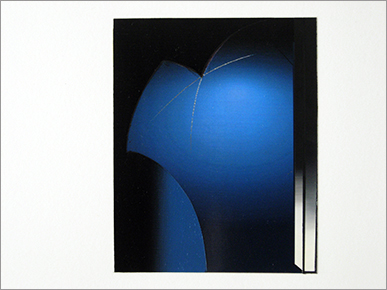

In 2008 you were one of 30 Chicago artists commissioned to create artworks for the McCormick Place West Building in Chicago, works that responded to Chicago’s cultural history.
My eight large paintings were an homage to the work of writer Nelson Algren, specifically to his 1951 prose poem Chicago: City on the Make. Algren’s work is basically a social critique that reflects Chicago’s history of corrupt politicians and gangsters, the downtrodden and the dispossessed. However, what I was responding to was the beauty of Algren’s prose, its song-like quality, its rhythms and alliterations. My paintings were made by spraying and brushing acrylic polymers over aluminum panels.


Let’s look at two of these large works—13 feet high by 8 feet wide.
Algren writes about different aspects of the city. In one passage he creates an image of gangsters and crooked politicians meeting in pool halls. The phrase “green-biazed cloth” is his reference to the fabric that covers the pool tables. I wanted to make a beautiful image out of his prose. In my painting …green-biazed cloth… I used the green of the cloth, a yellow strip referring to the lights above the pool tables, and included a gradated vertical strip to their right to create a sense of atmosphere. In the niches in which the paintings are installed, part of each space is deeper than the walls on which the paintings are hung. The atmospheric strip gives the illusion that you could enter that deeper space through the painting.


Algren talks about Calumet City, an area known for corruption and illegal activities. From there you can look across Lake Michigan to the steel refineries of Gary and Hammond. As a former steel-hauler, I had a personal association to these places and Algren’s images of them. In my painting …refineries… I conjure up the glow of molten steel and the blue of the lake.

In 2010 we see you returning for inspiration to the music of Olivier Messaien and his composition Amen des étoiles, de la planète à l’anneau (Amen of the stars, of the ringed planet). These celestial bodies undoubtedly had religious connotations for the devout Catholic, Messaien. Your series contains both paintings and prints.
The Satunarius series deals with the planet Saturn and its rings. The image of the blue rings might suggest halos. The colors red and blue are featured in these works because I’m also dealing with the phenomena of redshift and blueshift, which refer to the lower and higher frequency light waves associated, for example, with the concepts of an expanding (red) or contracting (blue) universe. The digital print Red-Blue Shift Key Signature forms the point of departure for a large group of prints.
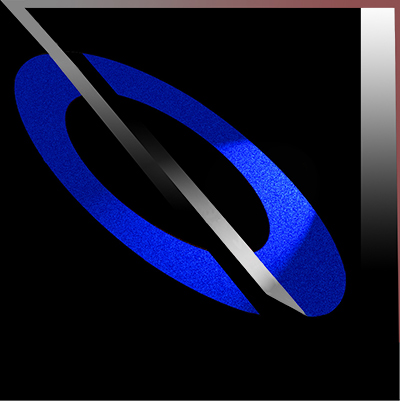
The small images across the top of these prints function like a musical staff, a reference to Messaien’s music.


This series led to a collaboration between you and musical composer Stephen Dembski in which you produced short animations accompanied by excerpts from Dembski’s music.
This is an ongoing collaboration. Steve and I are approaching this in ways similar to two jazz musicians trading solos and feeding off of one another’s responses. These initial attempts are very rudimentary. They should be considered more as preliminary sketches. As each of us learns the techniques and materials that the collaboration demands, we hope to realize larger and more sophisticated pieces.
In 2011 you created another series based on Goya’s paintings of the 13th Duchess of Alba, this time his work La duquesa de Alba y su dueña (The duchess of Alba and her duenna) painted in 1795.

Goya was critical of some of the the abuses and hypocrisies of the priesthood. In this small painting the Dutchess of Alba shoves a red amulet—a charm to ward off evil—into the face of her duenna, La Beata, a very religious member of the older generation. I’m interested in belief systems, in what is possible to know. In this painting there is a juxtaposition of light and dark, amulet and crucifix.
Pagan superstition and religious belief.
In my small study of Goya’s painting, there are actually three crosses—one containing a gold strip that repeats La Beata’s cane; one made by adding a square to the right side of the painting and the crucifix itself that La Beata is holding—the number three suggesting the Holy Trinity.

I did a number of variations based on this study. Here the crosses and the coloration relate back to the forms and colors of the study, the two crosses also suggesting the two figures.

In some variations I broke up and eliminated elements of the cross, included atmospheric passages and variations on the gold vertical line.


On a visit to the National Ceramics Museum in Valencia, you became quite interested in some of the ceramic tiles you saw. And as we’ve seen, you’d previously worked in ceramics while at the Artigas Foundation in Gallifa.
The Spanish word “azulejo” refers to glazed ceramic tiles. With the Azulejo works I am once again challenging the idea of painting as object. I created the illusion of space in Azulejo x 2 by opening an illusory space on one side of the work.


And here we see a blue line that raises questions about the solidity of the painting as the line traverses and appears spatially in front of an atmospheric passage that suggests depth.
You recently had an exhibition at Zolla/Lieberman Gallery in Chicago called [Epoché] Recent Paintings. The term “epoché” is an important notion in Phenomenology, a philosophical tradition that focuses on conscious experience from a subjective point of view. So once again, you are exploring ideas about the complexities of perceptual experience.


Epoché was originally a Greek term meaning abstention or a suspension of judgment. An important idea for me from my readings in Phenomenology is the idea of a very intense kind of looking—the kind of looking that I am often engaged in when I’m making a painting. “Bracketing” is another way of referring to this kind of looking that suggests reducing one’s experience to a kind of intense purification and meditation.
In this series you actually use bracket forms to symbolize the idea of bracketing and to draw attention to certain areas of the paintings.
One visitor to the exhibition told me that to him, the brackets suggested door handles. I love that comment; it develops the idea of opening space in these flat painted objects. The brackets tend to focus attention on their locations in the paintings, but also make you want to look elsewhere, see what else is happening. So again, I’m encouraging viewers to intensely explore what is before them.


Some of these works include a single half circle, recalling the rings of Saturn and the intense blues of the Satunarius series. Interestingly, some of the rectangles bend, suggesting some kind of warping.
With this distortion I’m thinking about how gravity bends light and raising questions about how we see things in space.
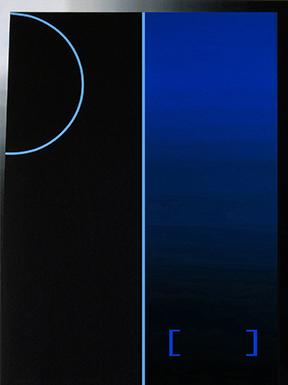

As we have moved along during this interview, I have had numerous occasions to reflect back on the works we have discussed. And not unlike what often happens as I move through a series of ideas, new insights are creeping into what I am doing now.

Among those thoughts is how important narrative and storytelling that simultaneously explore both fiction and painting as a thing-in-itself have been to me. It’s a form of play between subject, theme and materials that exemplifies my art, perhaps best characterized by the closing line of the W. B. Yeats’ poem Among School Children—“How can we know the dancer from the dance?”