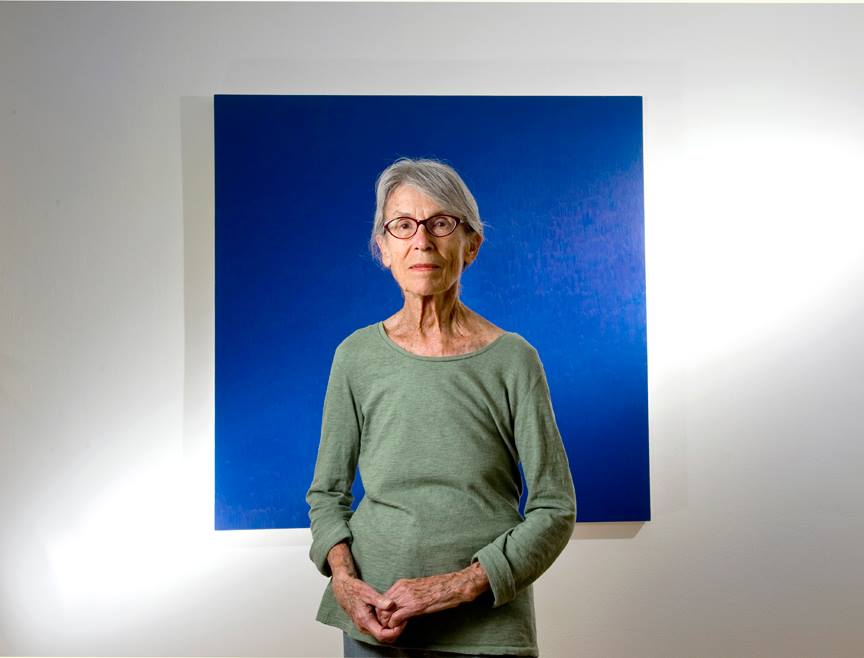
In memoriam | Marcia Hafif

Marcia Hafif | Pomona | California| 1929 -2018

Marcia Jean Hafif is recognized as one of the most significant figures in American abstraction of the second half of the twentieth century. Her work is associated with the Radical Painting Group, an artist collective active during the 1970s and 1980s, which she co-founded with Joseph Marioni, Olivier Mosset, and Erik Saxon, emphasizing painting as a methodical process and as a tool for visual investigation.
Hafif graduated from Pomona College in 1951 and initially worked as a third-grade teacher. In the late 1950s, she divorced and began graduate studies in Italian Renaissance and Far Eastern art at Claremont Graduate School. In the summer of 1960, she took a class with Richards Ruben, through which she met Walter Hopps and several artists associated with the Ferus Gallery in Los Angeles, establishing early connections with the contemporary art scene.
In 1961, Hafif traveled to Italy intending to spend a year in Florence, but she was drawn to Rome, where she remained for nearly eight years, deepening her engagement with art history and the formal concerns that would define her later work. After returning to California in 1969, she enrolled in the first MFA class at the University of California, Irvine, temporarily shifting her practice away from painting to experiment with photography, film, sound, text, and installation. In 1970 she began the film Notes on Bob and Nancy (1970–1977), featuring fellow UCI graduate students Nancy Buchanan and Robert Walker, and her MFA thesis exhibition at the U.C.I. Gallery in 1971 presented twelve black-and-white photographs documenting gallery space, reflecting her early interest in work that references itself.
In 1971, Hafif moved to New York City to return to painting at a moment when the medium’s relevance was widely questioned. On January 1, 1972, she made her first pencil-on-paper drawing of short vertical marks systematically covering the page, a method she transferred to painting. Over the following year, she developed An Extended Gray Scale (1972–73), a series of 106 oil paintings, each 22 by 22 inches, ranging from white to black, with each tone determined by her ability to perceive a difference from the preceding canvas.
Hafif exhibited for more than eight years with Sonnabend Gallery in Soho and Paris, developing series that became the foundation of The Inventory: 1974 Mass Tone Paintings; 1975 Wall Paintings; 1976 Pencil Drawings; 1978 Neutral Mix Paintings; 1979 Broken Color Paintings at The Clocktower with Alanna Heiss; and 1981 Black Paintings. During this period, she also published articles on painting in Artforum and Art in America, reflecting on the practice and theory of painting.
Throughout the 1980s and 1990s, Hafif produced new series while establishing relationships with galleries across Europe, including Munich, Düsseldorf, Vienna, London, and Paris. After 1999, she lived part-time in California, continuing to develop additional series, most recently the Shade Paintings. Her work is included in major collections worldwide, including The Museum of Modern Art in New York.
Hafif’s career demonstrates a consistent exploration of perception, repetition, and systematic variation. Her methodical approach to painting, coupled with experiments in other media, positions her as a key figure in late twentieth-century abstraction, whose work bridges conceptual rigor with visual subtlety and formal discipline. Her influence extends through her paintings, writings, and contributions to artist-led initiatives, leaving a legacy that continues to inform contemporary approaches to abstract painting.