First published in 2010 in Geoform, a curatorial project by Julie Karabenick, and republished with permission.
Interview by Julie Karabenick
Gonçalo Ivo was born in Rio de Janeiro, Brazil in 1958. He is the son of Brazilian writer and poet, Lêdo Ivo. Ivo took art courses at the Museum of Modern Art in Rio de Janeiro and studied Architecture and Urban Planning at the Fluminense Federal University where he received a Diploma in Architecture. He has been exhibiting his work since the late 1970s in countries around the world, including Brazil, France, Italy, the US, Venezuela, Spain, Algeria, The Netherlands, Switzerland, Canada, Mexico, and Japan. His work has been the focus of over 40 solo exhibitions. It may be found in numerous private, corporate and public collections, including: the Museum of Geometric and MADI Art, Dallas, TX; and in Brazil, the Niterói Museum of Contemporary Art and the National Museum of Bellas Artes, Rio de Janeiro; the University of Ceará, Fortaleza; and in São Paulo the Museum of Contemporary Art, the Gallery of the State, the Itaú Cultural Institute and the Moreira Salles Institute. Ivo divides his time between Paris where he works and has lived with his family since 2000 and his second residence and studio in Teresópolis, Brazil.
You’ve said that your work begins with color.
For me color comes first—not a precise color, but more of the sensation of a kind of color, a certain intensity, a warmth or coldness, a radiance. Color has always been my passion.


Maybe this is my personal experience of what the Romantic artists called “inspiration.”
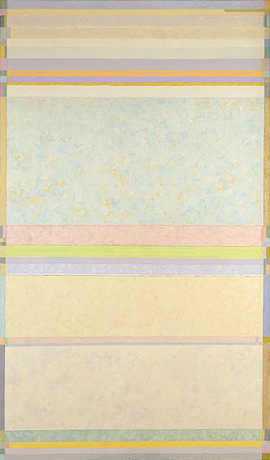
Often my paintings are quite large because I want their colors to impregnate our senses, emotions, and thoughts—to carry us poetically to other places. I believe it was Matisse who said that two kilos of blue are bluer than one kilo of blue.

Ultimately, I may be trying to reach unattainable colors. To paint, it’s necessary to leap over the wall of dreams. Of course when you’re in the act of painting, many things influence the process. We’re always negotiating between our desires and reality.

Intuition guides me. I don’t rationalize while I paint. I simply breathe and move ahead.

What enchants me is the act itself, the being there and making something that reflects my own way of experiencing the world.

For me, painting is like a trip on a train. When you’re inside the train, the most wonderful feeling is to look out at the landscape and forget about the departure and arrival. The pleasure is in the trip itself.

A rich variety of life experiences and sources influence your paintings.
Yes, my work reflects the intersection of many sources. Sometimes references appear to the art of Cézanne, Klee, Mondrian or Braque, and at other times to the timeless arts of ancient cultures. My work may also reflect memories from my travels and from my childhood, my love for poetry and music. To me, that’s the beauty of creation—ideas come from everywhere.

To me, the moment of creation is linked to a certain enchantment, to a moment of evasion—the seeking out of another place or state of awareness.
Your paintings most often have some type of geometric structure—for example, wide or narrow stripes of color or dense arrangements of small rectangles and triangles.
I’ve found that color makes me think in a plastic manner. Most of the time, geometry possesses me. It’s simply something that I can’t control.

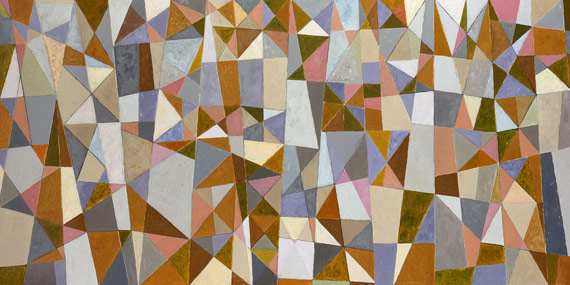
As you can see, the geometry in my wor.k is often irregular, even playful.

All around us there is geometry in nature. Our first experience of it might be the skyline.

Your paintings often have a grid-like structure.
Yes. Thinking back, when I was young I spent my vacations by the sea in northern Brazil. There you can see fish traps—currals de peixe—an ancient way of fishing found in countries around the world. Perhaps the grids in my work were originally inspired by seeing these structures.


In this painting from the late 80s, we can see a kinship to these fish traps.
At that time, I painted a lot of monochromatic surfaces divided in an archaic drawing style using charcoal or oil paint stick. These divisions in space were meant to be a poetic commentary on the fish traps.


And the theme of fish trap structures continues in recent work.
Looking back, I realize that I’ve accumulated a number of series of works. In each series, I feel I research the possibilities and limits of painting.

JK: Let’s look at another series. You’ve said that you’ve always been touched by the landscape.
GI: There’s a strong connection between the things I paint and the visible world. When I work I’m often looking for a personal landscape. I’ve been working on a series based on rivers—Rios— since 1987. Back then my wife, Denise, and I would watch the Brazilian cultural channel late at night. One memorable program featured great rivers of the world.

And I recall as an adolescent going with my uncles to the mouth of the São Francisco River—a very large river like the Mississippi—and crossing it in a small boat. There at midday I saw laundresses laying their colorful fabrics along the riverbanks.

The Rios series recalls these beautiful fabrics washed at the riversides. The rough surfaces in these paintings suggest high water bands left by successive tides.

This ongoing series has proved to be fertile ground for experimentation with color, texture and materials.

For example, in recent works from this series I’ve made collages using cotton fabrics, satin, ribbons, carnival paper and a wide variety of other papers. I work over each stripe in layers of tempera.

As we can see, the physical qualities of your work—the paint handling, textures and experimentation with materials—are very important to you.
I really believe that the work of the hand has the same importance as the work of the mind. In fact, I think they are one. The brushwork and the traces left behind its passage are unique—like DNA.

We can see the textural richness of your work in a close-up of the above painting.
Yes. Sometimes I like to use very rough surfaces. Faithful to Braque’s lesson, I construct a painting as a building—from the bottom up—in successive layers, working from transparency to opacity.
And you frequently add a variety of materials to your paints.
Back in the 80s, I didn’t have access to all the acrylic mediums that are available today. So I used a lot of colored sand that I collected on my trips to the far north of Brazil. I also used charcoal powder from the fireplace in my studio. Today I use acrylic mediums. In the large Oratório painting below, there is a marked texture in the large central area where I used marble powder, limestone and acrylic mediums in the early layers. These were followed by oils.

In addition to working extensively in oils and tempera, you’ve worked in watercolor since your childhood. And as a young man, you taught watercolor classes at the Museum of Modern Art in Rio.
Each medium has its own meaning in my painting. I think of my watercolors more as chamber music, while a large oil painting is more like a symphony.
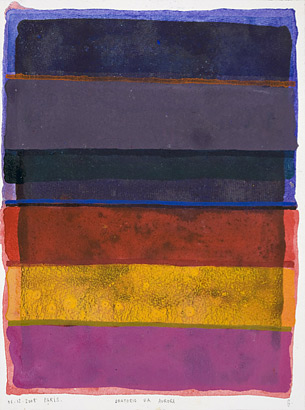
As we can see in the Oratório paintings above and the Rios paintings below, you often work on a series or theme in several different mediums.
The medium often affects how a series will develop. Right now, I feel that I’m free to work on all my series in any of the mediums and techniques that I use—watercolor, tempera, oil, collage, and so on.


In many of your watercolors, we see the complex geometric structures that you often use in larger works on canvas, and at other times, you depart from a highly geometric structure.
I firmly believe that there is a hidden geometry that underlies all the organic structures in the world.
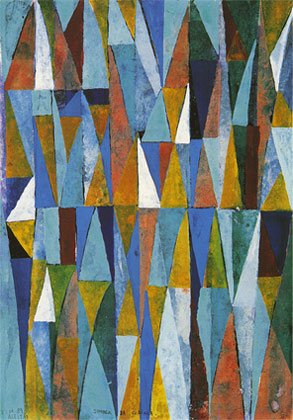
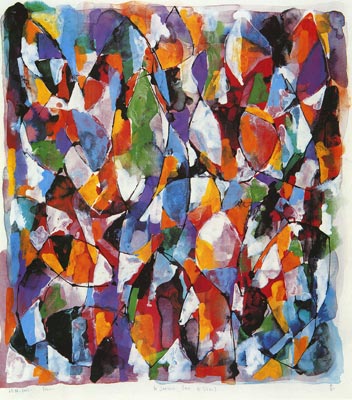
You’ve worked in watercolor in sketchbooks since the early 80s.
Yes. I’m much freer when painting small watercolors in my sketchbooks. They’re important because I think they’re part of my daily reinvention as an artist. My sketchbooks are also like diaries of images, secret thoughts that I don’t need to share with anyone. And I can make these small watercolor sketches in airports, on trains or after a day’s work in the studio.

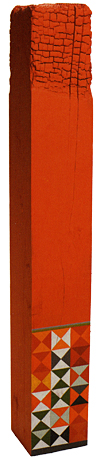
You also make painted wooden objects.
I’ve worked on a series of wooden objects since 1984. I make them from chance findings from along the shores of Brazilian beaches or along the banks of the Seine.


Initially these pieces were like wall reliefs, but later I began to work on all their surfaces. I also began to burn these objects in the fireplace in my studio. Some become almost impossible to paint as, once burned, they border on immateriality. Most of the time I try to control the burning as if I were painting an object—it’s not a chance process.
I don’t think of these objects as sculptures. My concern is not with form in space. For me, these are chromatic registers in space and time.

In the objects below, I tried to preserve the cracks and grain of the wood. I worked in very transparent color. The gold leaf reminds me of old master work from the Middles Ages.
And the use of nails in the object below?
The nails bring to mind those used in African masks and statues. To me, making these objects feels like a kind of magical ritual.

Some of these objects, like those below, seem to confront the viewer, perhaps as figures.Yes. These objects have a certain poetic ambiguity that I enjoy.

Your introduction to art came at an early age.
My artistic education began in my family’s apartment in Rio de Janeiro. When I was growing up, my father, poet and writer Lêdo Ivo, worked as a journalist. He told me that every month he would set aside some of his salary to buy art. At this time, there weren’t many galleries in Brazil, and an art market hadn’t yet developed. But I grew up in a house full of paintings. My parents’ tastes were very eclectic, and their collection was like a small museum. They collected both Latin American and international artists.I always wanted to be an artist. I began painting when I was six or seven years old, first with gouache and watercolor and, when I was 13 or 14, with oils. I asked my father to introduce me to his painter friends. Almost every week we would visit an artist’s studio. Also by age 10, I was addicted to music—to Bach, Vivaldi, Brahms, Mahler.
What types of art did you respond to?
From a young age, I was interested in economical and subtle styles of represenation. Sometimes my father would drop me off at the studio of his friend, Iberê Camargo, an important expressionist artist. I loved his still lifes that contained only two or three elements. And I think the thick textures of his oil paintings would exert a lifelong influence on me.One day my father acquired a painting by an important Brazilian modernist, Alfredo Volpi. Seeing his work was a very powerful experience for me. Volpi had such a strong sense of color. He also had an abstract and spare plastic language. I took a wooden board and made my own Volpian piece. It had an almost vertical line from top to bottom with several converging lines, making the shape of a fish’s bones, all in red and cerulean blue.
In 1970 your parents bought a small farm high in the mountains, about 15 miles from the city of Teresópolis and some 80 miles from Rio.
The main house was built by a German immigrant in the late 40s. Half the property was covered by high altitude tropical forest and half he had planted as a large eucalyptus forest. At that time, I was 11 years old.There was a small storage shed on the property that became my first studio. During high school, I would spend weekends and summer vacations there.Of course over the years, my studio in Teresópolis would undergo many transformations. Below is a photo of a newly added studio space with its view of the mountains in the distance.

When did you begin your formal art studies?
At 16 I entered the Museum of Modern Art in Rio to study painting with Sérgio Campos Mello and drawing with Aluísio Carvão. Sérgio, a great Dionysian, was experimenting with conceptual art. We discussed modern and contemporary work— Hopper, Sheeler, Stael, Pollock, Rothko, the Pop artists, and many others. Carvão, a seminal concrete and Grupo Frente artist, told me that I “knew how to draw.” I was his youngest pupil, and he always showed my work as an example.
As I said, there was barely an art market in Brazil at that time. My father saw that many of his artist friends were suffering economically. He insisted that I attend university and study architecture. However, I still continued to paint and draw, and soon I became known as an artist—primarily a watercolorist.
At 19 I took part in my first important exhibition. Leading artists from Brazil sent work to this show. For me—a young and unknown artist—to have been accepted as I was, was very important. Two years later, I had my first solo exhibition. The work I showed was all figurative. I explored shadow and light in realistic paintings of windows—sort of minimalist interpretations of Hopper and watercolor landscapes of the countryside, urban and suburban settings.
The following year, I took my first trip to Europe. I would sightsee during the day and return to my hotel at night to compulsively make drawings and watercolors. When I returned to Brazil, I decided to wait until the following semester to return to architecture school. I spent five months in Teresópolis painting, dedicating myself to watercolor. One series focused on landscape and a second on the painter’s table.


In 1983 I received a Diploma in Architecture from the Fluminense Federal University in Rio de Janeiro. At this time, I was frequently exhibiting my paintings and was receiving attention from critics and collectors. I began teaching watercolor at the Museum of Modern Art in Rio. I taught on Monday and Friday afternoons, so I had the rest of the week to work—for the first time as a professional artist. I also had time to study and experiment.
Very important in the early 80s was my growing interest in African art. I frequented the best bookstore in Rio that carried imported books and catalogs. I also began to listen to African and ethnic music. I remember I bought a beautiful book about the South African Ndebele people. The women paint their houses with geometric patterns. At this time, I was also touched by Amish quilts, African textiles, and Nepalese paper craft.
We can see new directions your work was taking by examining some small watercolors and sketchbook images from 1984.

The three small watercolors below represent a period of transition toward something new, something that would develop over the course of many years. There is clearly a geometric organization of space in these watercolors. Charibdes is very close to the Oratório series I do today. Actually, my more purely geometric watercolors came from this early period.
I still have these small books of watercolors. For me they are extremely important—they are my psalms, my books of prayers.


The images from the spiral watercolor sketchbook below were done at the same time. I used to paint some 10 to 15 watercolors a day in addition to working on larger paintings in acrylics. In 1983 I had seen a beautiful exhibition of Turner’s watercolors and travel sketchbooks at the Prado in Madrid. I was finding that watercolor gave me great freedom to express myself.

The images below are examples of a large series I began in tempera and collage on small cigar boxes. They show a clear simplification of form and space.
And the early use of the grid in your paintings.


Yes. Perhaps these images and those below reflect the colors of the night and the complex grid of city lights.
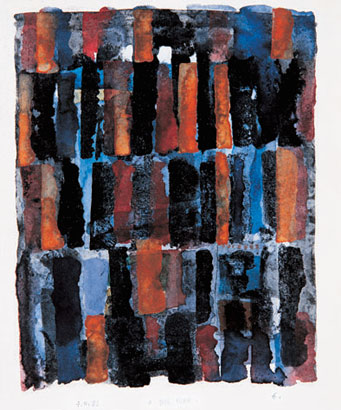
In 1986 you married biologist Denise Esquenazi.
Yes, and I began working full-time as a painter. In the following years we began living at the farm, and I added more rooms to it, as I have continued to do over time.
Looking at two watercolors from that late 80s, we see the complex gridded arrangements of triangles and rectangles evident in more recent work.

Yes. I was also making large monochromatic oil paintings at this time. I was gradually becoming deeply affected by the Teresópolis landscape, by the eucalypus forest adjoining the farm.

I began making a series called Forests in the early 80s. The Forests work below also reflects my study of Cézanne and, in this case, his painting, Les Baigneuses.
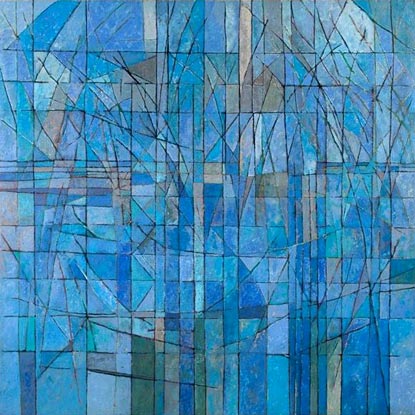
Under contract to a commercial gallery, it was only after four years that I felt my work was mature enough to warrant a solo show. I think this was a good decision. Daily work in the studio helped me to more deeply explore color, form, and construction and how to express them pictorially.
Despite all the small squares and triangles in the works below, I still see an overall simplification of space, an important kinship to the work I’ve done more recently.

It’s interesting that in the 1990s, you resumed figurative painting.
In addition to working abstractly, I was developing a large series based on trees, the majority of which I made between 1996 and 2001, an especially prolific time for me.
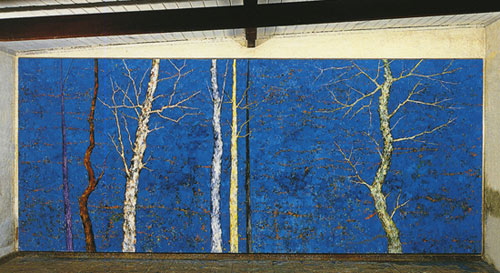
The Trees series really began with the painting below. I had been working on a large grid-based work that I was not pleased with. In the orchard next to my studio, there was a dead pear tree that I refused to have cut down. Its trunk and twisted branches were a haven for birds, parasites and fungi. Its branches were dry and white like bones. During the night, its flickering outline came like a large wave sliding over the blue sea bed.

During the period when I worked on the Trees series, I was also looking at a lot of figurative work. I think that with this series I was asserting my right to paint in any style I wished, to be diverse in my work.

To me, the two small temperas with gold leaf below evoke the Italian landscape. And I have a strong interest in medieval art. In many paintings from the MIddle Ages and even the Renaissance, you’ll see images of an apostle carrying a miniature of a church in his hand. These paintings also loosely allude to this scene.


And, as with so many of your series, your works range from very intimate temperas and watercolors to very large oils on canvas.
Yes. One strange thing about the Trees series was that the paintings only worked well either in very small formats or at a large scale, as in the case with The Lake. This painting evokes a small lake near my studio, the pear tree and eucalyptus. If you turn the painting on end, you see the same structure as the Oratories works in the intervals between the trees.

Your Forests paintings are generally more abstract.
I’m often inspired to translate the sights that move me into my own pictorial language. Just as I’ve done with the the fish traps I saw along the northern coast of Brazil, I try to capture my experience of the forests around the Teresópolis farm in a personal and poetic way.
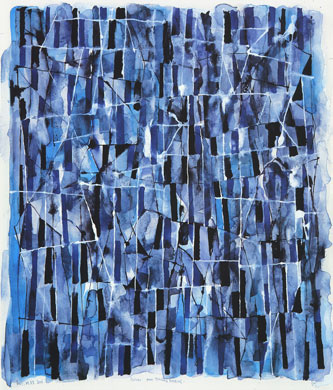
In these two watercolors below from 2001, their complex structures remind me of the Panos works and others.
I think my work travels a circular path—I always return to earlier subjects.

Returning to an examination of some of your ongoing series or themes, you’ve done many paintings that deal with various aspects of architecture.
Many sources influence this work. When I was a child, my father gave me a set of wooden blocks, some with colored drawings on their faces—like windows, doors, church towers. You could build a town with these blocks. I loved this toy. When I studied architecture at the university, I was mainly interested in low cost architecture. I began to visit the poorer areas outside Rio where many houses had striking geometric features or painted facades. I’m also attracted to simple, clean buildings adorned by a plain geometry—like chapels at the side of road.
In this painting, Cidade or City, I was thinking of the buildings of the Dogon people of Mali. The small white areas might be windows or empty spaces and create a rhythm like Mondrian used in the Boogie Woogie paintings.
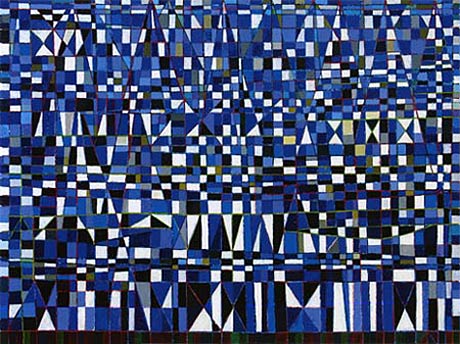
In The City and the Sun below, I was interesed in how the light of the sun spreads across the geometric shapes.

It took me four years to finish African Cathedral. I have many paintings that I leave unfinished in a corner of my studio. One day I may decide to work on one. If I like the result, it’s done. If not, it goes back to the same place.

The Cathedral painting below suggests a fragile structure.
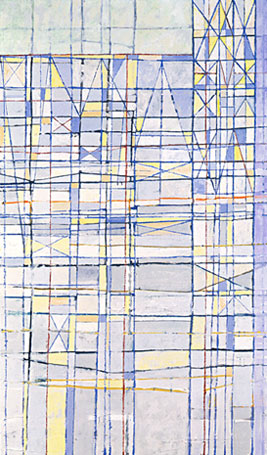
You have an entire series in part inspired by the color and geometry of building facades.
In these paintings I’m interested in geometry and also frontality. These works also speak to an extensive series of facade paintings by Brazilian modernist, Alfredo Volpi, whose work so impressed me as a child.

In these two Facade paintings, we see this very strong frontality as well as intense colors.
These paintings present a relatively flat plane and in part reflect my fascination with work from the Middle Ages—all the shiny gold and strong contrasts of color.

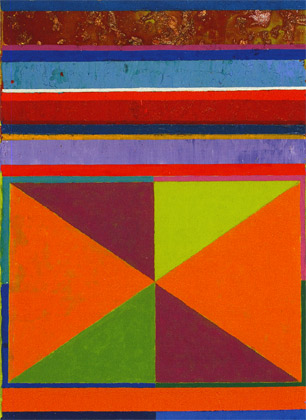
The Facades below suggest both African Dogon constructions and fish trap imagery.
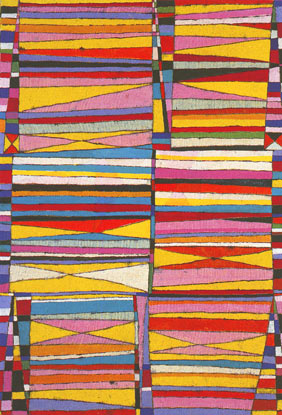
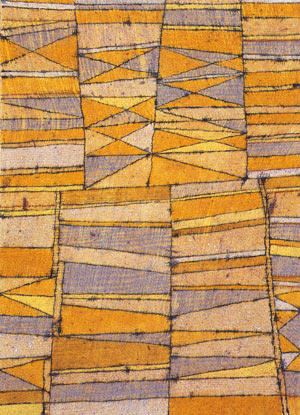
We’ve already seen images from two of your very large series—Panos da Costa and Tissu d’Afrique— that reflect your love for textiles from Africa and South America.
I’ve admired patterns and fabrics for a long time, I believe since the 80s. I remember that as a child, a poet friend of my father’s gave me two boubous—traditional garments from the northwest coast of Africa. They had geometric shapes and intense colors. To everyone’s surprise, I would dress in them. Today I have a very large collection of books about patterns, textiles, rugs, and so on.
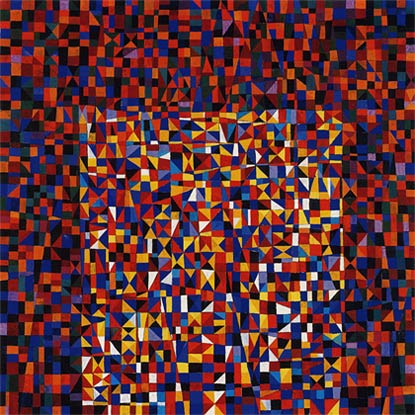
The first time I saw the term “pano da costa” was as the title of on a piece by trumpeter John Hassel on a CD by the Kronos Quartet, an American string quartet. Music is always present as a source of inspiration in my life.

Years ago, I had visited Cachoeira, a small city in Bahai, the state in Brazil that has had the most African immigration. There is a procession there that celebrates the beautiful pano da costa textiles brought to Brazil from the west coast of Africa. In Portuguese “costa” also means “back,” and these textiles were worn on women’s backs for magical protection.

To me, the Pano da Costa paintings are like polyphonic music.

Your large series, Tissu d’Afrique or African Fabric, is also inspired by bold and frequently geometrically patterned textiles.

I began this series in 2003 or 2004. These paintings are further ways for me to explore color—its possibilities and limits.
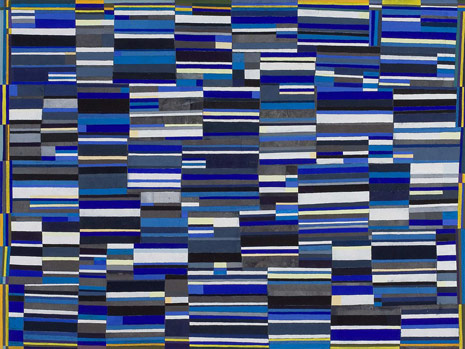
It’s interesting how you sometimes add thin bands of contrasting stripes that run up and down the vertical edges of these paintings.
These edges make the work more fluid and ambiguous. Their different colors and intensities add a strange tension as the eye has to constantly adjust as it moves toward these edges. They also provide a kind of entrance to and exit from the painting.

This series had its origins in my Rios paintings.

The recent, more simplified Tissu d’Afrique paintings—like the one below—seem to lead directly into your Oratory series.
I think that in the last few years, my work has become a synthesis of all I’ve done. Though I haven’t stopped making paintings with small rectangles and triangles, there’s a movement toward simplicity, toward a totality in which color and form are one, toward larger spaces and toward silence.

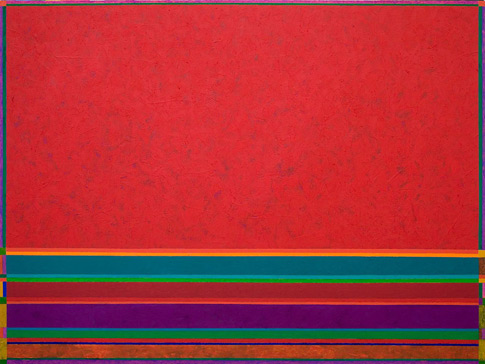
As I’ve said, I want to create a place for the eye and the mind. This has led me to make very large paintings. I want to create the feeling of standing before a large wave or the walls of ancient churches, or produce the delightful sensation of looking into the immensity of a deep blue sky.

In addition to the Oratory series—an oratory being a place of prayer—you have another series called Prière or Prayer.
These are long horizontal works. When finished they remind me of musical scores, interminable litanies or fugues and variations. In each there is the search for color—or rather for a chromatic rhythm. They also bring a sensation of the mobility of form, plane and space within a shallow depth.
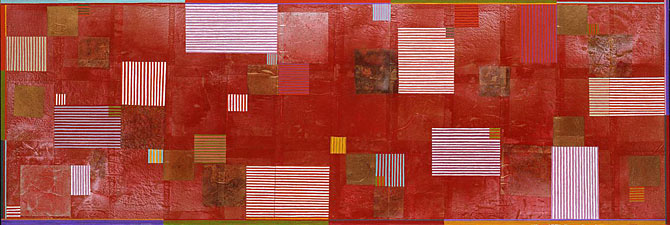

They are painted in tempera with gold, silver and copper leaf and collaged with popular Chinese prayer papers. They are my visual psalms. When I began to really concentrate on watercolors in the early 80s, I was in love with the illuminated manuscripts made by monks and priests in the Middle Ages. If you look at the Prière series, you will find some similarities.
You divide your time between Paris and Teresópolis.
I’ve lived with my family in Paris since 2000, though Denise and I had lived there for shorter periods of time since 1993. For the past six years, we’ve lived in a lovely apartment that’s near Opéra Garnier, Place de la Concorde and Place Vendôme. I don’t believe there’s a connection between the Parisian cityscape and my current painting. What really affects me in Paris is its cultural environment.

I work when my children are at school, perhaps from 8 am to 4 pm. I primarily work in small and medium formats or in sketchbooks.
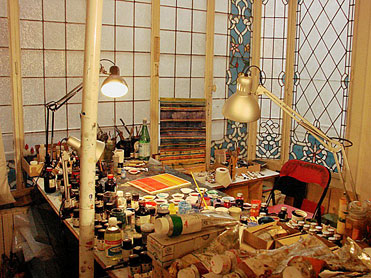

The situation in Teresópolis is completely different. Over the years, the landscape there has affected me profoundly.

I’m a pictorial animal. The studio is my space. There I feel that time does not exist. In Teresópolis I have several large studio spaces. I wake up very early, about 4 or 5 am. I have my coffee, talk to the dogs, look at the many birds in the sky. I work until about 6 pm and by 9 I’m in bed.


Making art is a way out of the material world, out of everyday life. For me, the daily practice of making art is an act of devotion that has its own rituals and practices.

Over the years, this practice has taught me much about life and its significance. Today we live in a pragmatic society where people are increasingly loosing the ability to think, see and reflect. In this scenario art is essential.
