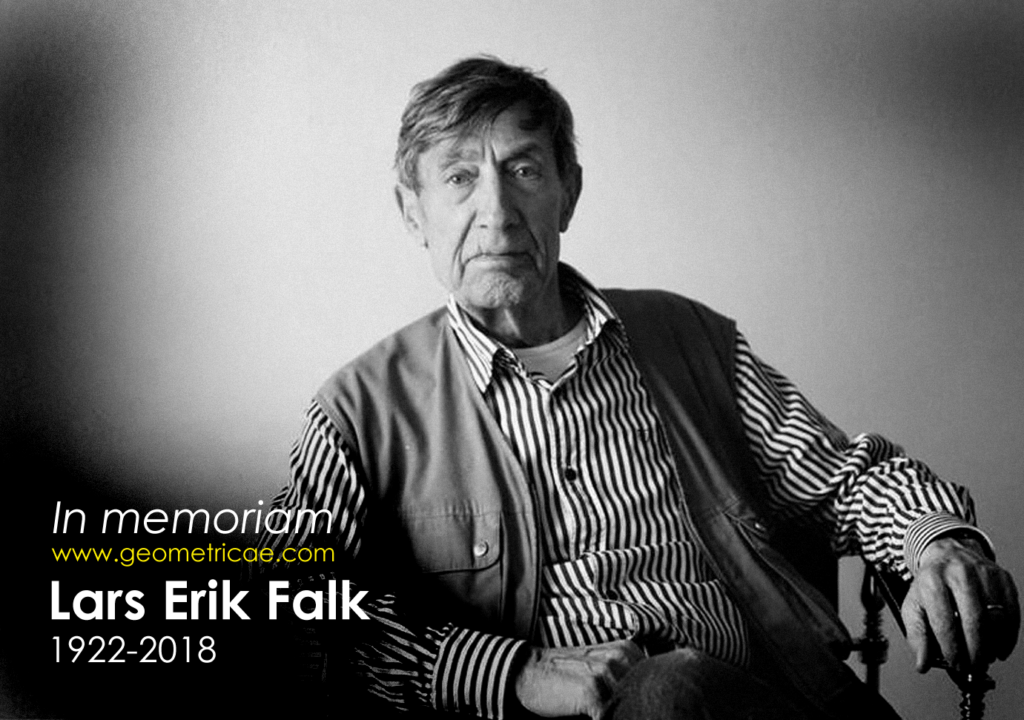
In memoriam | Lars Erik Falk

Lars Erik Falk | Uppsala | Sweden | 1922-1918

Lars Erik Falk occupies a central position within Scandinavian geometric abstraction, articulating a rigorous sculptural language grounded in form, space, and structural tension. Educated in Stockholm, Falk enters the public art scene shortly after completing his studies, presenting his first solo exhibition in 1952 at Welamssons Art Gallery. From the outset, his work aligns with a generation of artists committed to redefining abstraction through spatial precision and material clarity.
Close dialogue with contemporaries such as Olle Baertling and Eric H. Olson informs Falk’s early development, reinforcing a shared investigation into geometry as an active, spatial construct rather than a purely visual system. These exchanges encourage an approach in which sculpture becomes the primary field of experimentation, allowing form to operate directly within physical space.
Throughout the 1950s, Falk concentrates almost exclusively on sculpture, identifying it as the most direct and uncompromising mode of expression. He works predominantly with steel and aluminum, materials chosen for their structural integrity and capacity to articulate sharp, exacting geometries. His sculptural practice rejects ornament and narrative in favor of clarity, rhythm, and spatial articulation, situating the object as an active agent in its surrounding environment.
During the 1970s, Falk introduces the 73-degree angle as a defining structural principle in his work. This departure from the static orthogonality of the 90-degree angle establishes a state of tension between stability and movement. The 73-degree inclination functions as a zone of transition—neither rest nor full dynamism—opening a field of variations in balance, rhythm, and directional force. This angle becomes a persistent motif, structuring both individual works and broader series.
Falk’s sculptural language gains sustained attention across Europe, with exhibitions held throughout Sweden. His work contributes to a broader discourse on geometric abstraction in which precision, material presence, and spatial interaction converge. Rather than treating geometry as a closed system, Falk employs it as a generative framework, capable of continuous modulation and formal renewal.