 19/10 2019 – 16/8 2020
Museum für Konkrete Kunst | Ingolstadt | Deutschland
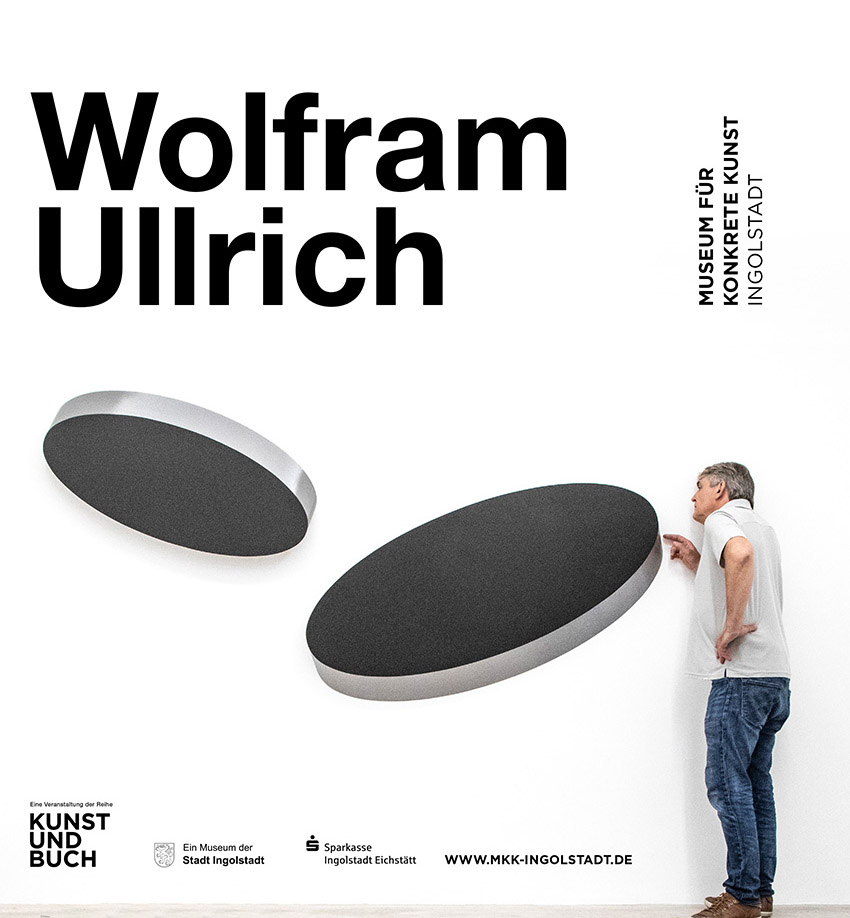
The exhibition unfolds as a study in perceptual tension, where minimal gestures engender maximum effect. Wolfram Ullrich’s works, arranged in seemingly simple configurations, begin to produce optical shifts that are anything but static. The multi‑part structures do not merely occupy space; they extend it, transforming flatness into an experiential field where depth is neither literal nor illusory, but a negotiation between viewer and work. Patterns of repetition, subtle variations in relief height, and finely calibrated shadows conspire to create a sense of dynamic presence; they invite the eye to move across surfaces as though they were landscapes of light.
What at first appears to be a series of almost imperceptible surface modulations quietly transforms into a spatial revelation. Slightly raised planes, through Ullrich’s finely tuned gradations and exacting control of light and shadow, take on an unexpected corporeality. They seem to step forward, delineate edges in space and confound the viewer’s expectations about the difference between surface and relief. This visual alchemy reshapes the way we inhabit the room: walls become fields of movement, planes become horizons, and perception itself becomes the medium of the work.
These effects are the result of Ullrich’s highly refined technique, which interrogates the boundaries between painting, sculpture and perception itself. What is striking is how little seems to have been done and how much is ultimately revealed. The reliefs retain an economy of means — the slightest elevation, the faintest shift in value — yet these minimal interventions produce a compelling sense of physicality. Virtually flat surfaces become resonant, vibrating thresholds where geometry and sensation coincide.
The spatial logic of Ullrich’s works encourages a kind of phenomenological engagement: to see is to move, and to move is to see. The physical act of approaching, stepping aside, or shifting one’s line of sight changes the visual outcome. Walls and corners are no longer neutral backdrops but active participants in the perceptual choreography. Architecture and artwork become intertwined in a continuous negotiation, reinforcing the idea that geometry is not merely formal but generative — a tool for situating the body within a field of experience.
Throughout the exhibition, the tension between surface and depth, subtlety and presence, recurs as a central theme. What begins as quiet visual precision ultimately reveals a layered engagement with how we comprehend space — not as fixed or stable, but as contingent upon eye, mind and movement working in tandem. In this context, Ullrich’s works do not simply present optical effects; they foreground the act of perception itself as a form of inquiry.
Presented together, Ullrich’s pieces suggest that abstraction does not need excess to be powerful. Instead, restraint can be precisely what activates perception, allowing color, form and shadow to enter into a dialogue with the viewer’s body and attention. This is art that does not assert itself by volume or gesture, but by the subtle modulation of surfaces and the intricacy of its visual architecture.
It is in the experience of this modulation — the way light slips across a plane, the way a slight elevation alters a shadow — that the true impact of Ullrich’s work is felt. His practice demonstrates that perception, space, and geometry are inseparable; the exhibition becomes a space of discovery where seeing is an act of participation, and where the careful orchestration of light and form challenges our understanding of the physical and the visual.