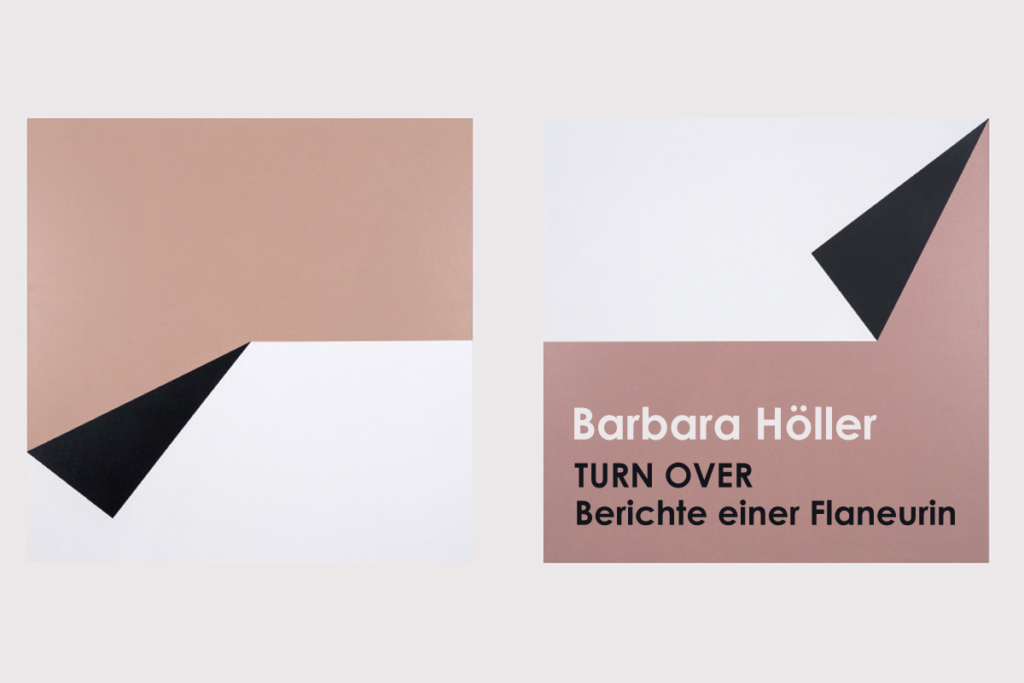
The exhibition unfolds as a meditation on movement, pause and perception in an age defined by acceleration. Our present is marked by restlessness — a condition shaped not only by physical mobility but by the constant overlap of real and digital spheres. Multiple dimensions of existence demand simultaneous attention; life unfolds across screens, architectures and networks that require continual switching. Yet the global slowdown of 2020 redirected attention toward isolation, silence and the fragile possibility of change — a moment of suspension within the forward thrust of contemporary life.
Within this context, the ehibition brings together recent bodies of work that reflect on orientation, distance and transformation. The exhibition traces how places are constructed, remembered and reimagined — not as fixed coordinates, but as shifting constellations shaped by perception and movement. The works evoke mapping as an emotional and cognitive process, suggesting that location is as much psychological as geographical.
The spatial framework of the exhibition plays a crucial role in articulating these concerns. A constructed inner space is inserted into a larger architectural volume, supported by a massive steel structure that immediately commands attention. Only upon closer inspection does the layered logic of the architecture reveal itself: one space nested within another, simultaneously autonomous and dependent. This spatial interweaving mirrors the entanglement of our physical and virtual realities. Just as digital and real worlds overlap and collide, so too do the architectural layers create a perceptual tension between containment and openness, presence and mediation.
Barbara Höller’s practice navigates these tensions with a quiet precision. Her works — often restrained in material and gesture — investigate the subtle dynamics between proximity and distance, observation and immersion. Surfaces, lines and structural interventions articulate moments of interruption within continuous flow. Rather than dramatizing acceleration, Höller introduces intervals: visual pauses that invite reflection. In doing so, she positions the viewer not as a passive observer, but as a participant moving through layered spatial and conceptual thresholds.
The figure of the flâneur — or, here, the flâneuse — becomes a conceptual anchor. As cultural historian Karl Schlögel suggests, the flâneur understands the repertoire of nearness and distance cultivated by those who practice attentive observation. The act of lingering stands in opposition to the prevailing momentum of the “mainstream” and its relentless tempo. In this sense, the exhibition proposes a subtle resistance: to pause, to look, to inhabit space deliberately rather than consume it rapidly.
Höller’s works resonate with this ethos. They do not impose spectacle; instead, they create conditions for awareness. Distances become visible, thresholds perceptible, and spatial relations newly charged. The layered architecture amplifies this experience, encouraging viewers to navigate between enclosure and openness, interiority and exteriority. Movement through the exhibition becomes a reflective act — a quiet negotiation between acceleration and stillness.
Ultimately, Turn Over suggests that change — the “turn” implied in the title — may not always manifest as dramatic rupture. It may instead emerge from attentive shifts in perception, from the willingness to slow down and recognize the subtle transformations occurring within and around us. In this way, the exhibition becomes both a spatial experience and a philosophical proposition: that in learning to read space differently, we might also learn to inhabit time with greater awareness.
| Geometric Abstract Art Magazine |
