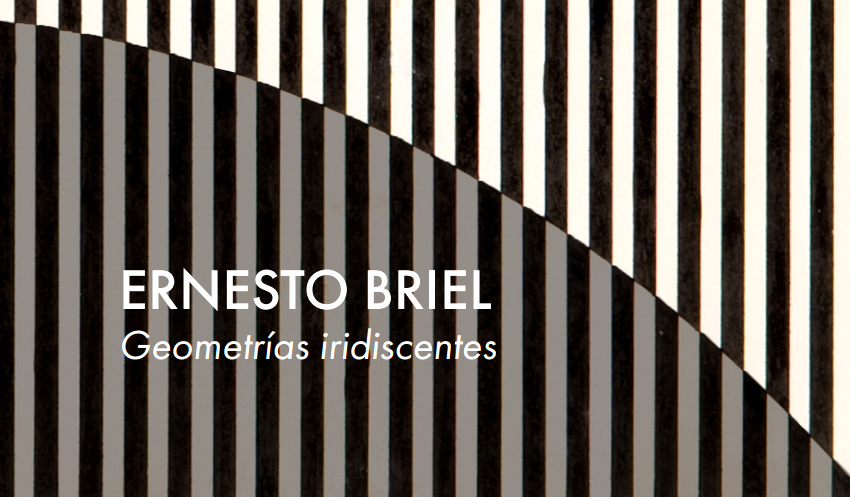
 19/12 2020 – 20/3 2021
Curator | Ariel Jiménez
Juan Carlos Maldonado Art Collection (JCMAC) | Miami | Florida
The exhibition focuses on the work of Ernesto Briel, a Cuban optical artist whose production remains little known even among specialists in Latin American art. His work demonstrates a meticulous investigation of form, colour, and perceptual effects, operating within the strict logic of geometric abstraction while engaging the eye in subtle optical shifts.
In Cuba, the development of such an autonomous artistic practice faced profound historical and political constraints. Briel’s approach shows that expanding aesthetic boundaries can itself be a political act: by exploring visual perception and enriching the tools of artistic expression, his work opens possibilities for reflection and social equilibrium beyond immediate ideological pressures.
Through a series of intricate compositions, Briel establishes a dialogue between geometric rigor and perceptual experience. Each piece challenges the observer to engage actively, discovering how minimal adjustments in form or colour create dynamic spatial effects. The work is both an exercise in visual precision and a meditation on the potential of abstraction to generate meaning and emotional resonance.
This exhibition situates Briel within the broader context of modern and contemporary abstract art, showing how geometric experimentation can coexist with intellectual depth and social sensitivity. His practice exemplifies how abstraction, far from being purely formal, can participate in the larger currents of cultural and aesthetic reflection.
Ernesto Briel is an artist whose work begins in the sixties of the last century; that is to say, when concrete, optical and kinetic abstraction had already borne its best results in the countries of the region, from Argentina to Mexico. With this, the public is faced with an abstract-geometric practice –and typically optical– when the expansion of these aesthetics reached maximum popularity and with it, even a hybridization process that makes this works a curious Pop expression of abstraction. Hence this unexpected hybridization of optical strategies in the manner of Vasarely with Pop motifs, such as traffic signs, letters, stars, and signs of wide circulation in the cities of the present.
Ernesto Briel was born in Guanabacoa, Cuba in 1943. An artist with a particular interest in the theater, Briel was a painter, producer and theater set designer who also worked briefly as an actor. He studied painting at the Escuela Nacional de Bellas Artes San Alejandro, and design at the Escuela Nacional de Diseño in Havana, and later photography, at the Parsons School of Design in New York. In 1969 he founded the Grupo de Arte Optico Cubano along with fellow artists Fornes, Serrano, and Morales, becoming the most representative and methodic artist of the genre. Feeling ostracized by the community regime due to his orientation he migrated to the US as part of a generation that left the island through the port of Mariel in the spring of 1980. Soon after his arrival he participated in the exhibit Three Cuban Painters at Middlesex County College in 1982 and in 1992, Jadite gallery of NY presented the exhibit Two Geometric Artists, along with Carmen Herrera, followed by a post humous solo show in 1994. His work is in the collections of the Jersey City Museum in New Jersey, the Museo Nacional de Bellas Artes in Havana and the Housatonic Museum of Art in Bridgeport, Conn. Briel died in NYC in 1992.