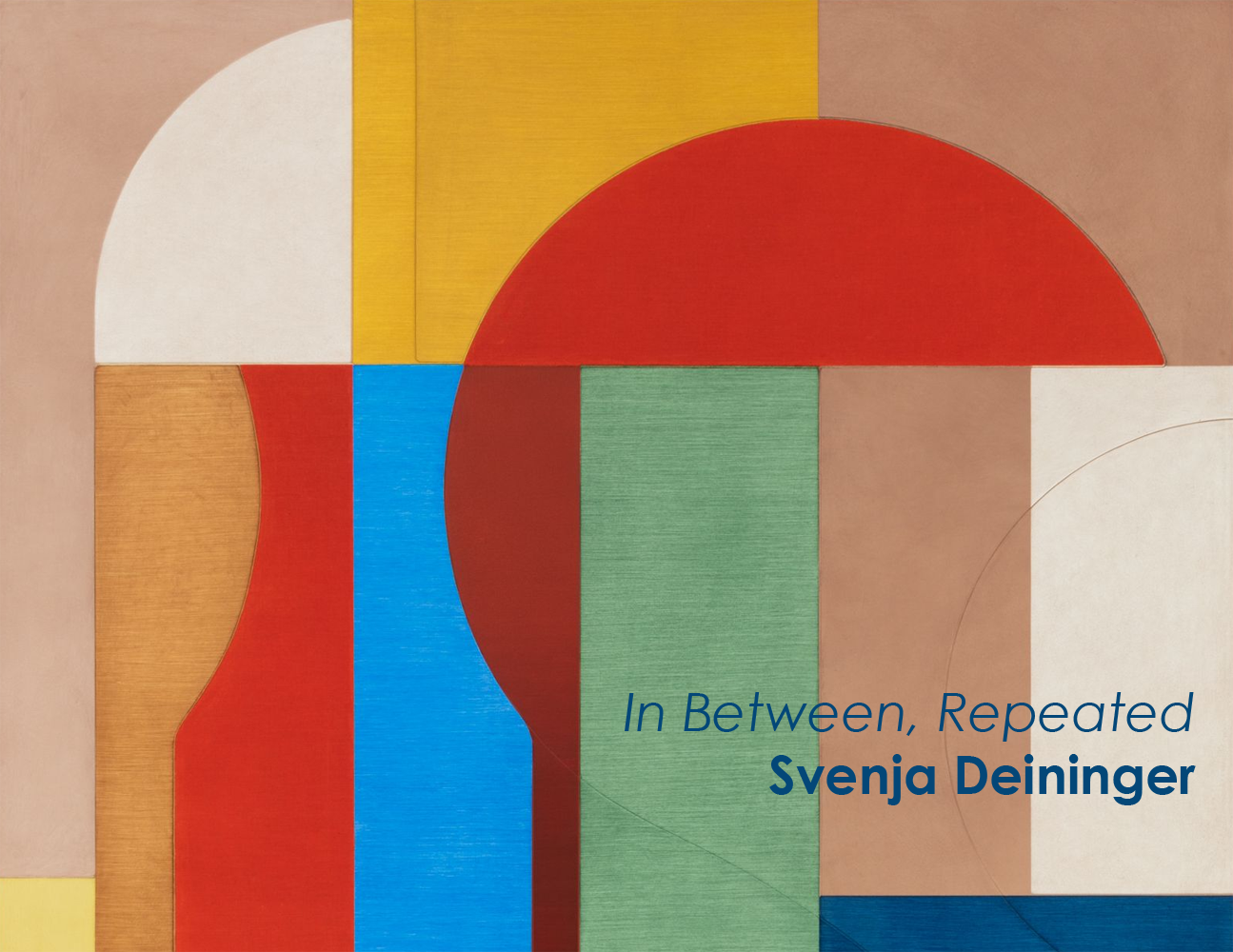
 4/11 – 18/12 2021
This exhibition introduces a new body of paintings by Svenja Deininger, continuing her sustained investigation into the mutable relationships between shape, colour, texture and surface. Her practice unfolds in a space of deliberation and recalibration, where compositions emerge slowly through a process that is at once controlled and fluid. Each canvas becomes a site of negotiation: between abstraction and figuration, between memory and immediacy, between gesture and restraint.
Time is not simply a condition of production in Deininger’s work; it is an active material. Paintings originate from an initial visual intuition that undergoes prolonged transformation. Patterns are juxtaposed, tonal intervals adjusted, shapes displaced or softened. References—sometimes traceable to art historical precedents, sometimes rooted in fleeting impressions—are absorbed into a vocabulary that never settles into quotation. What remains visible is not the reference itself, but the residue of a thinking process that continuously re-evaluates spatial relationships.
Surface plays a decisive role in this inquiry. Deininger treats the painted plane as a skin subjected to cycles of application and removal: pigment is layered, scraped back, polished, repainted. These gestures accumulate into finely tuned textures where slight variations in thickness and finish alter the way light inhabits the work. Matte passages absorb, satin areas diffuse, denser zones hold the gaze. The result is neither illusionistic depth nor flat assertion, but a tension between tactile presence and optical vibration.
Although individual works can originate from schematic drawings—occasionally even from figurative prompts—the final compositions often render these sources unrecognizable. What might begin as a curved outline suggestive of a torso dissolves into interlocking chromatic planes and subtle textural shifts. Abstraction here does not erase the body; it displaces it, allowing traces of corporeality to persist beneath layered decisions. The human presence is neither depicted nor denied, but translated into rhythm and proportion.
Installed together, the paintings form a carefully orchestrated environment. Deininger approaches exhibition-making as an extension of her studio practice, considering how works converse across distance, scale and orientation. Vertical stripe paintings, developed during a period of seclusion at the onset of the pandemic, assume a structural role within the installation. While compositionally reduced, they remain materially complex, functioning almost architecturally—like visual columns that regulate the cadence of the space and anchor more intricate compositions nearby. Their apparent simplicity belies a dense catalogue of painterly techniques embedded within their surfaces.
The exhibition thus operates as a spatial text. If each painting can be understood as a word, the installation becomes a sentence whose syntax is shaped by proximity, interval and pause. Deininger conceives of this arrangement as a holistic process: works are developed concurrently, nurtured as interdependent entities before they enter the autonomy of the gallery. Even once separated, they retain the memory of their collective incubation.
Occupying a space “in between,” her practice resists alignment with any single ideological lineage—whether modernist autonomy or conceptual seriality. Instead, it sustains a restless interrogation of painterly language itself. Production is neither mechanical nor repetitive; it is cyclical and organic, driven by equal commitments to looking and doing. In this expanded temporality, reflection becomes action. Each painting records not only its own making but also the duration of attention it demands, inviting viewers to enter a similar rhythm of sustained perception.