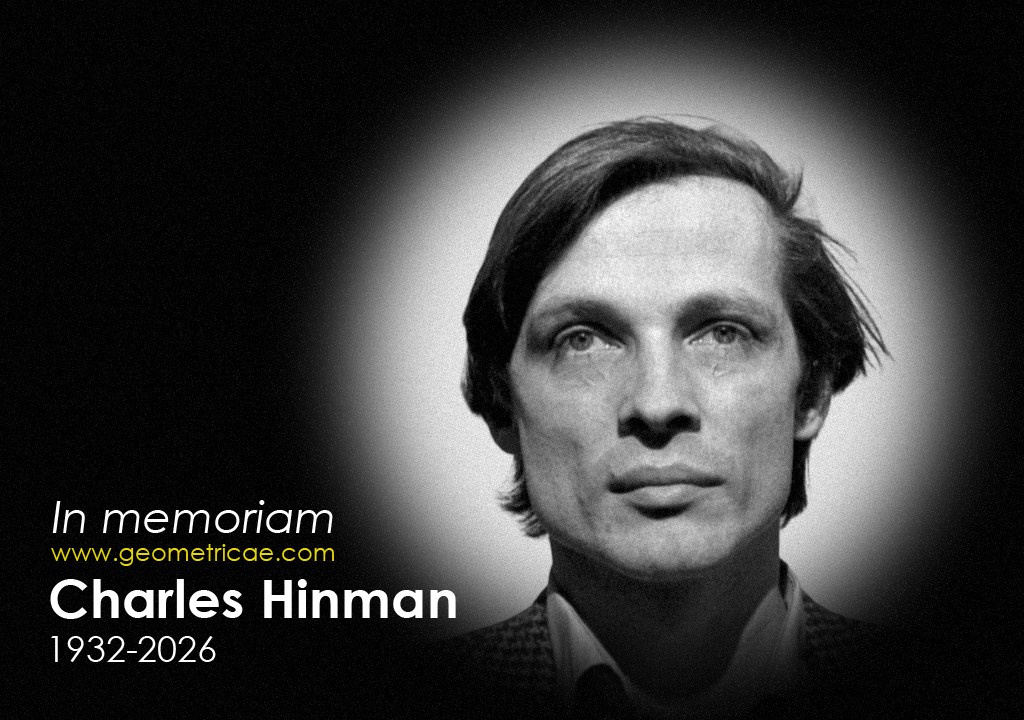
Charles Baldwin Hinman expands the traditional picture plane into three-dimensional space, exploring the relationship between painting, form, colour and structure. His shaped canvases occupy a position between painting and sculpture, combining geometric and organic structures, color, light, shadow and physical space. His work is associated with the development of the shaped canvas and with the expanded conception of painting that emerged in New York during the 1960s.
Hinman grew up in Syracuse and attended art classes at the Syracuse Museum of Fine Arts, now the Everson Museum of Art. He studied at Syracuse University, receiving a B.F.A. in 1955. His university years also included an unusual parallel activity: he played professional baseball as a left-handed pitcher in the Milwaukee Braves minor-league organization. After completing his degree, he moved to New York and studied at the Art Students League, where he worked with Morris Kantor and met artists including James Rosenquist and Lee Bontecou. In 1956 he was drafted into the United States Army and served for two years. According to biographical accounts, he was stationed in California and worked as a social worker in a military prison.
After his military service Hinman returned to New York. In 1960 he and James Rosenquist established studios at Coenties Slip in Lower Manhattan, sharing a loft that had previously been occupied by Agnes Martin. The area had become an important community of artists working outside the dominant language of Abstract Expressionism. Robert Indiana, Ellsworth Kelly, Jack Youngerman, Lenore Tawney and other artists were associated with the neighborhood, which brought together different approaches to abstraction, object-making and the relationship between art and the surrounding architectural environment. Hinman remained at Coenties Slip until 1962, while also beginning a period of teaching that would continue throughout his career.
From 1960 to 1962 he taught mechanical drawing at the Staten Island Academy, and from 1962 to 1964 he taught woodworking at the Woodmere Academy on Long Island. These activities were important to his subsequent practice. Technical drawing provided him with a precise understanding of projection, measurement and construction, while woodworking gave him direct knowledge of materials, carpentry and structural assembly. Rather than treating the canvas merely as a surface onto which an image was applied, Hinman increasingly approached painting as something that could be designed and constructed.
In 1963 he began developing his first shaped canvases. His initial experiments moved beyond the conventional rectangular support by cutting and suspending canvases and by introducing physical depth into their construction. Some of the early works incorporated hinges, cords and adjustable elements, allowing the forms to project into space or to find a particular equilibrium under gravity. He subsequently developed increasingly complex wooden armatures over which canvas was stretched, making the support itself an integral part of the work.
Hinman’s first important public presentation came in May 1964, when his work was included in Seven New Artists at the Sidney Janis Gallery in New York. The exhibition also included Arakawa, Larry Bell, Robert Irwin, Norman Ives, Robert Slutzky and Robert Whitman. Hinman showed works in which the traditional rectangular picture plane had already been disrupted, including suspended and irregularly shaped canvases. The exhibition brought him to the attention of the New York art world, and his work was subsequently represented by Richard Feigen Gallery.
The same year, Hinman had his first solo exhibition at Richard Feigen Gallery in New York. During the following years his canvases became increasingly volumetric. Rather than simply changing the perimeter of the picture, he pushed the surface outward, creating forms that occupy the space normally separating a painting from its viewer. One of the significant early works was Poltergeist (1964), subsequently acquired by the Museum of Modern Art. The work exemplifies Hinman’s interest in making the physical structure of the painting participate in the perception of its image.
This development coincided with a broader reassessment of the nature of painting in New York. In December 1964 the Solomon R. Guggenheim Museum presented The Shaped Canvas, curated by Lawrence Alloway. The exhibition examined artists who had challenged the conventional rectangular format, but its definition of the shaped canvas concentrated on works retaining a continuous, essentially two-dimensional surface. Hinman’s more deeply constructed, three-dimensional paintings therefore occupied a position outside the Guggenheim exhibition’s selection. In January 1965, however, Shape and Structure at Tibor de Nagy Gallery provided a different framework. Organized by Frank Stella, Henry Geldzahler and Barbara Rose, the exhibition included Hinman together with artists including Donald Judd, Carl Andre, Robert Morris, Larry Bell, Will Insley and Neil Williams. The exhibition connected the shaped canvas to the broader emergence of Minimalism and to the increasing movement of painting into real space.
The distinction was important to Hinman’s practice. His work shared with Minimalism an interest in physical structure and the rejection of traditional pictorial illusion, but he did not abandon color or the perceptual possibilities of painting. His objective was not simply to turn a painting into an object. Instead, he explored the tension between the actual volume of the constructed work and the visual space suggested by its painted surface. As he later explained, his interest was to establish “real sculptural space” in relation to an “illusory space” and to make the two interact.
In 1965 Hinman was included in Young America 1965 at the Whitney Museum of American Art and in Three Young Americans at the Allen Memorial Art Museum at Oberlin College. The Whitney subsequently included his work in Art of the United States 1670–1966 and in its annual exhibitions. His presence in these exhibitions placed him within the generation of American artists redefining painting during the transition from Abstract Expressionism to Minimalism, Color Field painting, Pop and other forms of postwar abstraction.
During the summer of 1965 Hinman was an artist-in-residence at the Aspen Institute in Colorado, where he produced the Sunspot series. These works investigated curved forms and the relationship between color and volume. The following year he presented the series at Richard Feigen Gallery. His work of this period increasingly combined strong color contrasts with convex and concave surfaces, making the physical relief of the canvas inseparable from the way color was perceived.
In 1965 Hinman also moved from Coenties Slip to the Bowery. He initially worked at 2 Spring Street, in a building associated with artists including Robert Indiana and Will Insley, before establishing the studio at 231 Bowery that would become his principal working environment for more than five decades. The Bowery became an important part of his artistic identity and connected him to a wider community that included James Rosenquist, Tom Wesselmann, Harvey Quaytman, Frances Barth, David Diao, Max Gimblett and others.
Throughout the second half of the 1960s Hinman continued to develop the possibilities of the shaped canvas. His works could project dramatically from the wall, curve around concealed wooden structures or appear to hover through the relationship between their physical construction and their painted surfaces. Color was not simply applied to the object but became an active component of its spatial effect. The painted planes could appear to extend beyond the physical limits of the canvas, while the edges and projections generated shadows and reflections on the surrounding wall. This interaction between the constructed object and its environment became a persistent feature of his practice.
His participation in exhibitions such as Art in Process: The Visual Development of a Structure at the Finch College Museum of Art further positioned his work alongside artists associated with the emerging Minimalist vocabulary. He was also included in Painting: Out from the Wall at the Des Moines Art Center in 1968, an exhibition addressing the expansion of painting into three-dimensional space. His work was acquired by major American museums, including the Museum of Modern Art and the Whitney Museum of American Art.
Hinman also developed an international exhibition career. His work was shown in Japan, Europe and elsewhere, and he exhibited through Galerie Denise René in Paris and Hans Mayer in Düsseldorf. During the early 1970s Denise René presented his work in Paris and New York, connecting his practice with the European history of geometric and kinetic abstraction represented by the gallery. He also produced editions in collaboration with Denise René and with Domberger in Germany.
The international context was significant because Hinman’s work occupied a position between several established categories. It could be discussed in relation to Minimalism because of its reduction of pictorial imagery and emphasis on structure; to Color Field painting because of its use of large areas of color; to Op and perceptual art because of the changing effects generated by color and spatial relationships; and to sculpture because of the physical construction of the works. Hinman nevertheless maintained that he was making paintings. His central problem was how to make a painting operate simultaneously as a physical object and as an image.
The construction of a Hinman painting generally began with drawings. He developed volumetric forms in charcoal, selected particular configurations and then translated them into technical or “shop drawings” that determined the wooden armature. The canvas was stretched over the constructed framework, after which the surface was prepared and painted. Color decisions could involve additional drawings and repeated adjustments to the painted surface. The process therefore combined freehand drawing, technical drafting, carpentry and painting.
The forms themselves often suggest movement, buoyancy or flight. Rather than appearing heavy and static, many of Hinman’s structures seem to cantilever from the wall or to float in front of it. Curved and angular elements meet in configurations in which gravity appears temporarily suspended. His interest in these forms was connected not only with geometry but with the perceptual ambiguity created when a physical volume and its painted representation are experienced simultaneously.
During the 1970s Hinman continued to vary the relationship between color, volume and structure, including periods in which he explored monochromatic white works. At other times, strong chromatic contrasts emphasized the distinction between different planes of the construction. The resulting shadows and reflections became part of the visual field surrounding the painting. The wall ceased to be a neutral background and became an active participant in the work.
His interest in printmaking also developed alongside his painting. Hinman produced screenprints, lithographs and embossed works, including projects associated with Graphicstudio. The National Gallery of Art holds examples of his lithographs, embossings and studies from the late 1960s and early 1970s. These works demonstrate that his investigation of contour, line, relief and spatial perception was not limited to his large constructed paintings.
In the 1980s Hinman expanded his practice into relief and large-scale constructions. He worked with Bummy Huss Paper in New York on cast-paper reliefs and undertook commissions for architectural environments. Among these were works for the Grand Hyatt Hotel in New York in 1980, Southeast Bank in Miami in 1983 and the Madison Green Building in New York in 1984. In 1980 the Everson Museum of Art in Syracuse organized a major exhibition of his work, which subsequently travelled to the Laguna Gloria Art Museum in Austin and the Museum of Art, Fort Lauderdale.
One of the important statements associated with Hinman’s work comes from the catalogue of the Everson Museum exhibition. He described his objective as bringing together “real and illusionary space,” treating the two as separate realms that could interact within a single painting. His later description of his paintings as occupying a “6-dimensional space” extended the idea by adding time, light and color to the three dimensions of physical space. The statement indicates the extent to which Hinman’s practice was concerned with perception rather than simply with the alteration of a canvas’s outline.
His teaching career continued alongside his studio practice. He taught at Cornell University’s New York City program, Syracuse University, Pratt Institute, the School of Visual Arts, Cooper Union, the University of Georgia and Princeton University, as well as at the Art Students League of New York. At the University of Georgia he held the Lamarr Dodd Chair in Painting and was named Lamarr Dodd Distinguished Professor of Painting during his tenure there.
Hinman’s work remained present in American museums and collections throughout the later twentieth century, although his position within the standard histories of Minimalism and postwar abstraction was less prominent than that of some of his contemporaries. His inclusion in exhibitions devoted to shaped painting and the expansion of the picture plane increasingly brought attention back to the significance of his early experiments. In 1979, Shaped Paintings at the Visual Arts Museum in New York placed his work in a broader history that included Kenneth Noland, Ellsworth Kelly, Robert Mangold, Bernard Venet and Tom Wesselmann.
Recognition continued through the following decades. Hinman received grants from the National Endowment for the Arts, the Pollock-Krasner Foundation, the Adolph and Esther Gottlieb Foundation and the Richard Florsheim Foundation. In 2012 he received a John Simon Guggenheim Memorial Foundation Fellowship. His work entered the collections of institutions including the Museum of Modern Art, Whitney Museum of American Art, Hirshhorn Museum and Sculpture Garden, Los Angeles County Museum of Art, Albright-Knox Art Gallery, Louisiana Museum of Modern Art and Tel Aviv Museum of Art.
His later career also brought renewed attention to the historical importance of his work. Exhibitions such as The Shaped Canvas Revisited at Luxembourg & Dayan in New York in 2014 reconsidered the history of shaped painting beyond the narrower definition established by the 1964 Guggenheim exhibition. Hinman’s three-dimensional canvases demonstrated that the shaped canvas could become more than an irregular perimeter: it could become a spatial construction in which the distinction between painting and sculpture was deliberately left unresolved.
The Kreeger Museum’s Charles Hinman: Structures, 1965–2014, presented in Washington, D.C., in 2019, was the artist’s first museum exhibition in the Washington area and his first survey in more than three decades. Its inclusion of works spanning almost fifty years emphasized the continuity of Hinman’s investigation rather than presenting his shaped canvases merely as a historical episode of the 1960s. Among the works shown was Sails (1965), an acrylic painting on shaped canvas whose wooden armature brings the painted planes into a sharply projecting three-dimensional configuration.
In the 2020s Hinman’s work continued to be reassessed in relation to Minimalism, Color Field painting, geometric abstraction and the history of the shaped canvas. Exhibitions including Beyond Minimalism (2023) emphasized the difficulty of assigning his work to a single movement. His practice had developed alongside Minimalism but retained a sustained interest in color, optical perception, constructed form and the pictorial possibilities of the painted surface.
Works by Charles Hinman are held in the collections of the Museum of Modern Art, Whitney Museum of American Art, National Gallery of Art, Hirshhorn Museum and Sculpture Garden, Los Angeles County Museum of Art, Albright-Knox Art Gallery, Louisiana Museum of Modern Art, Tel Aviv Museum of Art and other institutions. His career, extending from his first shaped canvases in the early 1960s to works produced more than five decades later, can be understood as a sustained investigation of what happens when the boundary between the image and its physical support is removed. Rather than treating the canvas as a passive rectangular field, Hinman made its structure, volume, color and relationship to surrounding space part of the painting itself. In doing so, he helped establish one of the significant paths by which American abstraction moved beyond the conventional picture plane in the postwar period.