Versione italiana
Versión española
Interview by Edna Bozyski
On the occasion of the tenth anniversary of Geometricae magazine, I had the privilege of engaging in a long and in-depth conversation with its founder, Gianfranco Spada—an artist whose career spans painting, architecture, and research into geometric abstract art. Throughout this interview, Spada offers a unique insight into his creative process, his influences, his relationship with art history, and his conception of cultural legacy. It is an opportunity to delve into the thinking of someone who, in addition to his artistic practice, is dedicated to preserving and disseminating the richness of geometric abstraction on an international scale.

When and how did your relationship with art begin?
From a very young age I felt a deep fascination with art. My earliest artistic memory is a postage stamp reproducing Picasso’s Guernica, given to me by a naval captain. I would sometimes accompany my father, a customs officer, during the inspections he carried out on ships docking at the port of Bari. As an avid stamp collector, I took advantage of those visits to ask the officers to save for me the most interesting stamps used on their journeys around the world.
That Guernica stamp was extraordinary: its unusually large size and the power of the image left me spellbound. I spent days contemplating it, moving through its narrative, its symbolism, its abstraction of horror. I was captivated by that combination of formal simplicity and compositional complexity, by that chaos laden with meaning.

My second great artistic memory came during adolescence, in the most unexpected way: through a can of L’Oréal hair spray. Its packaging featured a geometric composition of primary colours and black lines. One day, leafing through an encyclopaedia, I came across Mondrian and discovered a body of work that bore an evident relationship to that design. It was a genuine “eureka” moment: I suddenly understood that abstract art possessed such power that even a commercial brand used it as a visual lure.
At the same time, I developed a growing obsession with historical architecture. I was struck by the clear, solid volumes of Romanesque churches, or by the geometric purity of Renaissance palaces silhouetted against a blue sky. Without realising it, I was already learning how to look.
Do you remember how your first works and artistic experiments came about?
From childhood I was interested in drawing architectural volumes; with nothing more than a wooden ruler I would produce building views without even knowing the formal rules of perspective. It came almost naturally, and I often made these drawings for my classmates, introducing small stylistic differences so that they would appear to be their own. Over time I have realised that I am still exploring those very same perspectives that fascinated me as a child.
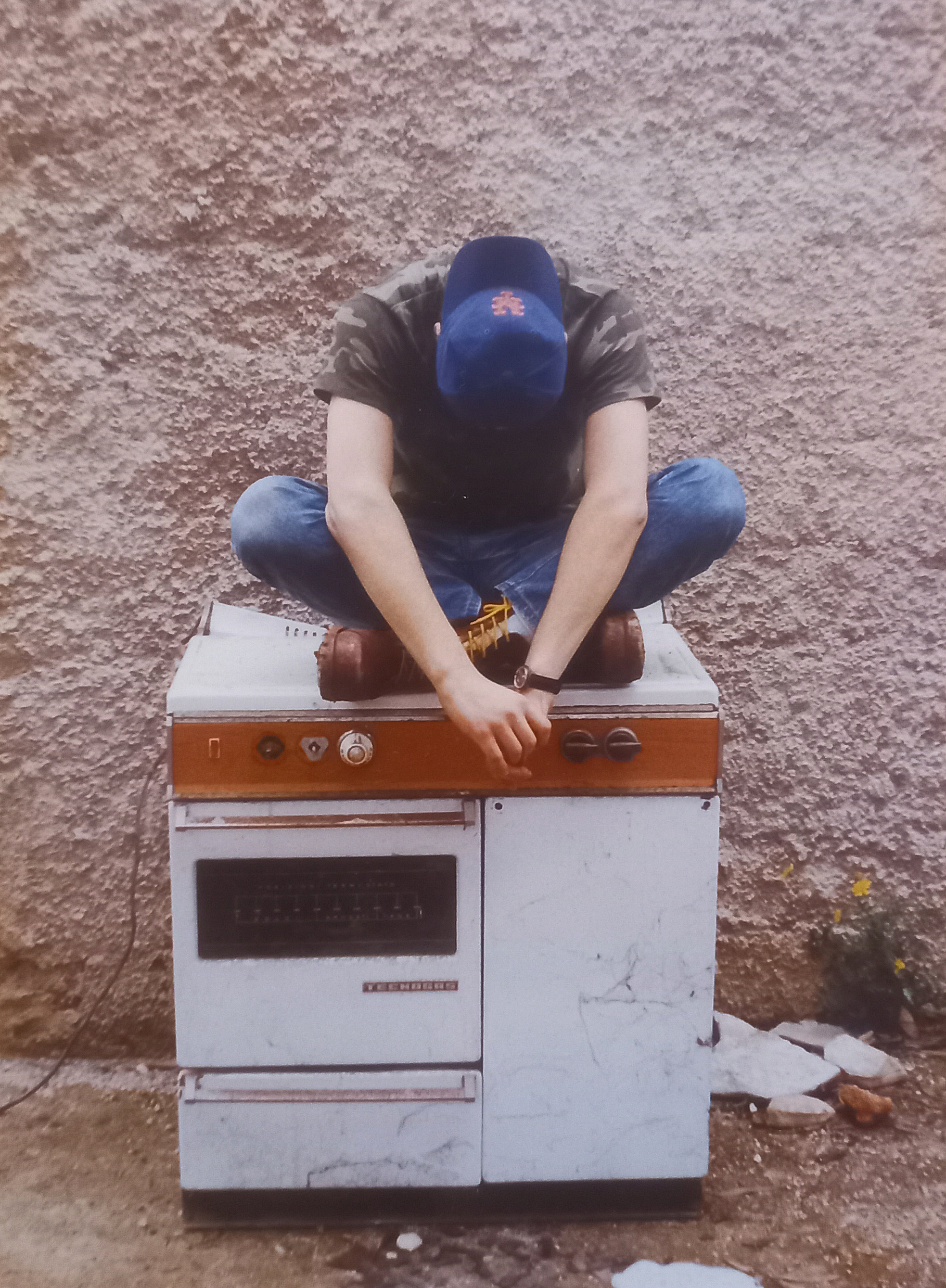
My first true artistic intervention was to pour several glasses of red paint over my Vespa, breaking its uniform colour and creating stains resembling gunshot wounds. Later, around the age of seventeen, my discovery of Warhol profoundly shaped my path. I could not get his famous Marilyn out of my head, and with the help of a friend—taking advantage of my parents’ absence—I painted an enormous version of Marilyn on one of my bedroom walls. From Warhol I learned essential lessons: that a work never comes from nothing, that it always reinterprets previous ideas, that technique is secondary, and that only deep analysis reveals the complexity of an image.
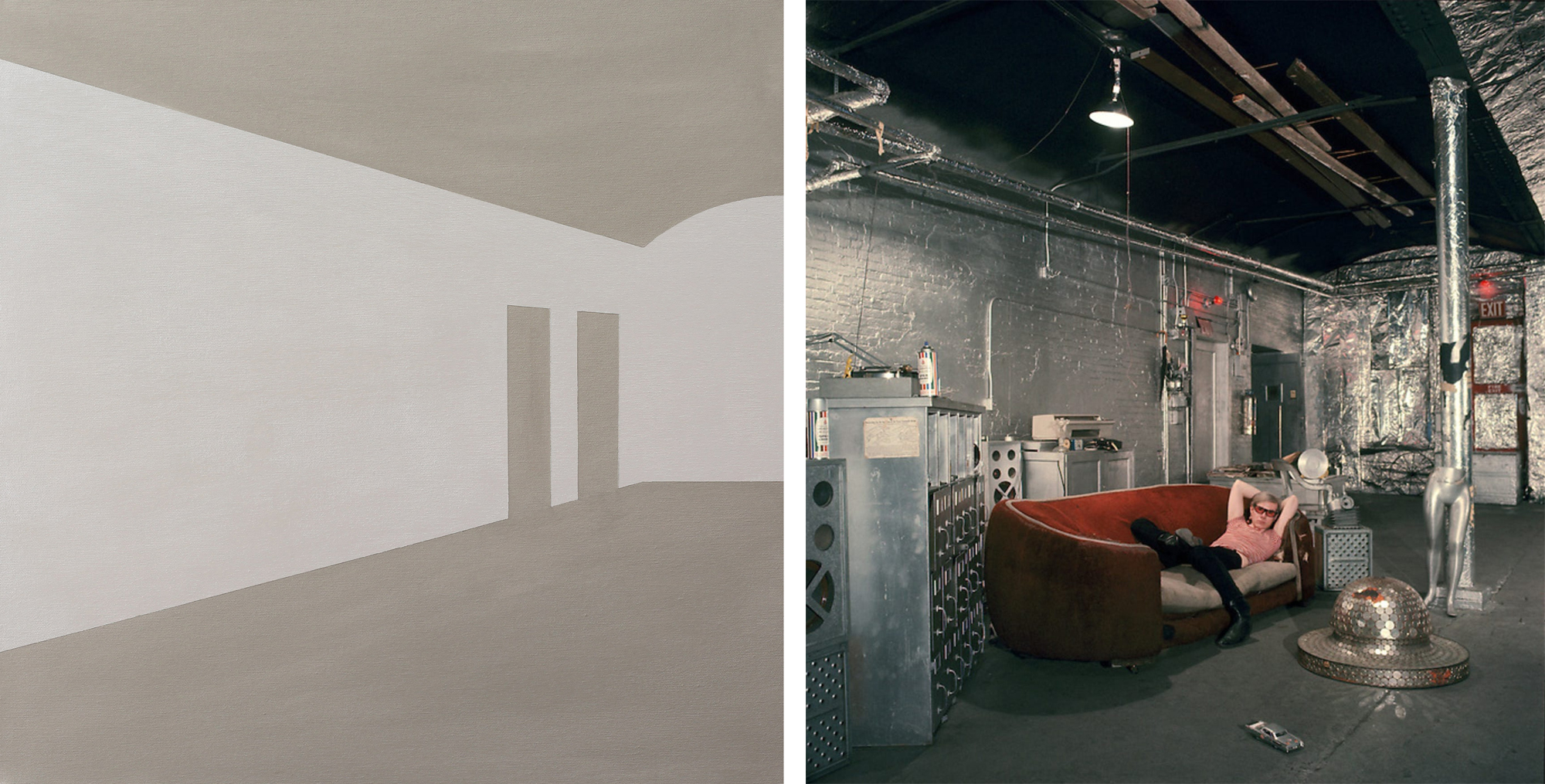
During my university years, I pushed further the relationship between space and creation: I painted my room and all its objects silver, in a kind of “silver room” in the spirit of the Factory, and I produced a work I remember vividly—a bleeding Coca-Cola bottle—combining Warholian pop with conceptual experimentation.
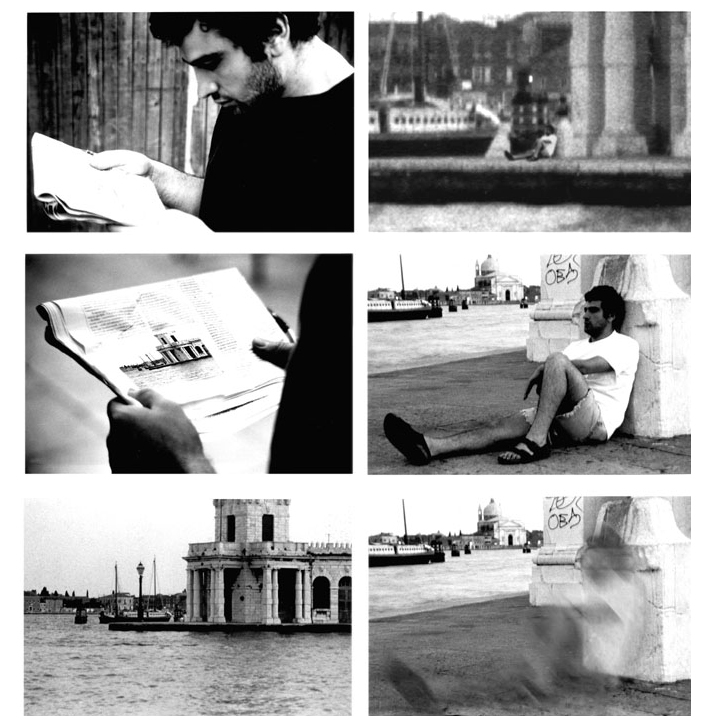
Through him I also discovered photography, and I became fascinated by the work of Duane Michals, whose narrative approach and dreamlike irony inspired me to create a photographic series that earned me the highest mark in a university exam in the History of Photography, under the guidance of the renowned Italo Zannier.
In parallel, I became obsessed with architecture and minimalism: I photographed abandoned buildings and desolate urban landscapes and later explored the work of Tadao Ando in Europe, immersing myself in his pure, ascetic geometry.
Together with university colleagues, we developed irreverent models, such as a neighbourhood of Milan built entirely out of chocolate, which we then ate amid laughter and celebration.
In the late 1990s, during my Erasmus period in Brussels, I immersed myself in a minimalist aesthetic inspired by Donald Judd, stripping my surroundings of all unnecessary decoration and living solely among books and art catalogues. I lived in an abandoned building that we helped to restore, whose history was fascinating: it had once been the famous hotel-brothel Le Grand Miroir, where Baudelaire spent his final years ill and almost aphasic.
All of this—from childhood drawings to pop, photographic and minimalist experiences—was a continuous laboratory of experimentation that, only in retrospect, I realise constituted my first true artistic works.
What kind of education did you receive? Do you think it influenced your artistic concerns?
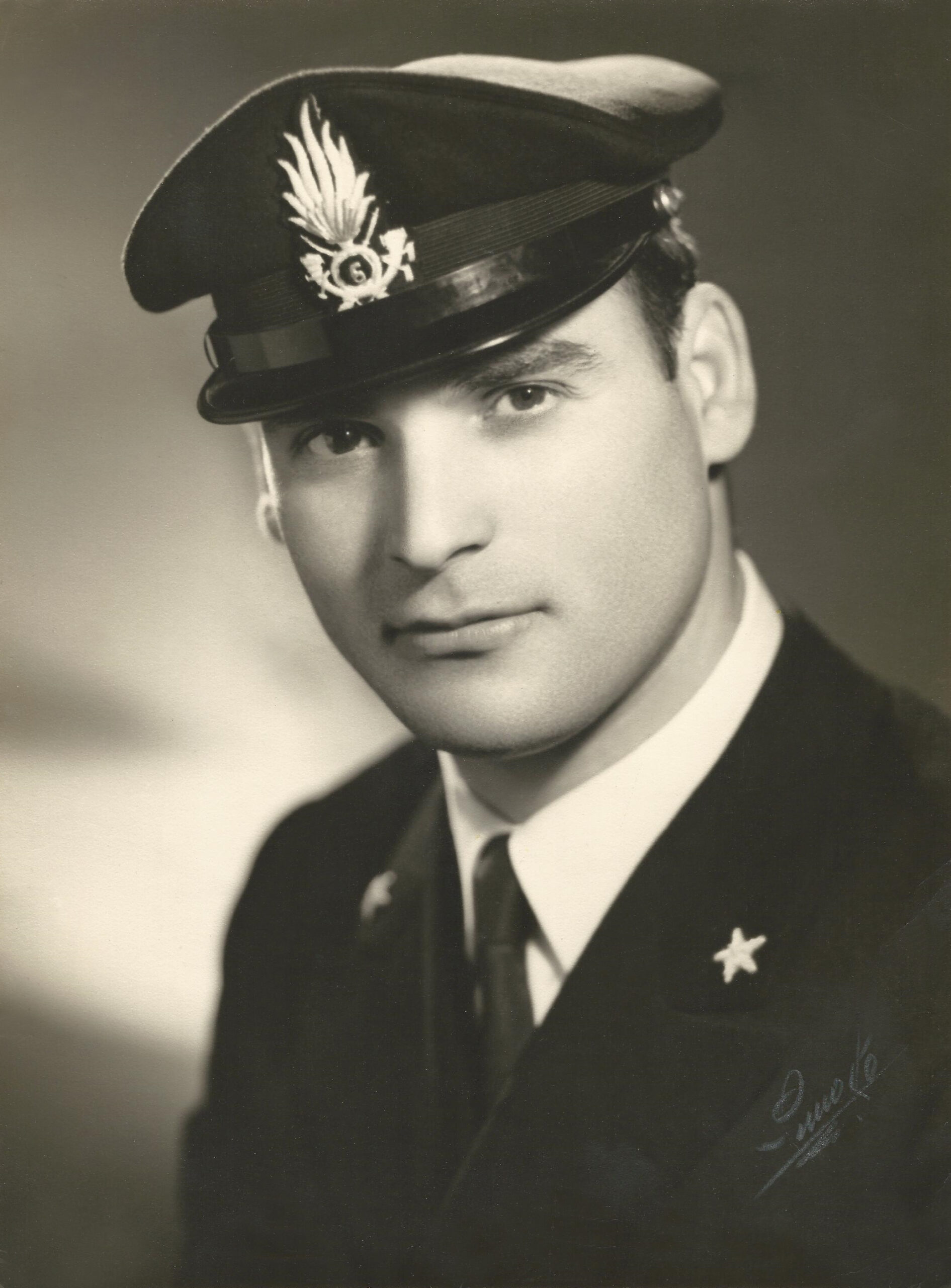
I received a very particular education. My father, despite being in the military, had a strong creative side: he never stopped making, inventing, building. Trained as a mechanical technician in military schools, he possessed a natural ability for anything he set his mind to. The great lesson he passed on to me was blunt and direct: if you want something, don’t wait or go round in circles trying to earn the money for it; if you want a toy—he would say—make it yourself. He gave vivid examples: if you like cars, you don’t need to become a notary to collect them; become a mechanic and build them yourself. I internalised that maxim from a very young age. I made many of my own toys, and I believe that, in part, this is why I ended up studying architecture. I was always designing my ideal house, first in cardboard and later, as a teenager, in wood, at increasingly ambitious scales.
My mother, on the other hand, was a tailor, as were almost all of her family: six siblings, all tailors. You can imagine my childhood unfolding among fabrics, buttons, patterns, fittings and bespoke commissions. I grew up in an environment where design and a direct relationship with the client were essential. I was fascinated by the smell of the huge stacks of layered fabrics that my uncle cut with a large machine, and by the scent of the worn wooden tables, impregnated with lanolin. And the buttons… that infinite universe was my first encounter with colour, with form, with geometric abstraction.
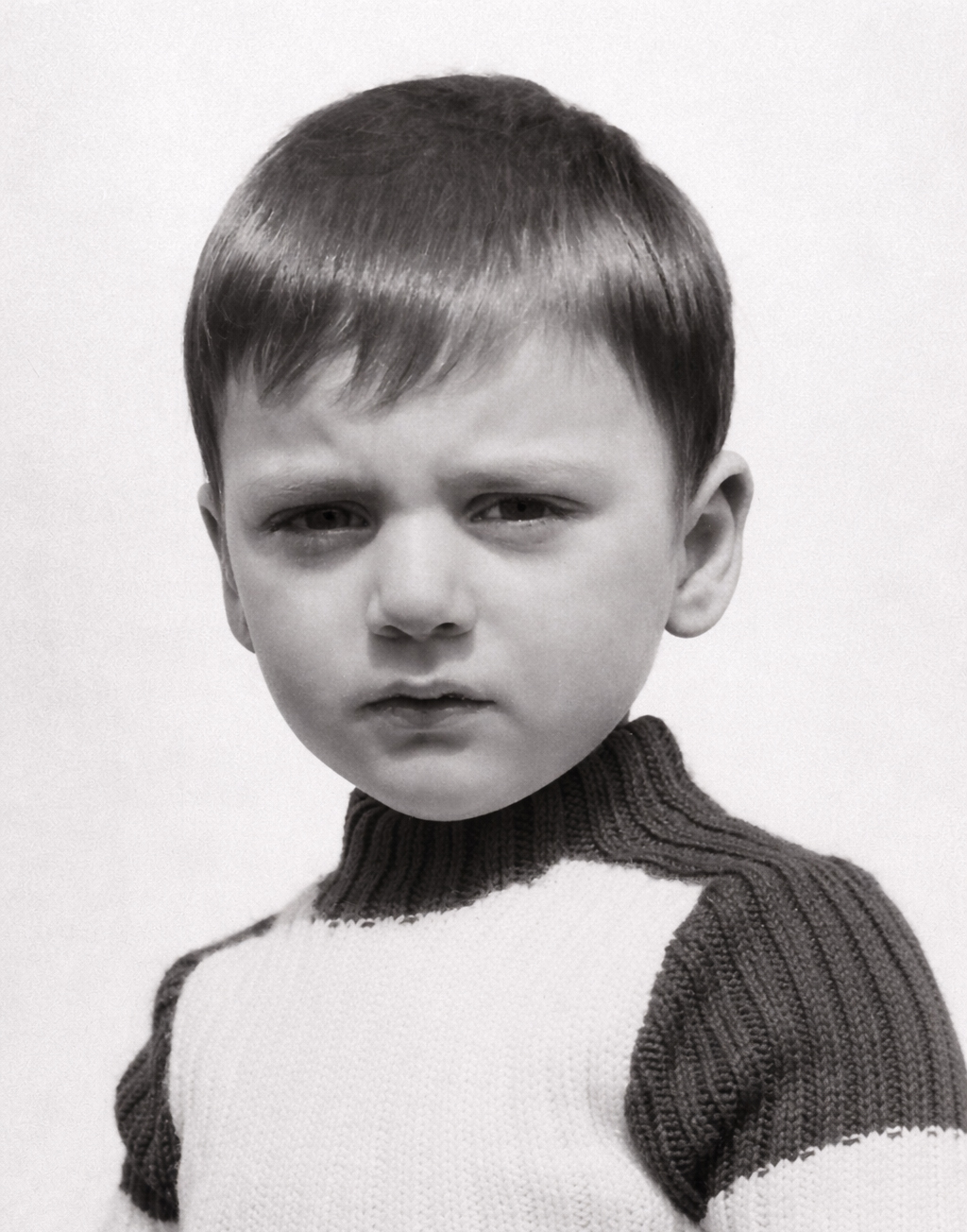
Another decisive influence on my artistic sensibility—probably the most important—came from the special education I experienced thanks to my sister, a person with different sensitivities who needed to attend specialised centres, which I often accompanied her to. There I met children with very diverse realities, some with extreme needs. I learned to play differently, to understand that perception is always relative, to communicate at times without words, through sounds, gestures or silences. It was pure abstraction. Many of the friends I made there lived very short lives due to their health conditions, and all of this taught me to feel deeply things that other children took for granted. It involved many hours of sensory and emotional stimulation that have left a decisive imprint on me. I also learned the importance of solitude as opposed to gregariousness, the construction of an inner world removed from social noise. And I developed a finely tuned sense of realism, an attentive eye for recognising at a glance certain pathologies of the human condition from which I try to keep my distance with a blend of stoicism, asceticism and austerity.

How have your studies in architecture influenced your artistic production?
Both in architecture and in art I define myself, above all, as self-taught. My personal concerns have almost always followed paths different from academic programmes and the rigid mechanisms of the university system. From my earliest design exercises I tried to reconcile my artistic explorations with functional requirements, but I often encountered resistance from certain teaching assistants who, obtusely, discouraged any hint of creativity.
At the University of Architecture in Venice, where I studied, despite the presence of internationally renowned full professors, there was a system of supervision that delegated much of daily training to assistants. Many of them believed their role was to impose the kind of architecture practised by the professors, as a sort of disciplinary dogma. For example, the students of the great Aldo Rossi almost all ended up drawing buildings with small square windows and exposed brick, as if architecture were a replicable formula rather than a process of thought.
When I understood the perverse workings of the system, I decided to avoid the standard procedure of reviews with assistants and began presenting myself directly at final examinations with the full professors.
I recall that in one of my last degree projects I designed a Museum of Science for the city of Trieste. My proposal, highly radical for that context, consisted of a large cubic prism of apparent and extreme formal simplicity in its external volume, which housed within it a complex museographic system.

The museum, a blind cube entirely clad in white stone, established a clear dialogue with minimalist art. Its pared-down geometry referred directly to my sources in geometric abstraction, uniting architectural discipline and artistic sensibility in a single gesture.
So you did not receive a formal artistic training?
Nevertheless, at the University of Architecture there were many elective courses, and I took the opportunity to attend numerous classes of an artistic nature: stage design, art history with Luca Massimo Barbero, photography with Italo Zannier, and various workshops with Bruno Munari, Franco Purini and Gillo Dorfles.
Thanks to these experiences, I can say that in my work I approach architecture as an artist and art as an architect, fusing both disciplines in an inseparable way.
What artistic memories do you have of that period?
I certainly remember a renewed passion for the figure and work of Andy Warhol; I even painted the entire interior and all the objects of my student room silver in homage to his New York Silver Studio. I also recall the chance discovery of Situationism and my approach to classical painters through the meticulous study of small details in their works. The final exam in art history consisted of recognising, from fragments, the author, year and circumstances of the most important works of classical Italian art. Aware that the best approach was to know these works firsthand, a friend and I embarked on a car journey—a true tour de force through central and northern Italy. There I discovered, in awe, the paintings of Giotto, Mantegna, Piero della Francesca, Paolo Uccello and many others. It was an artistic pilgrimage, a wandering among churches and palaces, poorly fed and sleeping in the car, but profoundly instructive.
During my university studies I also became familiar with the world of art exhibitions. In Venice there was no shortage of opportunities to collaborate, in one way or another, on the installation of Biennale exhibitions, and in Brussels I had the chance to take part in the mounting of a major international exhibition, with guests such as the then still emerging artist Maurizio Cattelan.
What are you looking for when you confront a painting?
With my painting I aim to create poetry—but an unwritten poetry: a visual poetry in which, instead of words, verses and metaphors, forms, colours and proportions unfold. In this way I seek the perfection of a Japanese haiku and the serene simplicity of the poetry of Machado or Montale.
All my paintings operate on two levels: one that is apprehended by most people, and a deeper, metaphysical one, as De Chirico would say, which reveals itself in certain moments of heightened attention or sensitivity. From him, I have undoubtedly inherited his sense of human absence, a plastic solitude constructed solely through the combination of tectonic forms. I am fascinated by his serene metaphysics, that of spaces that are inhabited yet empty.
At heart, I am a classical painter, although I happen to be painting in the twenty-first century, and it would make no sense to imitate the style of a Giotto or a Piero della Francesca. Modern painting, as De Chirico already noted, has lost the architectural sense that was once evident. In ancient painting, this architectural sense was clearly manifest and, in Giotto, reached a level of metaphysical essence. This is undoubtedly one of the most Italian traits of my painting, which otherwise maintains an international—and ultimately Spanish—character.

Blue seems to be a recurring colour in your compositions. Why is that?
It is true: virtually all my works contain areas of blue. Indeed, on the rare occasions when I did not use it, I felt the works were incomplete and consequently set them aside. I have always felt a profound fascination with this colour: as a child I tried to reproduce, with watercolours, all the different blues of the sky that I could observe. Later, when I discovered the cyanometer of the naturalist Horace-Bénédict de Saussure, I encountered a surprising object that materialised that childhood concern.
The use of blue in my paintings began unconsciously: I sensed that something was missing if it was not included. Only later did I fully understand its importance, when I realised that this metaphorical representation of the sky constantly evokes childhood and its happy moments, which we inevitably associate with this colour. Those final verses of Antonio Machado—“These blue days and this sun of childhood”—which the poet wrote on his way into exile and death in Collioure, were profoundly revealing for me. I cannot help thinking of them every time I paint a picture.

But isn’t it always the same blue, as in the case of Yves Klein?
At first I did not really care about the specific type of blue, and it is clear that I used light blues, turquoises and sky blues interchangeably. Later, when I experienced a kind of revelation thanks to Machado, I discovered ultramarine blue—a colour with a name that is deeply evocative for me: I was conceived on a ship, by a father from Sardinia, an island overseas, and I now live in a country overseas in relation to my place of origin. What better colour, then, to express in all its complexity the Mediterranean nature of my essence?
Even so, your recent blues are never exactly the same.
I considered using a fixed formula for mixing my blue, but in reality I have never believed in its uniformity, as might be the case with Klein. My blues, although very similar, contain small nuances that make them different. This is because, although they may be allegorical, they are never conceptual. I do not believe in the conceptuality of a colour whose perception depends not only on the artist’s intention, but also on the quantity and type of light it receives.
Ultimately, Klein’s blue is a chimera: a precisely formulated colour that makes little sense in practice, since it will never be perceived in the same way. It is, in reality, an entelechy—a commercial stratagem elevated to an artistic concept.
So which blue are you trying to represent?
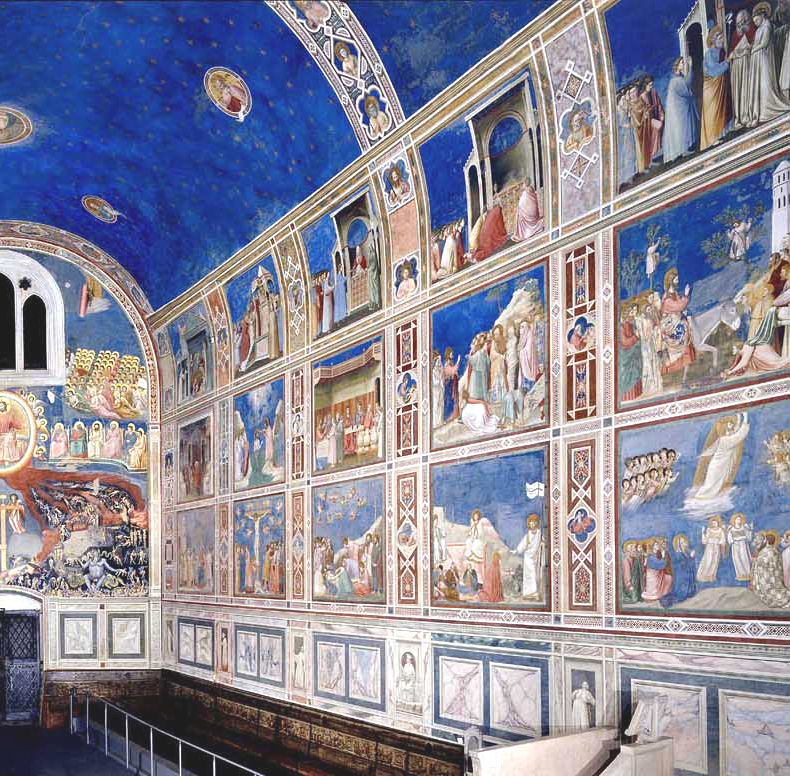
Mine seek to be archetypal blues, a blend of biographical memory: the skies of my childhood and the blue skies painted by Piero della Francesca, Magritte, De Chirico, but above all the blue of Giotto’s Scrovegni Chapel—an unforgettable ultramarine with which the painter reclaimed the blue of the sky, lost in Byzantine golds.
My blue skies are, mutatis mutandis, like those of Palladio: conceptually always the same, even though they represent different realities. They are imagined skies, awaited skies, remembered skies—pure abstraction.
On a compositional level, it seems that your blues have gradually gained greater prominence.
Yes, my discovery of blue also led me to give it greater importance as a compositional element. Matisse said that one square metre of blue is much bluer than one square centimetre, and my blues are perceived as more intense because they have increased in size. In different works I have explored the effects of quantitative balance at a chromatic level; in some, blue comes to constitute more than sixty per cent of the composition.
Another colour with a strong presence is immaculate white. What importance do you give it?
There is a book by Le Corbusier, When the Cathedrals Were White, that has accompanied me since my student days. At the time they were built, cathedrals were a resplendent white—a candid white that symbolised purity of spirit and a collective constructive energy. I immediately associated that title with the Romanesque cathedrals of my homeland and with the sensation of seeing them rise so majestically under the sun against a blue sky. Every time I use white—which in my case is titanium white, an extremely pure and luminous white—I cannot help but travel mentally to those places of my childhood, while also recognising that my love for modern architecture is due in part to this colour.

Spatial issues are very present in your work. What is your approach to them?
My works are homages to constructed space; they are neither suggested spaces nor interiors, but rather presential spaces in which volumes and masses relate to one another in search of compositional harmony. I am also interested in the absence of elements, in what I choose not to represent, since its negation enriches the whole. I paint by removing rather than adding, by refining and attempting to understand through stripping away; it is a process of unveiling, suggesting, revealing. Ultimately, I pursue the perfection of the Parthenon, following the imaginary line that connects it to the white Romanesque cathedrals of Apulia, Castel del Monte, the whitewashed Mediterranean villages, the architecture of Terragni and Le Corbusier, and the painting of Mondrian.

The titles you give your works seem to function as a complement to your pictorial discourse.
Yes, indeed, the titles are a necessary continuation of the work. They are entirely abstract and do not refer to concrete realities or objects, although they contain subtle allusions to the author or to the work being paid homage to, perceptible only to a few. For me they are very important: when read continuously, they function like short verses of a mantra-like litany. Through them I wish to clearly affirm my commitment to abstraction, especially because I find it contradictory when dogmatically abstract artists title their works with explicit references to reality—a true contradiction.
I have noticed that you use different languages interchangeably in your titles.
Yes, this is one of the subtle references I employ. I usually title a work in the language of the artist I am paying homage to, and on occasion I turn to Latin, which I consider a universal language. I have also used Basque, German or Japanese, depending on the work and the intention of the homage.
And what can you tell us about the size and format you use? They seem almost always the same.
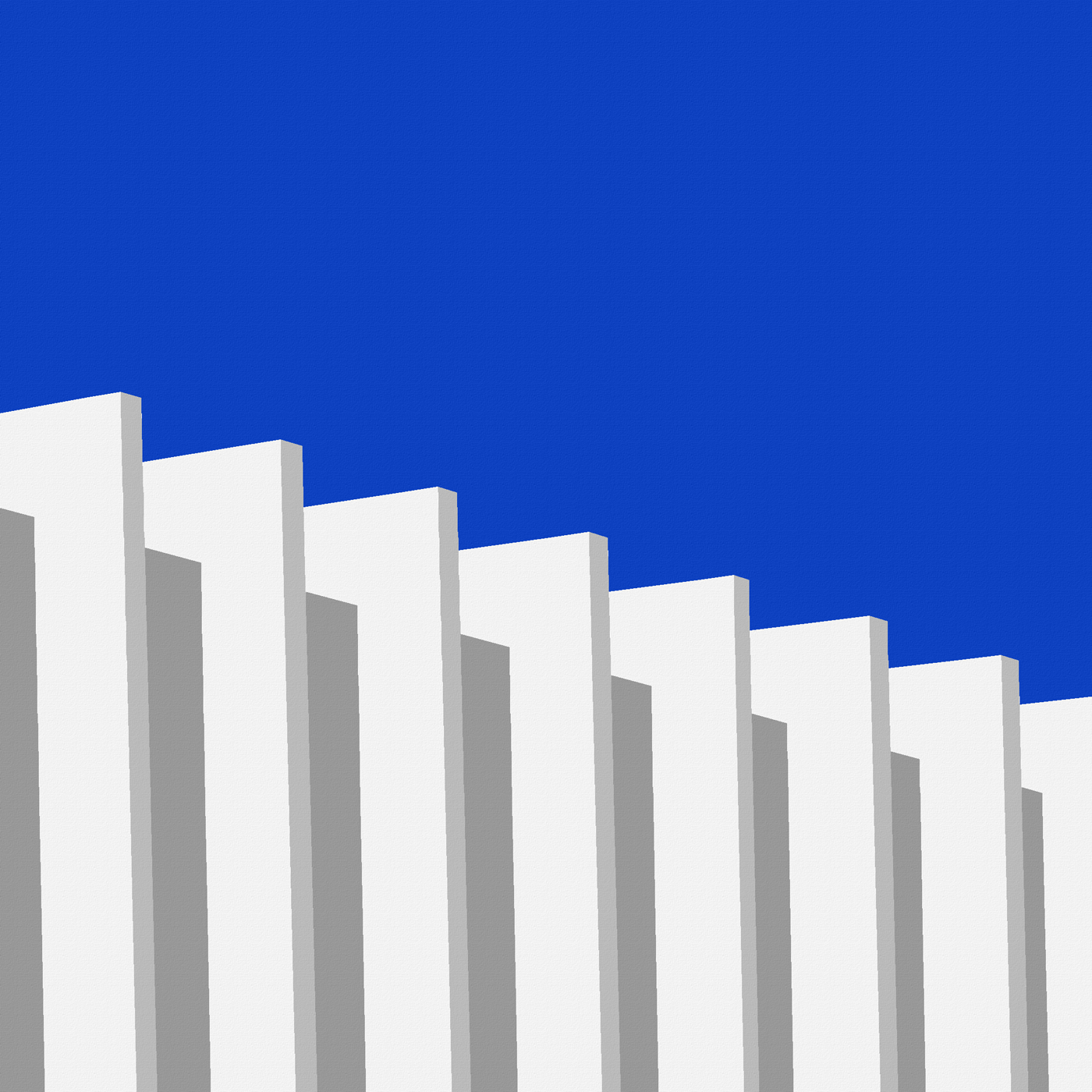
Yes, I tend to keep them constant. I prefer the square format in order to avoid any narrative associated with landscape or panoramic perception. I use a medium-small size, 60×60 cm, so that the painting is perceived as a present and concrete object, without inducing the viewer into a subjective or immersive reading. Each work can be apprehended in its entirety at a single glance, revealing its completeness and finitude.

You seem to be going against the current trend, where large-scale works abound.
I am not opposed to large formats, provided they respond to the pictorial needs of the work. Lately I see enormous paintings that could have been resolved at much smaller dimensions; When I saw Guernica for the first time reproduced on a postage stamp: it struck me as monumental despite its reduced size. Later, when I saw the actual work and understood its motivations, I confirmed that greatness does not reside solely in dimensions. The logistics of scale—canvas preparation, stretching, framing, transport or exhibition—often acquire disproportionate prominence over the pictorial act itself. The essential does not lie in magnitude; a small Rembrandt or Magritte can possess the same potency. What matters is the work itself, not its size.
Which periods can be discerned in your work?
I have never thought of my work in terms of periods, but with hindsight I can identify different phases. Although certain elements remain constant, each stage explores a different approach. We could summarise them in five phases. The first, the Opera Prima, consists of a single work: Eterno Rojo, my revelatory piece, which I have since attempted to understand and replicate in subsequent works.
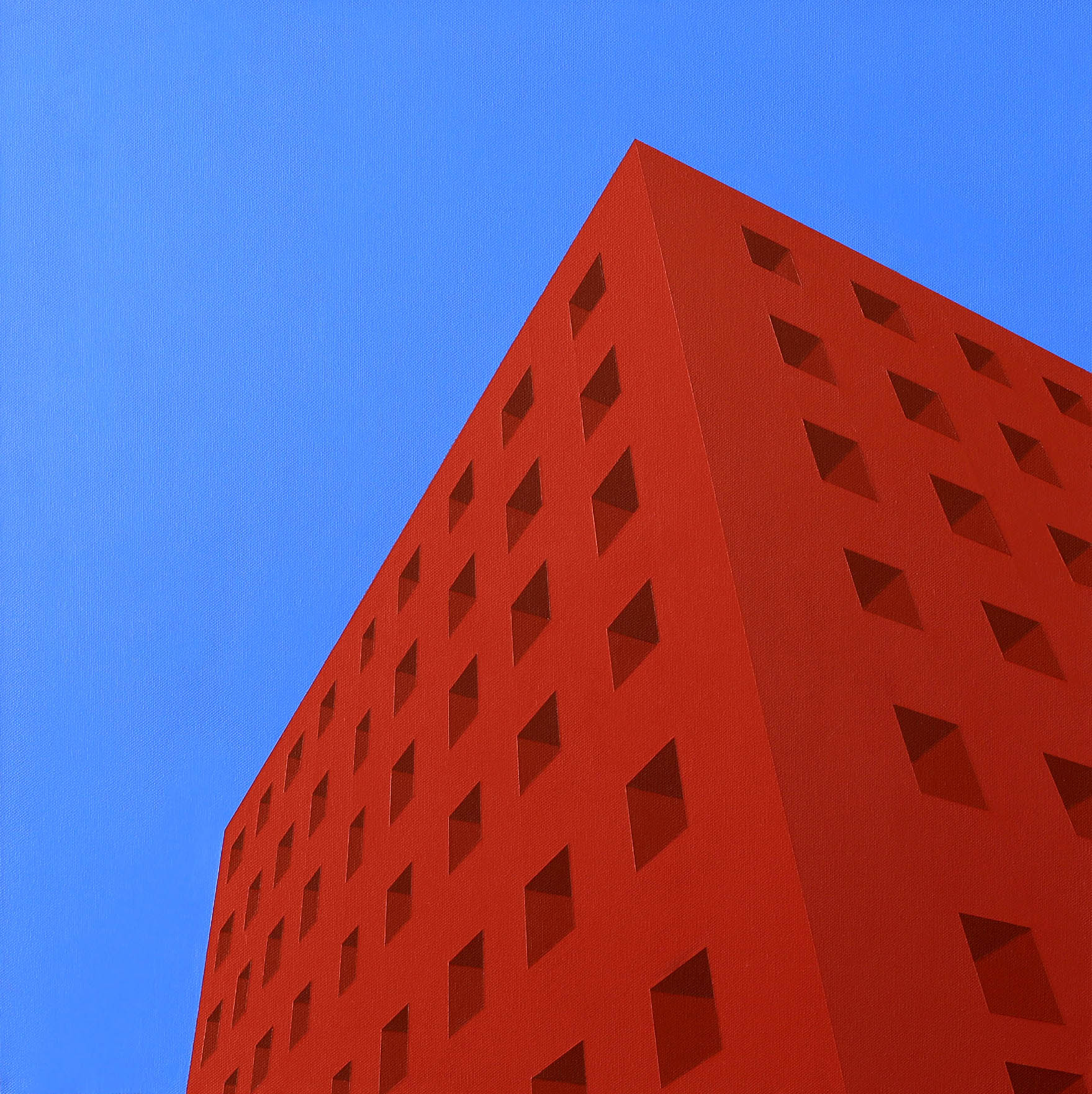
The second period could be called Tectonic Exploration, in which, using certain resources already present in Eterno Rojo, I explored new subjects capable of responding to the same precepts. The third phase, which I call Chromatic Studies, involved exploring colour as a determining compositional element, assessing whether it could sustain the structure of the work on its own. The fourth period is what I call the Revelation of White, when I realised that the contrast of titanium white against blue functioned compositionally in an exceptional way and evoked memories, providing me with a sense of calm and emotional fullness. I understood that, regardless of the subject, the combination of these two colours yielded deeply satisfying results. Finally, after the Revelación del blanco, came what could be defined as the Blue Eureka, when I decided to unify my blues and adopt ultramarine as the identifying colour of my work.
And which phase are you in now?
I am currently seeking a greater degree of compositional abstraction, eliminating, as far as possible, any obvious trace of architectural representation, while preserving the tectonic aspects that have accompanied me since my original search and which remain essential to me.
Is there any biographical relationship with these pictorial phases?
I had never really thought about it in these terms, but analysing my trajectory retrospectively, I realise that there is indeed a biographical reflection in these changes. The Opera Prima phase, which begins with Eterno Rojo around 2005, marks the moment when I perceived that all my pictorial experiments—both my pre-university training and those of the following decade—crystallised into a concrete vision. It was as if the path suddenly became clear. This period coincided with my establishment as an architect and with the need for an experimental pictorial search that would complement my architectural work.
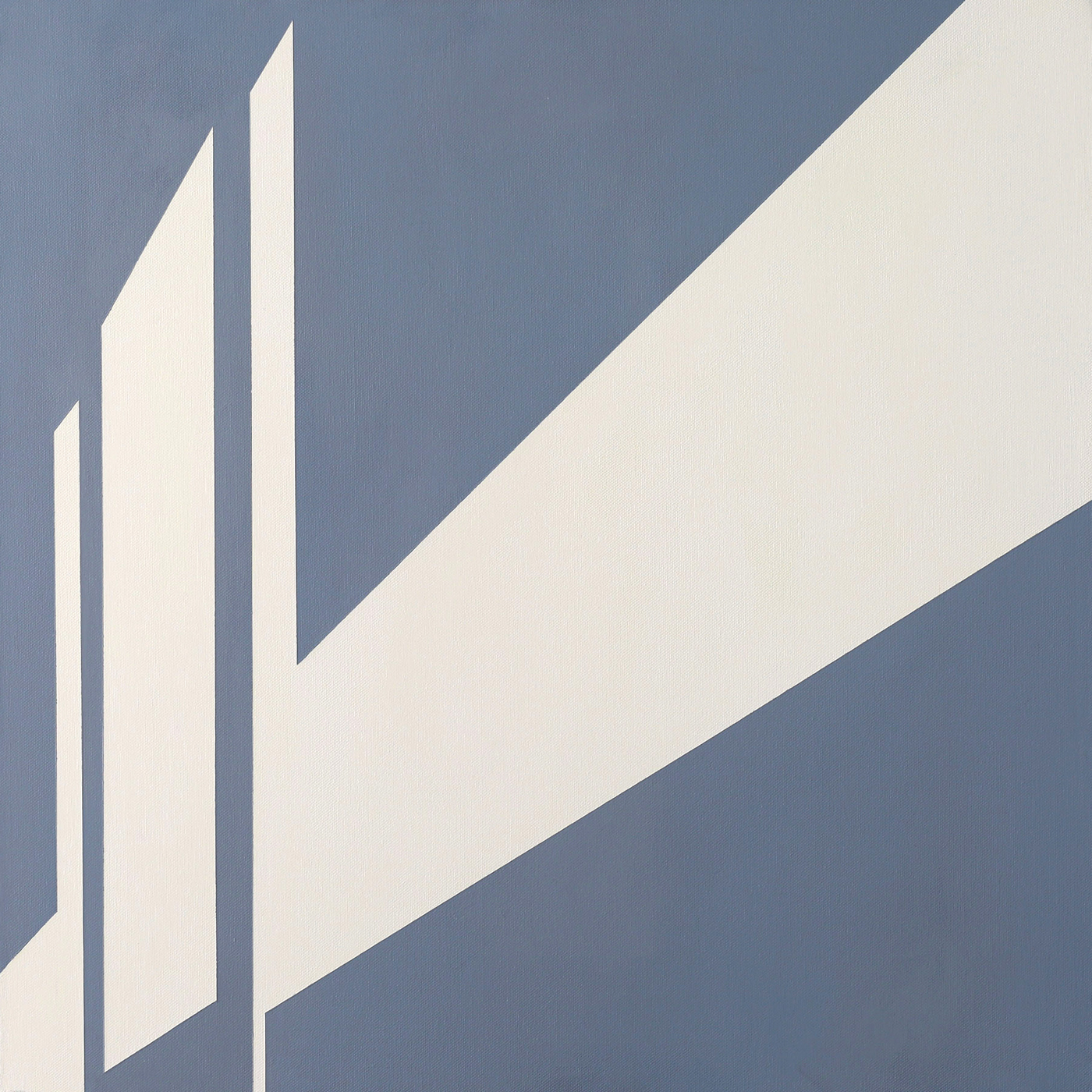
The second phase, Chromatic Studies, begins in 2007 after I was invited to participate in an exhibition at the College of Architects of Valencia. At that time, I was seeking to understand the essence of Eterno Rojo and attempted to replicate its force through other works of a distinctly architectural character. This stage coincided with the major economic crisis and the scarcity of architectural commissions, which I compensated for with an intense pictorial activity.
During my stay in London between 2008 and 2010, I became interested in the chromatic aspects of my work, focusing my practice on them and attempting to give them greater prominence than the tectonic search. Upon returning to Valencia, I realised that this chromatic exploration was not entirely satisfactory, and I experienced the Revelation of White, a pictorial phase in total contrast with the previous one. I believe that this chromatic experimentation was influenced by the effervescence of the London art scene, and that upon returning to Spain I rediscovered the Mediterranean essence of my work, initiating a process of purification that ultimately led me to white.
At the end of 2013, the sudden death of my father was a traumatic event and marked what I call the Blue Eureka. The day of his death was a splendid, sunny autumn day—one of those typical days in Puglia with an intensely blue sky—so evocative that I understood my pictorial search had to delve deeper into blue. It was then that I discovered the ultramarine lapis lazuli that has accompanied me ever since.

The final phase, in which I currently find myself, is fundamentally reductionist: I seek to simplify the compositional elements of my works. Biographically, this stage begins with a profound emotional change, following the divorce from my long-term partner and the beginning of a new relationship with my current partner, while at the same time I start exhibiting internationally and establishing contact with groups of Parisian abstract artists.

You define your painting as geometric abstraction, yet it seems quite different from what is traditionally understood as such. I am thinking, for instance, of the MADI movement, which you have mentioned on several occasions.
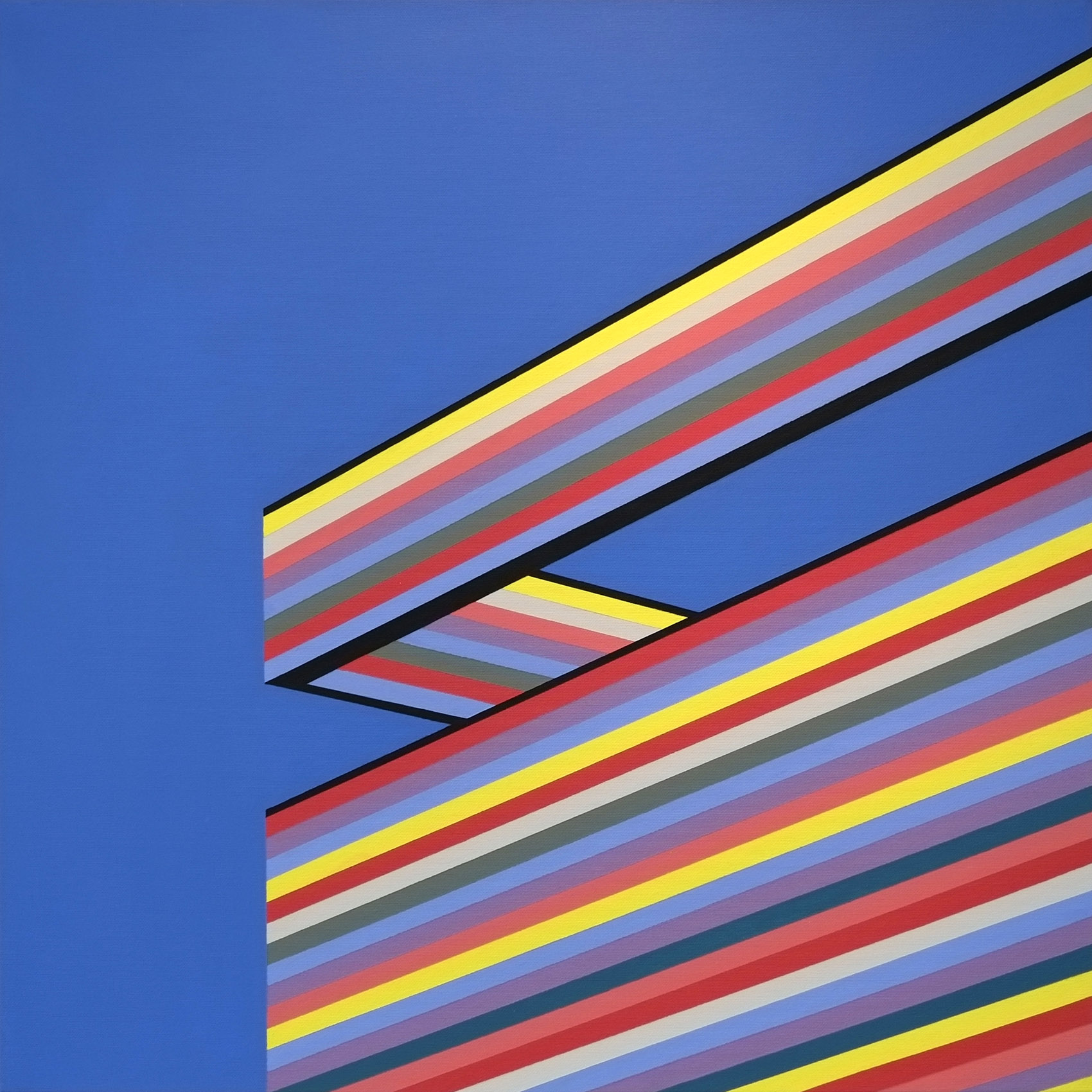
The painting I make is, for me, pure geometric abstraction. Although I always start from a concrete physical reality, the subjects that inspire me are themselves abstractions of pictorial works. It is a round trip, a back-and-forth process, in which I progressively strip away the superfluous so that the essential may emerge: the play of forms and colours, their relationships, their proportions. As you can see, it is an abstraction of an abstraction; everything else is secondary.
The perception of a certain architectural volumetry is merely a superficial reading of the work, a visual device that allows the viewer to connect through familiarity and compositional recognisability. Proof of this is that my work has been included in collective exhibitions of geometric abstraction alongside exponents of the Italian MADI Movement, with the group Art Construit International, and in the prestigious Parisian salon Réalités Nouvelles.
The historic Salon Réalités Nouvelles is undoubtedly a benchmark for abstraction worldwide. It cannot have been easy to be admitted. How did you come into contact with them, and what can you tell us about how it operates?
Exhibiting at the Salon Réalités Nouvelles is a fundamental milestone for any serious geometric artist. Taking part in it was indeed a real challenge. Over more than seventy years of history, artists such as Albers, Delaunay, Van Doesburg, Duchamp, Kandinsky, Klein, Mondrian, Moholy-Nagy, Morellet, Picasso, Poliakoff, Rotella, Schwitters, Vasarely, and the Spanish artist Eusebio Sempere, among many others, have exhibited there. As you can imagine, the responsibility was immense. It was not easy: after applying unsuccessfully for two consecutive years, my application was finally accepted on the third attempt.
The Salon takes place over three days, bringing together artists from across the globe and the finest of the international abstract scene. For me, it was a profound experience to meet in person and exhibit alongside so many veteran artists, some of advanced age and many of them great inspirations to my own work.
At Réalités Nouvelles, one realises that geometric abstraction is a collective art, constantly being rethought, which historically maintains its relevance and strength.
You are one of the few foreign artists to have exhibited at the historic Colegio de España in Paris. How did this come about, and what memories do you have of the experience?
All my monographic exhibitions have resulted from open public competitions, and the exhibition at the Colegio de España was one of them. When I learned of the possibility of applying, I did not hesitate for a second, as I was already aware of the relevance this institution has had for many Spanish artists based in Paris. Many Spanish artists have passed through there, whether as residents or simply to exhibit, including a great many of the geometricists I admire. The list is extensive, but I would mention some of the most significant: Sempere, Victoria, Palazuelo, Oteiza, Chillida, Picasso, Juan Gris, Miró, Dalí or Julio González, among others.
I must say that I received the news of my selection with surprise, and I was immensely pleased that the jury recognised that my work is fully Spanish, conceived and produced entirely in Spain, and that my origin was not an obstacle to including my name among the artists worthy of this recognition.
I will never forget the emotion I felt during the entire week I spent as a guest in such an international environment as the Cité Universitaire, within an institution so charged with history and artistic vicissitudes as the Colegio de España. Receiving the College’s medal, a work by the great Jorge Oteiza, was probably one of the most moving moments of my artistic career.
Here in Spain you have held important retrospective exhibitions, such as those at CEART in Fuenlabrada, the Paraninfo of the University of Murcia, the Museo del Mar in Santa Pola, or the Museo del Cable in Jávea. How did these come about, and what do you remember of them?
As I mentioned earlier, all of them were made possible thanks to open public competitions, in which I was awarded the organisation of each exhibition. I believe that this type of competition should be far more frequent: it seems to me a very democratic and direct way of assessing the artistic quality of a proposal. For example, knowing that an artist of the stature of Okuda was on the jury that selected me for CEART, or that Juan Manuel Bonet was part of the jury at the Colegio de España, is extremely motivating and allows figures you admire to recognise your work in a direct way.
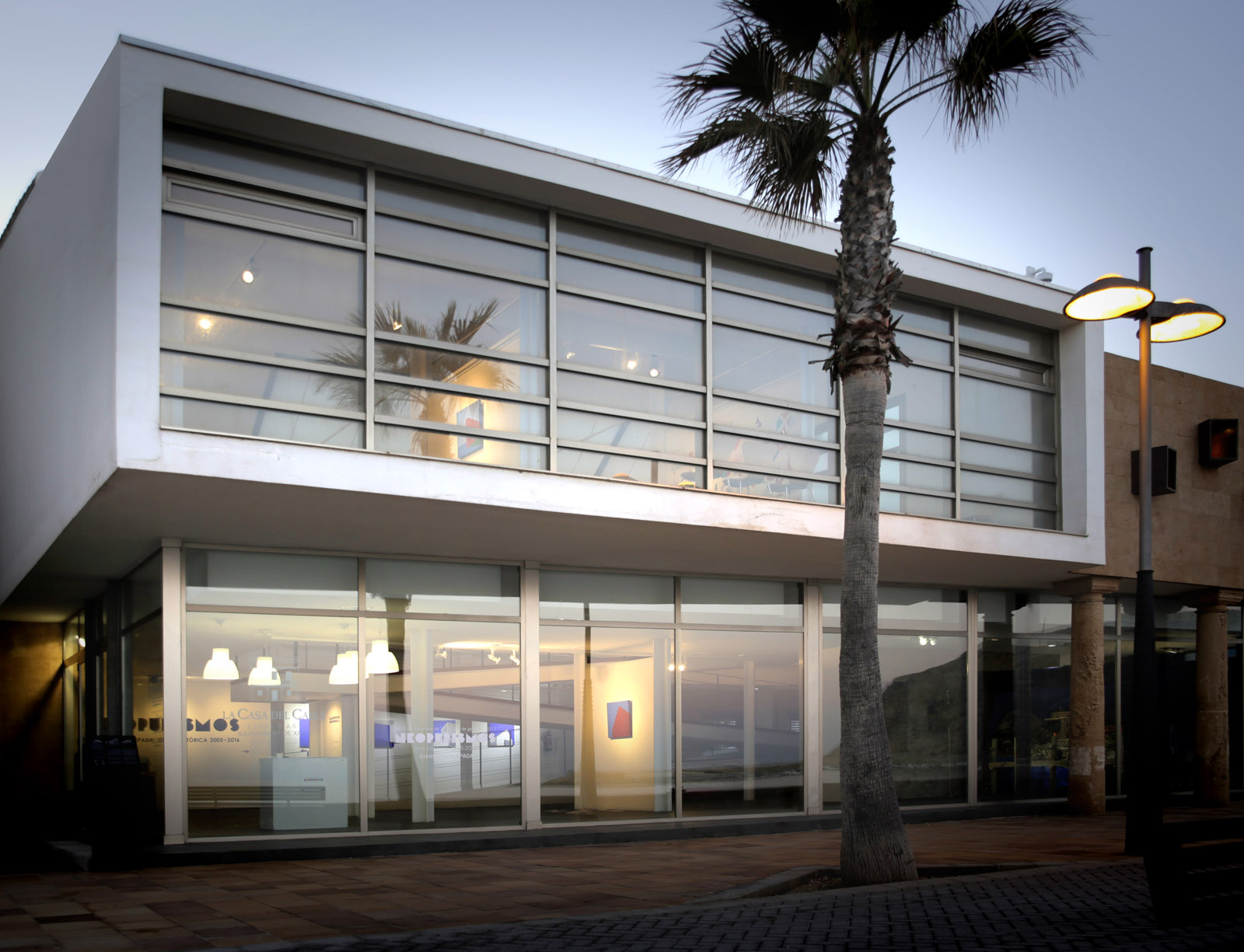
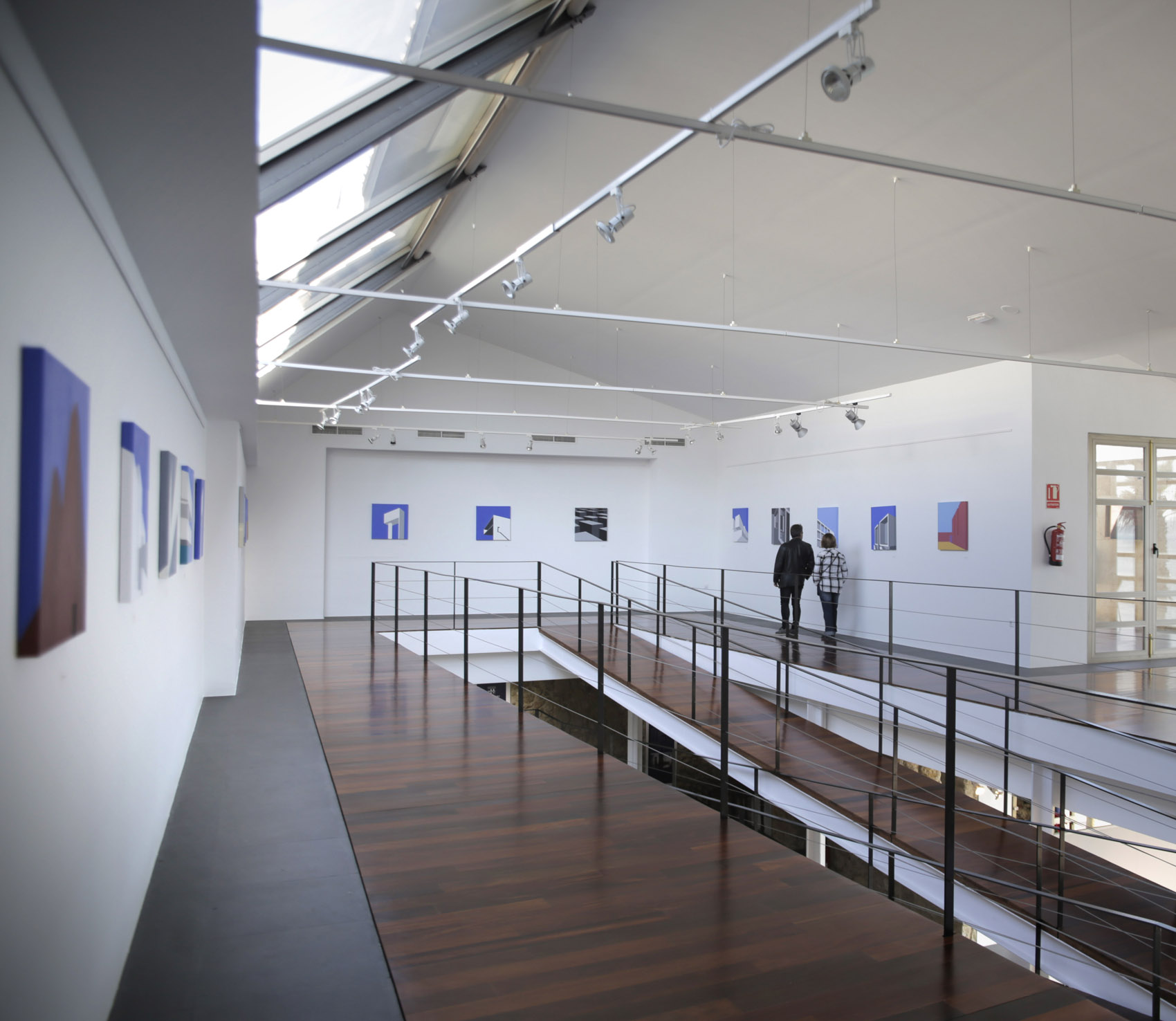
I hold very fond memories of all these exhibitions. Presenting a monographic exhibition in institutions of this kind is always deeply moving. For an artist like myself, who has a certain reticence about showing his work, these experiences are emotionally intense: it is like undressing in public, leaving the cave and confronting the audience. The logistics of such exhibitions are also complex, and installation is a delicate and often stressful moment, although museums usually have teams that assist in many aspects.
From these experiences, I also take with me the pleasure of having met outstanding professionals such as Juan Carlos Moya at CEART, or María José Cerdá-Bartoloméu at the Museo del Mar in Santa Pola—individuals who are extraordinarily dedicated and deeply committed to organisational work.

Where would you like to exhibit but have not yet had the opportunity to do so?
It is difficult to answer, because there are many places where I would like to exhibit. In Spain, I think of museums with a special focus on geometric abstraction, such as the Museo Salvador Victoria in Rubielos de Mora—a little-known gem—or the Museo Sobrino in Guadalajara, and of course Valencia, the city where I have yet to hold a major exhibition. In Italy, due to my connection with Sardinia, I would mention the Museo Nivola or the Galleria Comunale di Cagliari, which I believe would be ideal settings for my work. I would also love to exhibit in all the cities where I have lived: Bari, Venice, Brussels, Barcelona or London.
This question, however, reminds me of the concept of antibiography or anti-curriculum, which I often reflect upon. I have always liked the idea of writing an anti-curriculum listing all the things I have not done, the places where I have not lived… and this question about where I would like to exhibit could be an entry in that catalogue of still-unfulfilled desires.
Your pictorial trajectory seems to maintain a thematic continuity without major changes or evolution. What is this due to?
I have never believed in obligatory pictorial evolution. There are artists who undergo radical changes throughout their artistic lives, and often more value has been attributed to this than it truly deserves. For artists like myself, who have a very clear sense of direction resulting from a rational approach to pictorial problems, evolution is minimal and only appreciable through a careful analysis of the work. Of course, evolution is inevitable: the years pass and concerns change, but the premises remain, and in my case I still consider them fully valid.
Could this be related to your limited output?
No, I do not think so. On the contrary, when production is limited, as in my case, changes should be more noticeable, more visible. In the case of prolific painters, evolution and so-called periods are almost inevitable, as they are often compulsive artists, logorrheic with the brush, attempting to say everything in every possible way. Very few manage to transcend that condition and reach a level of lasting interest; Picasso was one of them.
Do you therefore advocate a more limited but more considered production?
Only around fifteen paintings by Leonardo are known, about thirty-four by Vermeer, some twenty-five by Bosch, and around fifty by Seurat. Reaching Picasso’s nineteen hundred or Renoir’s four thousand is, of course, an enormous leap. Yes, I do advocate a slow, considered production, which has nothing to do with the style or technique employed. Pollock, whose work appears to be executed rapidly, produced around three hundred and sixty works.
In my case, in truth, I have made only one work: a single piece, which for me is my revelatory and magnum work, Eterno Rojo from 2005. All my subsequent works have been an attempt to understand it and, at the same time, to reveal the inexplicable eureka I experienced with that painting.
How do you reconcile such a limited production with the issue of sales?
In reality, my pictorial production is not commercial in nature; I am exclusively interested in the artistic aspect of creation. I have sold only a few works to collectors specialised in geometric abstraction and to some institutions, which is where I most like my paintings to be, so that they can be enjoyed by a wider audience. I am far more interested in exhibiting than in selling; my vocation is more divulgative than commercial. Selling, in a sense, limits the dissemination of a work. I understand sales when they serve as a vehicle for a work to enter public or private collections with an exhibition-oriented vocation, or at least highly specific thematic holdings.
The commercial question in art has always interested me, and I believe that in order to create with total freedom, an artist cannot depend on the sale of his works. Duchamp made this very clear in an interview: at a certain point in his life he decided not to depend on painting as a means of livelihood and sought a job that would allow him free time to paint solely for himself—for instance, working as a bookseller in Paris. He sought to preserve his artistic autonomy, to paint for his own satisfaction and not to please others. For him—and I fully agree—there are two types of artists: those integrated into society and those who are completely free and do not depend on it in order to create.
Do you not think that by not actively participating in the art market your work may be less valued, or at least not achieve a strong market valuation?
The value of a work often has very little to do with its market price. We are all familiar with the more or less legitimate mechanisms used to inflate an artist’s valuation. It is a matter that does not concern me in the least. There are many cases of artists who sold little or nothing: Van Gogh is a well-known example, or the Cuban artist Carmen Herrera, a pioneer of geometric abstraction, who sold her first work at the age of ninety-eight after an extraordinary artistic career.
As I have said, sales are not a priority for me. In fact, had they been, I would probably have produced more commercial works—different formats, sizes, chromatic ranges and subjects. The freedom afforded by conceiving a work without commercial intent is a feeling I cannot renounce. I do not paint in order to be an artist; I paint for the simple act of painting. It is a form of meditation. Painting is a way of speaking, and a work says much about its author, but I do not like to expose myself excessively; I have a certain modesty and a strong concern for my privacy.
Moreover, in this era—when artists hungry for fame obsessively publish each and every one of their works on social media, documenting before, during and after the creative process in a kind of self-indulgent visual orgy—I prefer another path. I feel closer to writers who dedicate their lives to creating without concern for publication: Salinger, for example, published a single book, a bestseller, and then continued writing without publishing anything else during his lifetime.
Ultimately, I do not paint in order to appear, nor do I care about the logic of market valuation; I am pleased to be, as I sometimes joke, a famous painter even if no one knows it.
Returning to your work, it seems difficult to trace direct references to the artists you cite as influences, such as Mondrian, Warhol or Picasso. In what way do they remain present in your work?
My interest in these artists, and in many others, is far more complex. In a sense, I feel that all of them have influenced what ultimately becomes my own artistic production, but this influence goes far beyond evident formal or visual aspects. What has most interested me about these artists is their way of approaching the problems of art and how these were shaped by their respective biographies.
Conversely, in an inverse process, for some years now I have continued to encounter references and works previously unknown to me that may indeed have a relationship with my own. This is a line of research I pursue through Geometricae magazine, where I constantly seek historical references that reaffirm my pictorial postulates. It is astonishing to see the number of works I have discovered that could be considered direct references for my own pieces.
I do not intend to claim any form of genius with this—quite the opposite. My intention is to demystify the creative aura that artists often attribute to themselves and to recall that abstract art is a collective process with deep roots, and that genius, as such, does not exist: all creation is the result of continuous evolution.
When you say that abstract art is a collective process, what do you mean?
For me, abstract art is a form of collective expression in which all artists working within this current participate in a shared search through a common language—one that has now been evolving for over a hundred years since its beginnings. Unlike figuration or other artistic currents, geometric abstraction, in not wishing to express anything beyond what is expressed through its compositions of forms and colours, is a type of art that I like to imagine as anonymous. There are many geometric works of extremely high value whose authorship is difficult to determine, as they could have been made by different artists within this tradition. This does not mean that there are no works with more personal or recognisable traits—recognisability is often inevitable—but it is not what is sought in this type of art.

Gianfranco Spada with the painter Volkan Diyaroglu, during his studio relocation, 2020.
Do you think people understand abstract art?
Nations, money and religions are abstract concepts that are universally accepted, even though many people do not truly understand their mechanisms or real meanings; they are concepts we have created to respond to our needs. Flags are the ultimate expression of this abstraction and are, for the most part, geometric compositions. Abstraction in art responds to a worldview that does not need to pass through the figuration of reality and forms a fundamental part of our spiritual relationship with the universe. One does not need to resort to Kant to understand that seeking the real or the figurative in a painting is a simplistic rational process, an ancestral neural pattern that helped our ancestors recognise the dangers around them. It is similar to the way, as children, we look for zoomorphic shapes in clouds: an atavistic, natural reaction that, once understood, does not prevent us from appreciating the metaphysics of a non-figurative composition.
Have you ever gone through a period in which you questioned abstraction?
No, never; I have never felt that way. My vision of abstraction is not dogmatic nor a creed, but rather a way of thinking and of being. I could hardly stop thinking abstractly in the way I do. This does not mean that I ignore figuration or other types of art, which I find interesting; however, geometric abstraction devoid of historical knowledge and based on conceptual ignorance holds absolutely no interest for me.

Gianfranco Spada | Kunstoff Konzept | Acrylic on canvas | 60×60 cm | 2019.
Your works seem to have a framing and a composition reminiscent of photography. Is this part of your research?
I have often thought of my paintings as painted photographs, and photography is undoubtedly a fundamental part of my creative process. For each work I use photographs that I find online, trying to gather as many images as possible of the same subject, and then I draw my own perspective using vanishing points similar to those found in photography. During my years as a student I was very focused on architectural photography; I remember the many journeys with my favourite cameras: first a 1972 Nikormat, then a small and very robust Soviet LOMO that I won in one of the legendary lomography contests in Brussels, and finally a Hasselblad, whose low viewpoint reminded me of a child’s vision, with its square format that still influences my paintings today.
And despite your interest in photography, you do not use your own photographs for your paintings?
I broke with photography in a traumatic way at the beginning of the new millennium, almost premonitory. I sensed that with the advent of digital cameras, photography would become a mass language, increasingly trivialised. Then, suddenly, my suitcase containing all my cameras was stolen on a train to Naples. It was devastating, like physically losing extensions of my own body, along with all the memories attached to those machines with which I identified myself. At that moment I decided that I would never take photographs again…
From what you describe, there seems to be a common denominator in all facets of your artistic search: mixing, reusing and reinterpreting. Is that how you conceive it?
Yes, in a certain sense, creation is reinterpretation. I do not believe in the genial creator who pulls from his hat the ultimate novelty that revolutionises art. Some artists are obsessed with hiding their sources, anxious to demonstrate their originality, but they forget that “original” means precisely returning to the origins. This can only be achieved by reinterpreting and reworking what has already been done, and only by knowing that path beforehand; otherwise, one risks walking the same steps again, something I see increasingly in recent artistic production, with ignorant dilettantes hailed as geniuses.
All my paintings are, in one way or another, homages to other artists and architects; sometimes the homage is evident, and at other times so subtle that only a few can recognise it. My intention is to speak both to the viewer who remains on the compositional surface of the work and to the cultured viewer who identifies the reference, understands its reason and knows how to contextualise it within a broader framework. As Picasso, Stravinsky, Eliot or Faulkner said: “bad artists copy, good artists steal”, and this has been evident from Mozart in music to Picasso himself in art.
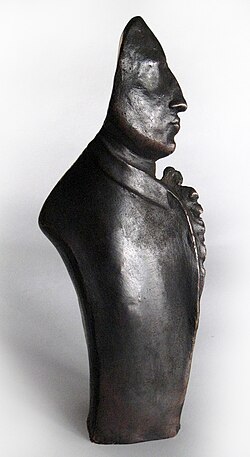
Statuette of the Traetta Prize, by sculptor Francisco Berdonces, 2015.
Speaking of Mozart, you have spent more than fifteen years working on the recovery of the figure of the composer Tommaso Traetta, organising a festival and awarding a prize in his name. What drives you in this endeavour?
Since childhood I have been fascinated by Traetta, whose statue presided over the square of my hometown. Later, in Venice, I discovered his tomb and recordings of his operas, and I understood the need to study and disseminate his legacy. After decades of research and travel through key cities in his career, I was able to reconstruct his role as a precursor in the transition from Baroque to Classicism and Romanticism, positioning him against his unjust neglect by German historiography. In 2008 I founded the Traetta Society in London, which organises Traetta Week and annually awards the Traetta Prize to those who contribute to keeping the legacy of historic European composers alive. This work reflects my deep respect for those who preserve musical history and my conviction that recognising others is, at the same time, a way of recognising oneself.
You say that your main commitment is to keep alive the historical legacy of our predecessors. Does this also apply to your artistic practice?
Absolutely. In everything I do — commemorating Traetta, the magazine Geometricae, my buildings as an architect or my paintings — I do nothing other than pay tribute to those who came before us. And this can only be achieved by studying them, trying to understand them, remembering them and honouring them.
In my paintings, for example, one can trace a hundred years of avant-garde art: the abstraction of Malevich, the purist essence of Ozenfant, the metaphysics of De Chirico, the minimalism of Donald Judd, to name just a few; but in reality the references are virtually endless.
You speak of the avant-gardes, and I sense that they interest you greatly. Is your work avant-garde?
No, quite the opposite. The avant-gardes of the Novecento ended with Punk and Situationism, the last avant-garde movements I recognise. Of course, I am fascinated by the creators of the avant-gardes, and I see a direct thread connecting Traetta, Malevich, Mondrian, Le Corbusier, Terragni, and so on; but my work is a synthesis of all this: it is not a continuation, it is a closure. The avant-gardes no longer exist; everything is more liquid, fluid and dematerialised, and those who define themselves as avant-garde do so out of complete ignorance of what the avant-gardes actually were. The word “avant-garde”, like “genius”, has been entirely trivialised and has lost its original meaning. Many contemporary artists labelled as avant-garde, genius or innovative do nothing more than tread the same paths already travelled throughout the twentieth century. Sometimes I think about it and I like to see myself as the last representative of the twentieth-century avant-gardes, whose legacy I try to defend and preserve.
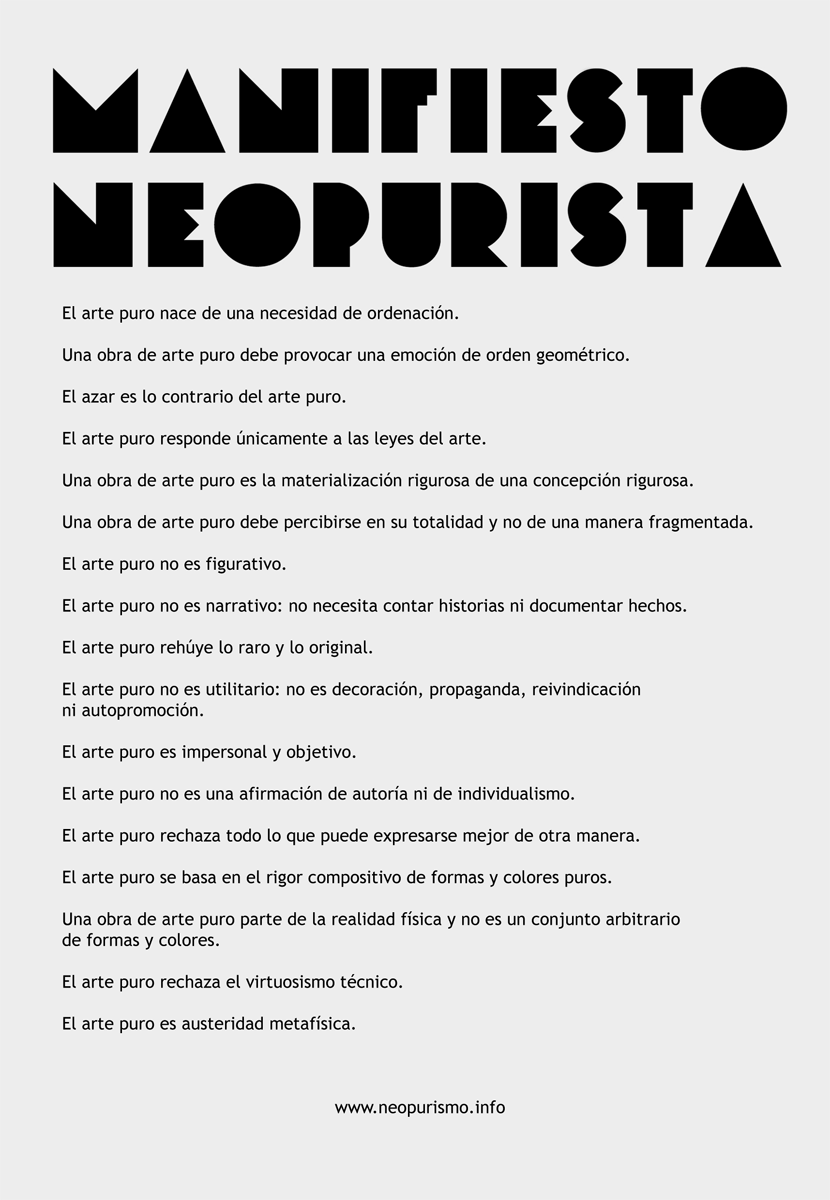
Gianfranco Spada | Manifiesto Neopurista | Valencia, Spain, 2015.
Would this explain your Manifiesto Neopurista?
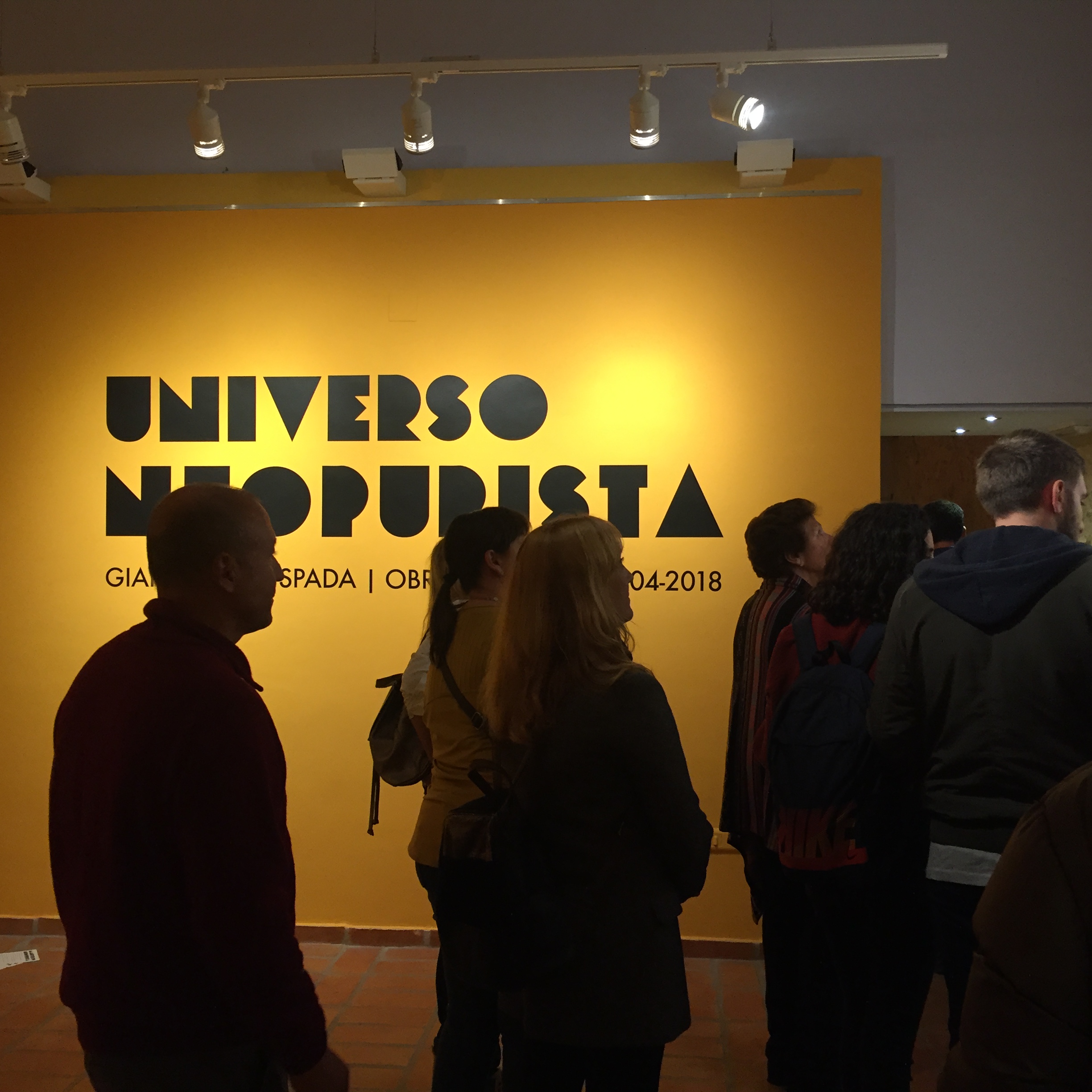
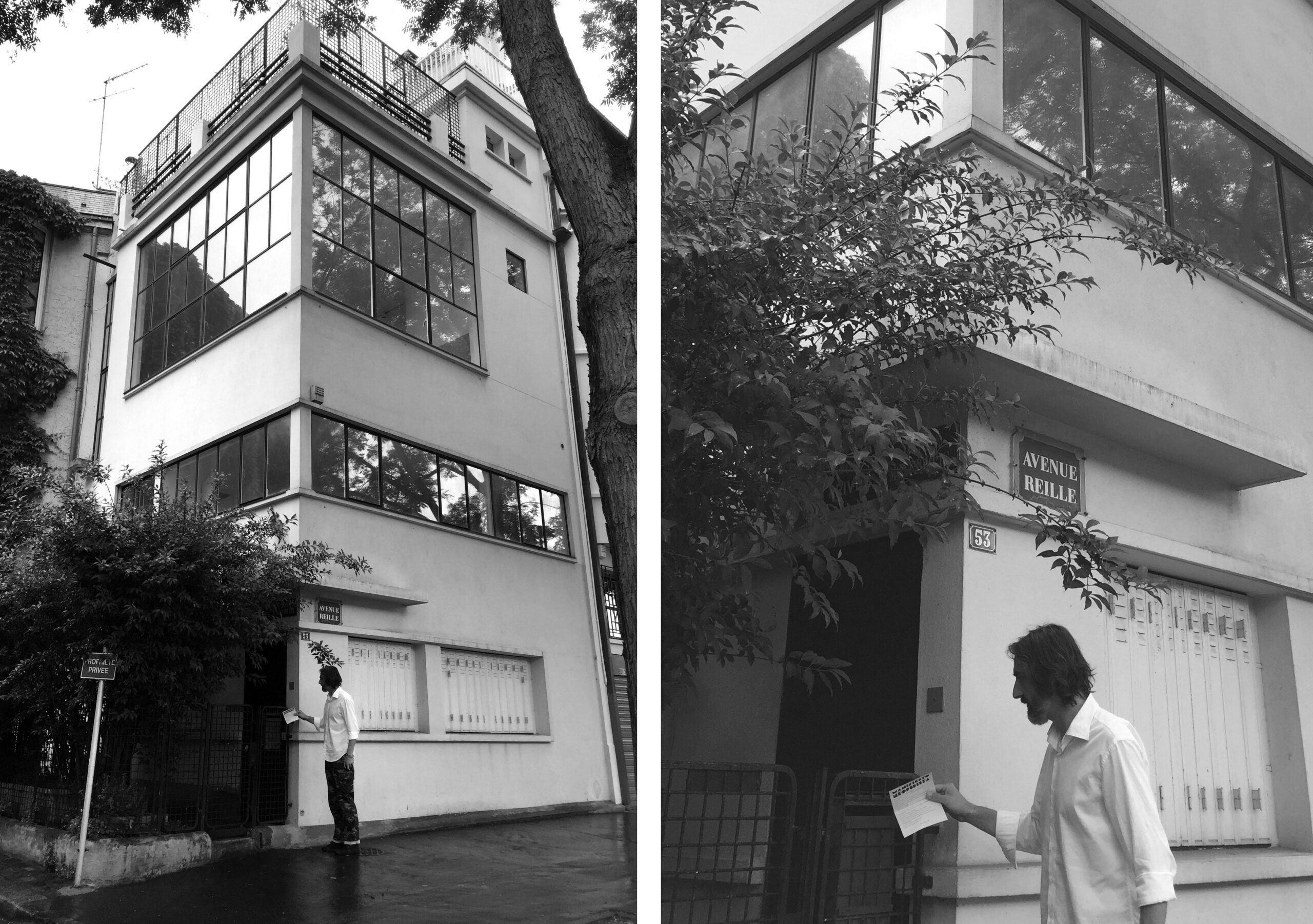
Yes, absolutely. I launched the Manifiesto Neopurista in 2015, ten years ago, and it was quite a provocation, because evidently we are not in an era of manifestos: nowadays many artists want to express themselves solely through their work, whereas Neopurism advocates quite the opposite. It was fun to distribute the leaflets at the openings; the public loved it, both as an artistic statement and as a nostalgic reminder of the performances of the historical avant-gardes. I believe many understood the irony and, at the same time, the historicist nod to those earlier actions. Behind it all is also my defence of art conscious of its own tradition and the artist’s role within it.

So, do you advocate for a humanist artist with broad knowledge?
Well, I would be satisfied with an artist who knows precisely the historical moment we are living in and who is conscious of the historical legacy that precedes us. It is not necessary to be a humanist; Caravaggio, for example, was not the prototype of a cultivated man: he was a quarrelsome libertine, but very intelligent and knew perfectly well the principles on which to base his pictorial proposal.
T. S. Eliot, speaking of literature, says that the creator, when beginning a new work, bears upon themselves the weight and wisdom of all previous works, and that upon completion the history is altered by this work, changing the previous perspective. The same happens in art.

Gianfranco Spada | Enigma Vacio Opus II | Acrylic on canvas | 60×60 cm | 2018.
In an article I published last February, I discussed the tectonic in art and described your work and that of other contemporary artists as neo-tectonic. What did you think of that reading?
From the moment you proposed the article Tectonics in Art, I gave my approval for its publication in Geometricae. On one hand, it seemed very well articulated; on the other, it obviously spoke of my work, and I fully recognise myself in what you wrote, especially in the definition of neo-tectonic, which actually describes my work better than neopurista, since, as I mentioned, the latter was a provocation — serious, but still a provocation. The article has had great impact both within the magazine and personally: we have received many congratulations, and many of the artists mentioned seem to have already adopted the term neo-tectonic as a standard way of referring to their own work.
How important is your artist’s atelier to you?
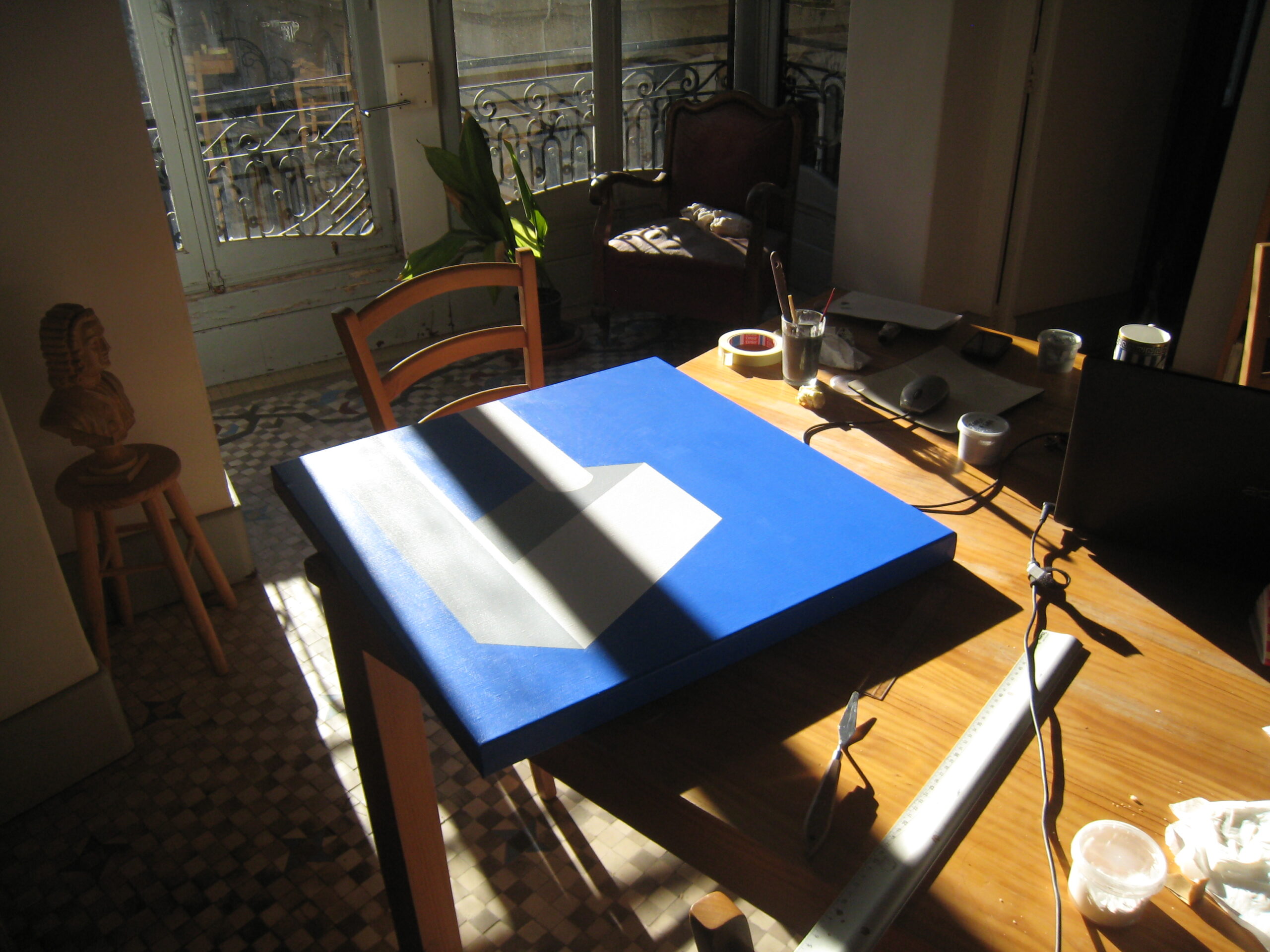
My atelier is very domestic; the core of my creativity, both as an architect and a painter, is an enormous custom-made wooden table, inspired by the great tailor’s tables of my family, especially those of my uncle with his renowned tailoring workshop. To create, I need nothing more than my table and my books: I do not require large spaces or many resources. Painting for me is like cooking: a domestic, private, intimate, genuine, direct and deliberate act, without tricks or ostentation. I have always been fascinated by artists’ ateliers, places where their personality is revealed; I am a great collector of photographs of these spaces, and with a single image I can imagine the kind of art created there. I am particularly interested in the evolution of ateliers throughout the twentieth century: some, like Francis Bacon’s, become dumping grounds; others, like Magritte’s, remain small and domestic, and their works function as windows to the world.
You mentioned cooking earlier — it seems to hold some importance for you?
Yes, it is fundamental to my creative process, both as an architect and a painter. Gastronomy is a form of alchemy that connects us directly to our past. I have researched extensively the relationship between artistic creation and gastronomy, how artists and architects approach this primary need, and how it can be reflected in their work. It is a fascinating subject; there has even been a fake cookbook attributed to Leonardo da Vinci, demonstrating the interest and attention this link between art and cuisine generates.
Do you then believe that cooking is art and chefs are artists?
Despite many points of contact between cooking and art, and the temptation to equate them, for me cooking is not art in itself. Likewise, not everything recognised as art is necessarily so. This does not prevent there being chefs who are true artists, just as there are artists who are excellent cooks. Art is created by artists: being an artist is a state of being, not simply an activity. Painting a canvas does not automatically make one an artist, nor does cooking well automatically constitute art.
How do your artistic concerns influence your work as an architect?
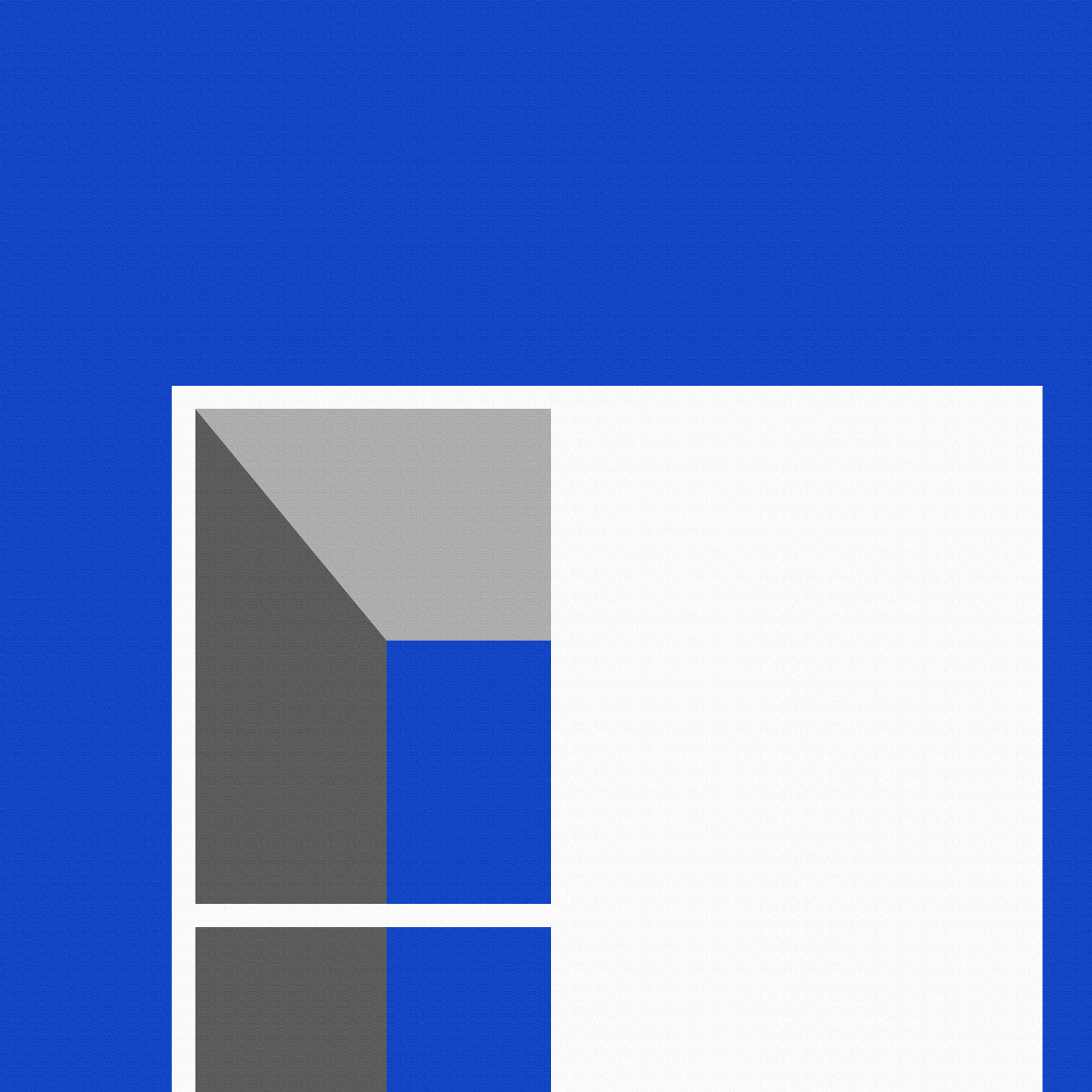
For me, the artistic search is a fundamental part of my architectural quest; there is no distinction between them, they are completely complementary. I do not understand architecture without a plastic vision and without addressing functional problems from an aesthetic point of view. Many forget that to firmitas and utilitas should follow venustas, beauty, that magical ingredient that transforms a mere construction into architecture. Art constantly reminds me that without beauty there is no possible path, and that beauty is not fulfilling a checklist with trendy ingredients: it is timeless, inscrutable, inexplicable, and unfathomable. True beauty reaches directly to the soul, generating a powerful communication between creator and viewer, a meeting of sensibilities, a joy for the heart.
Beauty in art seems more evident than in architecture; art enjoys a greater degree of freedom, and that is why I develop my plastic experimentation in painting, avoiding risks in architecture. A building does not rely solely on aesthetics: utility and durability are often valued more highly than visual appeal. In many cases, impeccable aesthetics may conceal serious shortcomings in habitability or constructive wisdom. A simple browse through Instagram, among unbuildable renders and glamorous buildings, reveals the emptiness of many supposedly perfect aesthetic proposals.

Gianfranco Spada | Vivienda Entre Naranjos | Simat de la Valldigna | Spain | 2007
What artistic legacy have the cities you’ve lived in left you?
In Bitonto, where I spent my childhood and adolescence, my architectural vision matured: the white Romanesque cathedrals, the whitewashed buildings, and simultaneously the awakening of my artistic concerns in a very conformist society with a heavy historical weight on its shoulders.
Later, in Venice as a university student, I realized that I could never paint like Corot, laugh at art like Dalí, be a better architect than Palladio or Brunelleschi, build a structure superior to the Pantheon, be more surprising than Warhol, a better filmmaker than Kubrick, or a better photographer than Duane Michals. It was a period of discovering the incredible artistic production of humanity throughout history and understanding how difficult it would be to contribute something new; attempting it felt like an illusory game, a lost bet from the start. This became clear to me in the numerous art biennials I experienced, where I collaborated with small works as an assistant in exhibition setups. Many works were shown that, under conceptual pretexts and minor alterations, repeated experiences already presented in the past. It always seemed more like a fair of vanities and trivialities than a showcase of the excellence of the state of art.
Later, in Brussels, I realized that art is not “made”: one is either an artist or not. I believe Brussels has the highest number of artists in the world, but I repeat: I do not mean artists of doing, but of being. It is no coincidence that most of the geometric artists who interest me most are Belgian; something of the Flemish School is bound to have endured!
In Barcelona, on the contrary, I encountered imposture, a desire to appear as an artistic city, and the construction of an artistic imaginary promoted by public authorities with almost limitless funds. Barcelona boasts immense artistic creativity that, in reality, I did not find in the everyday Barcelonian, who has more of the soul of a small shopkeeper than that of an artist. On the other hand, one cannot deny the great commercial ability of the Catalans, who have placed artistic creativity at the service of industry, but this concerns me less.
In London, I noticed the residue of great personalities passing through this cosmopolitan city. Every respectable biography in the art world includes some parenthesis in London, a transient city where living as an artist is very difficult. London represents the rational aspect of art, pure market, the place where art is commercialized.
As for Paris, a city I have not lived in but frequently visit and which remains part of my anti-bibliography, I have learned the high value its citizens place on all things artistic: it is a matter of state, yet reflecting the citizenry rather than being imposed upon them.

Gianfranco Spada with art critic Juan Manuel Bonet, Valencia, 2018.
And finally, Valencia, a city from which I have learned little artistically, as the average Valencian shows limited interest in art. At the public level, there is confusion about the role they want art to play, as they do not handle it with fluency. In Valencia, if you repeatedly graffiti a stick figure or any pseudo-social or pseudo-conceptual nonsense on the streets, it is very likely you will end up exhibiting in museums. It is a shame, as Valencia in the 1980s and 1990s was a true cultural reference with the IVAM Museum of Modern Art, then still directed by the great Juan Manuel Bonet, with exhibitions worthy of international museums, from which I learned a lot, even if only through the catalogs.
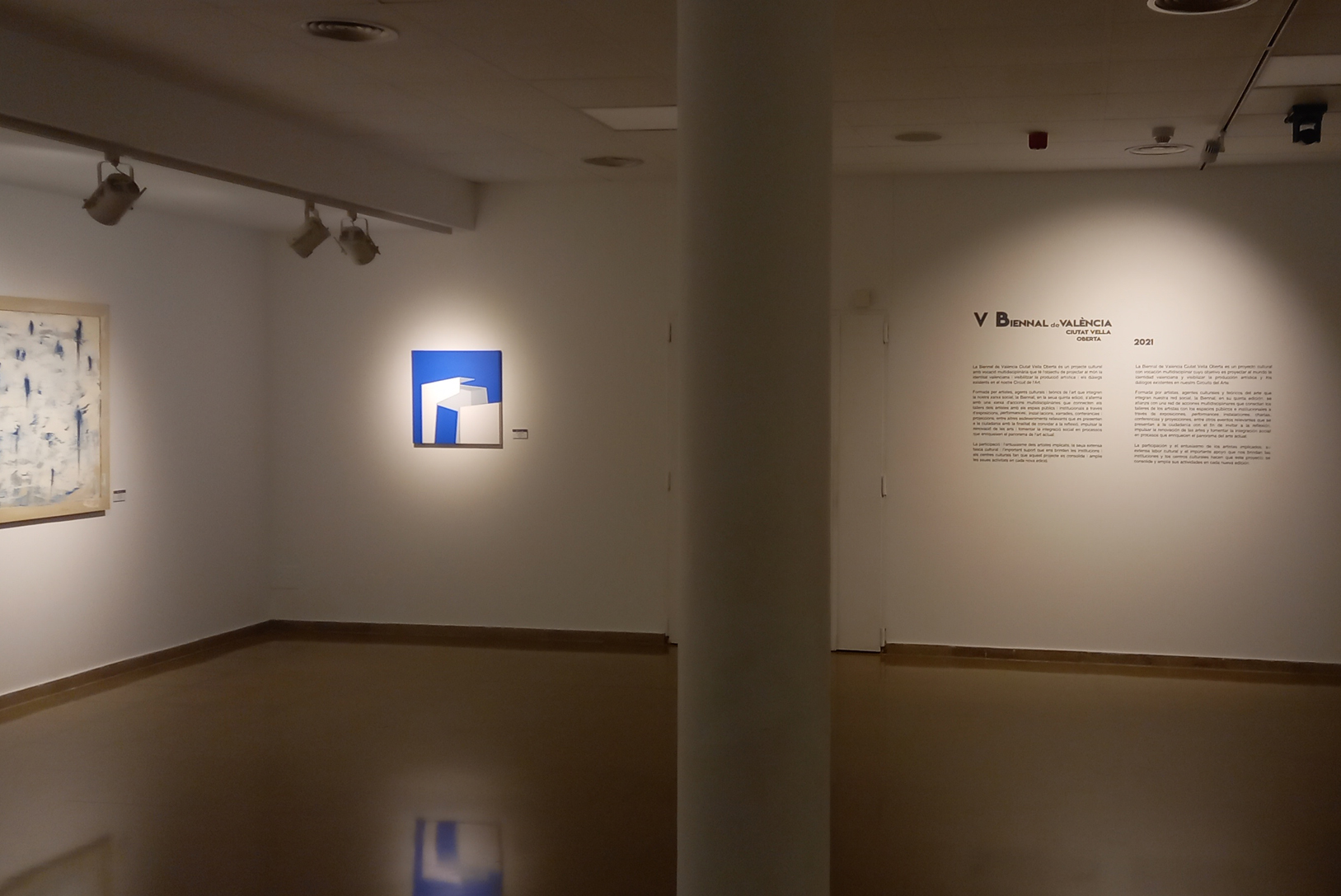
I see you are critical of street art?
Street art is a trap into which both artists and critics have fallen. I conceive street art only as a situationist, exclusively anonymous statement. Everything else is propaganda — personal, political, or social. Many artists have found, with the permissiveness of local politicians, if not direct financial support, a quick and direct way to self-promote. I have never tolerated the supposed rebelliousness attributed to street art, especially when it serves political power. Artists serving propaganda have caused much harm throughout history, regardless of their side. Art cannot be an urban imposition by compulsive artists trying, like stray cats, to mark territory and seek desperately an artistic self-affirmation they could not achieve otherwise. Politicians should not, with our taxes, fund the very art these artists are willing to offer for free; it is already hard enough to clean up the “brilliant works” they produce. Frankly, I am tired of seeing pseudo-artists continually shifting from revolutionary rebellion to total dependence on the commissions of politicians; it is utterly pathetic.

We cannot conclude this interview without asking about Geometricae, the magazine you founded, which is celebrating its tenth anniversary. What led you to create it and what is its mission?
My artistic search cannot be disconnected from the past nor ignore contemporary reality. Historically, artists formed groups, published magazines, and launched manifestos through them. My initiative follows this tradition: in a time of great individualism, I reclaim the intellectual aspect of creation, gathering artists around a shared medium that serves for information, communication, and deepening knowledge about the state of art, especially within their artistic current, without losing sight of the collective movement they belong to.
The mission of Geometricae is twofold: to be a platform for exploring the historical legacy of geometric abstraction, and at the same time, act as a scanner and amplifier of the current state of this movement.
From the overview provided by Geometricae, what is your opinion of the current state of geometric abstraction?
Geometry is undoubtedly more alive than ever; it is astonishing how many artists and followers constantly feed a stream of new creations on social media. Abstraction is a universal language appealing to the fundamental emotions of human beings and can be enjoyed by all audiences. The increase in production has led, correspondingly, to a proportional rise in the quality of proposals. Alongside a growing number of artists without solid foundations, fortunately there are many producing works of great validity and rigor.

Undoubtedly Geometricae is now a global reference for those interested in this artistic current. What projects do you have for the future?
Yes, the reception has been incredible; web statistics show a large readership, and we are also recognized at fairs and other events as a familiar reference. For the future, we aim to continue our current work, which is already significant considering it is self-funded and offered free of charge. We are actively seeking sponsors to improve quality, explore a print edition, and recently we began offering professional services to artists, collectors, and foundations to preserve their legacy and collections, leveraging our experience and network of expert collaborators. All of this is channeled through CIRCA, a research center on concrete art which, in addition to these services, offers a specialized library and works on creating the world’s largest archive of geometric abstract art, a legacy that would become one of the most significant of my passion for art.