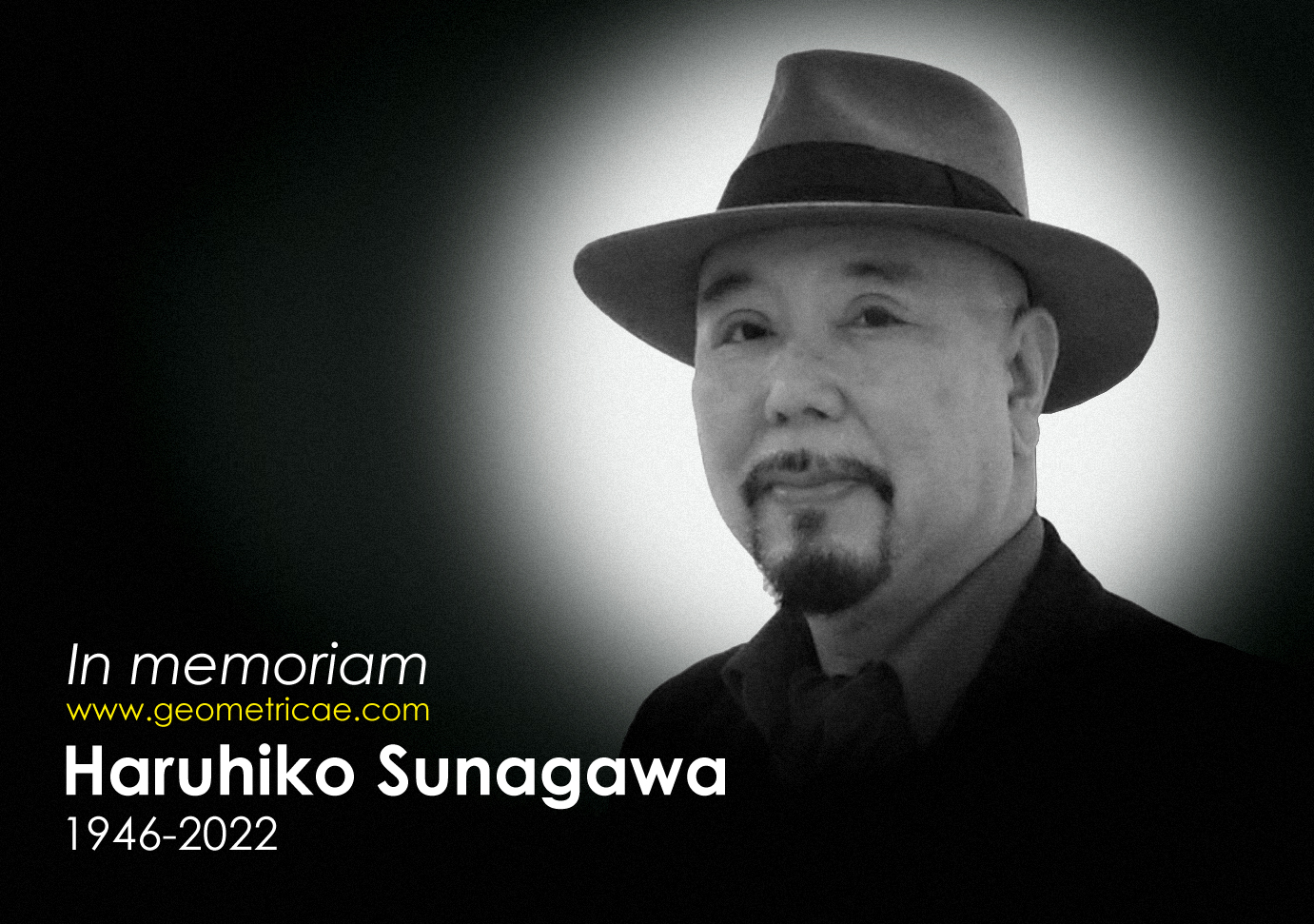
Haruhiko Sunagawa | Fukuoka | Japan | 1946-2022
Haruhiko Sunagawa develops a distinctive artistic practice at the intersection of geometry, spatial perception, and abstraction. He studies physics at the University of Sciences in Tokyo, gaining a foundation in analytical thinking, and later drawing and painting at Hammersmith College of Arts in London, integrating scientific rigor with visual exploration. Sunagawa’s work focuses on the representation of straight lines, points, and geometric shapes in space, where forms and planes interact to define, structure, and recreate empty space. He deliberately employs concepts that do not exist in nature, generating new spatial realities that are both abstract and perceptible. For Sunagawa, geometry etymologically means “measurement of the earth,” and he uses this principle to create compositions where measurement, proportion, and perception converge.
Throughout his career, Sunagawa participates in numerous solo and group exhibitions across Asia, Europe, and beyond, earning recognition for the clarity and inventiveness of his approach. He receives accolades such as the Bourdelle Sculpture Award in 1991, which highlights his contributions to sculptural abstraction. His installations, sculptures, and drawings engage viewers in active spatial dialogue, inviting reconsideration of line, form, and dimension. By experimenting with dots, lines, planar surfaces, and modular structures, he creates compositions where geometric elements function as tools to explore balance, rhythm, and spatial tension.
Sunagawa’s methodology emphasizes the idea of continuous variation: forms can be shifted, aligned, or recombined, producing perceptual effects that evolve with the viewer’s perspective. His work bridges the mathematical and the poetic, situating abstraction as a dynamic, living system that transforms the perception of space. Through these investigations, Sunagawa contributes to a broader discourse on geometric art, revealing the potential of line, plane, and space to construct entirely new visual and spatial experiences. His legacy resides not only in individual works but also in the ongoing influence of his ideas on contemporary geometric abstraction and spatial practice.