 17/5 – 21/9 2021
Durban Segnini Gallery | Miami | Florida
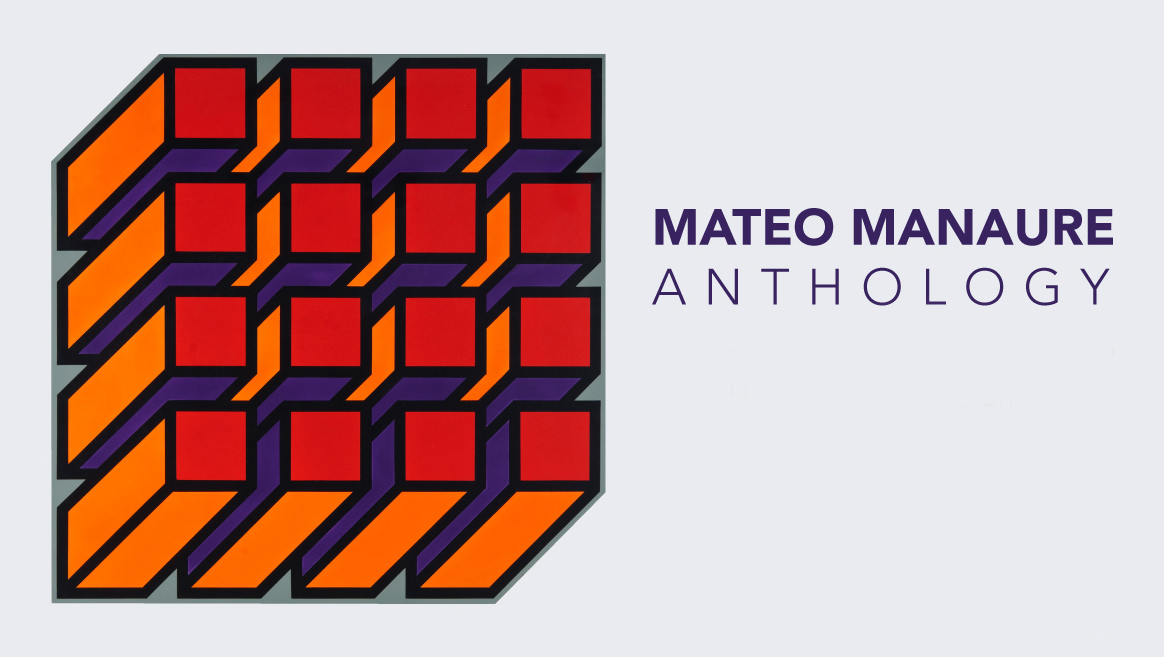
This anthology brings into focus the work of Mateo Manaure (Uracoa, Venezuela, 1926 – Caracas, 2018), a key figure in Latin American abstract art whose relentless inquiry into form, colour and spatial perception helped shape modern abstraction beyond purely formal considerations. Manaure’s practice resists complacent categorization: it spans geometric abstraction, optical exploration and an understanding of colour as a dynamic structural force rather than a mere surface attribute.
Manaure’s artistic trajectory is rooted in the historical convergence of Latin American modernism and European avant‑garde influences. After early formative years in Caracas and study abroad, he became part of Los Disidentes, a group of Venezuelan artists in Paris that sought to redefine artistic language through abstraction and conceptual freedom. This formative engagement with geometric principles and perceptual inquiry remained a constant throughout his career.
The works assembled in this anthology confirm Manaure’s persistent commitment to showing abstraction as a lived experience, not a sterile exercise in formal logic. His approach treats colour as an active phenomenon — capable of generating spatial depth, rhythm and visual tension — rather than a passive embellishment. Through disciplined repetitions, subtle counterpoints and chromatic interactions, his compositions create environments in which colour and form act in concert to reveal underlying structures of perception.
Beyond the rigid confines of geometric constructivism, Manaure’s work continually seeks resonance with human perception. His colour rhythms and structural dialogues evoke not only optical phenomena but also an ongoing conversation between viewer and surface. Rather than presenting artefacts fixed in meaning, the works invite contemplation of how colour and geometry co‑constitute our experience of space and visual order.
By extending his practice across decades, from early abstract experiments to later explorations of optical modulation, Manaure exemplifies how abstraction can remain open to complexity and interpretive depth. This anthology does not simply survey his output; it situates his work within a broader inquiry into how geometric form and chromatic experience intersect to produce new ways of seeing. In doing so, it highlights Manaure’s enduring influence on contemporary discussions around abstraction and colour theory, reaffirming his position as an indispensable voice in the ongoing evolution of abstract art.