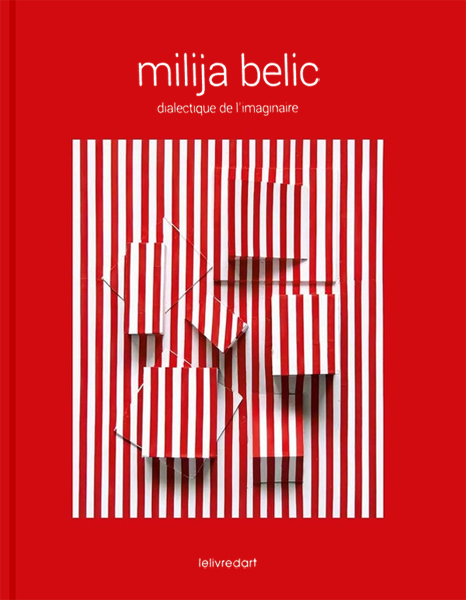
 Monographic Catalogue
Year: 2026
Texts: Milija Belic, Bernard Fauchille, Robert Liris, René Passeron, Katarina Ambrozić, Sreto Bošnjak.
Languages: Française
250pp. | 15x21cm.
Publisher: Lelivredart
ISBN: 978-2-35532-474-1
By Gianfranco Spada
Monographs devoted to a single artist generally fall into one of two distinct categories. Some serve a primarily documentary purpose: they record an exhibition, establish a chronology, assemble reproductions of the works, and provide sufficient bibliographical material to situate the reader within the artist’s career. Others aspire to something more ambitious, transforming the catalogue into an interpretive work in its own right. Here, the illustrations cease to function merely as a visual inventory and instead become part of a broader historiographical discourse.
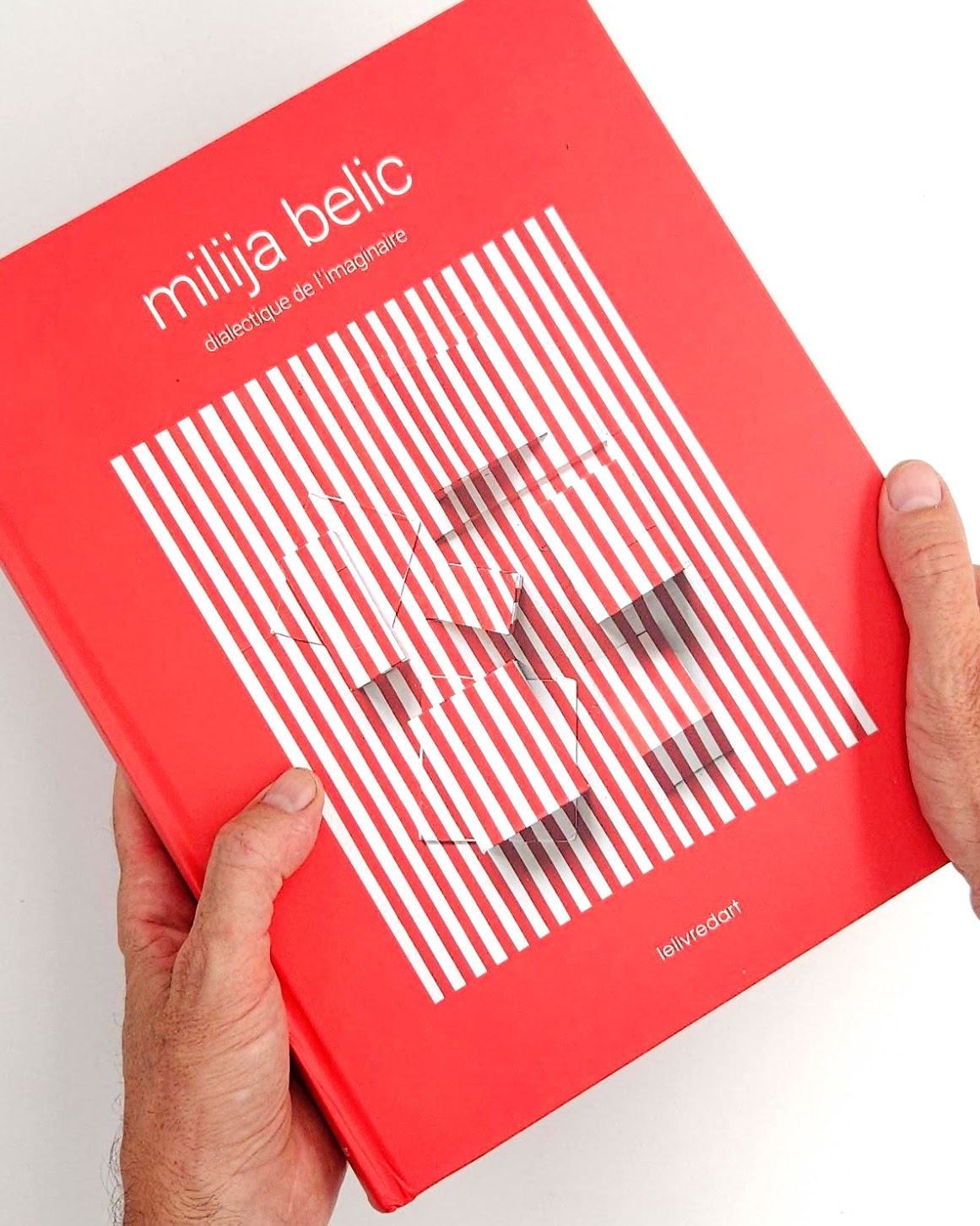
The monograph dedicated to Milija Belic belongs unequivocally to this latter category. It does not simply accompany the artist’s production, nor does it merely offer a retrospective survey spanning several decades of creative activity. Rather, it advances an intellectual reading of an artistic exploration sustained for more than forty years, turning the book itself into an extension of the ideas that permeate Belic’s entire oeuvre.
This distinction is especially significant because Belic occupies a singular position within contemporary art. Painter, sculptor, theorist and Doctor of Aesthetics from the University of Paris I Panthéon-Sorbonne, he has pursued, in parallel, a visual practice and a philosophical investigation that constantly nourish one another. He is not an artist who subsequently rationalises his work through explanatory texts; theoretical reflection is, for him, an integral component of the creative process itself. Painting, drawing, sculpture and writing emerge as complementary expressions of a single investigation into the nature of space, perception, time and the underlying structures of reality.
This dual identity determines the very architecture of the volume. Reproductions of the works engage in a sustained dialogue with essays by historians, philosophers, art critics and the artist himself, creating a path that deliberately resists a straightforward chronological narrative in favour of a genuine intellectual cartography. The reader progresses not simply through images but through ideas. Each body of work introduces new questions; each essay illuminates a different facet of an inquiry that is never static. The volume therefore assumes an uncommon role: it documents not only the evolution of an artistic practice but also the gradual formation of an intellectual framework.
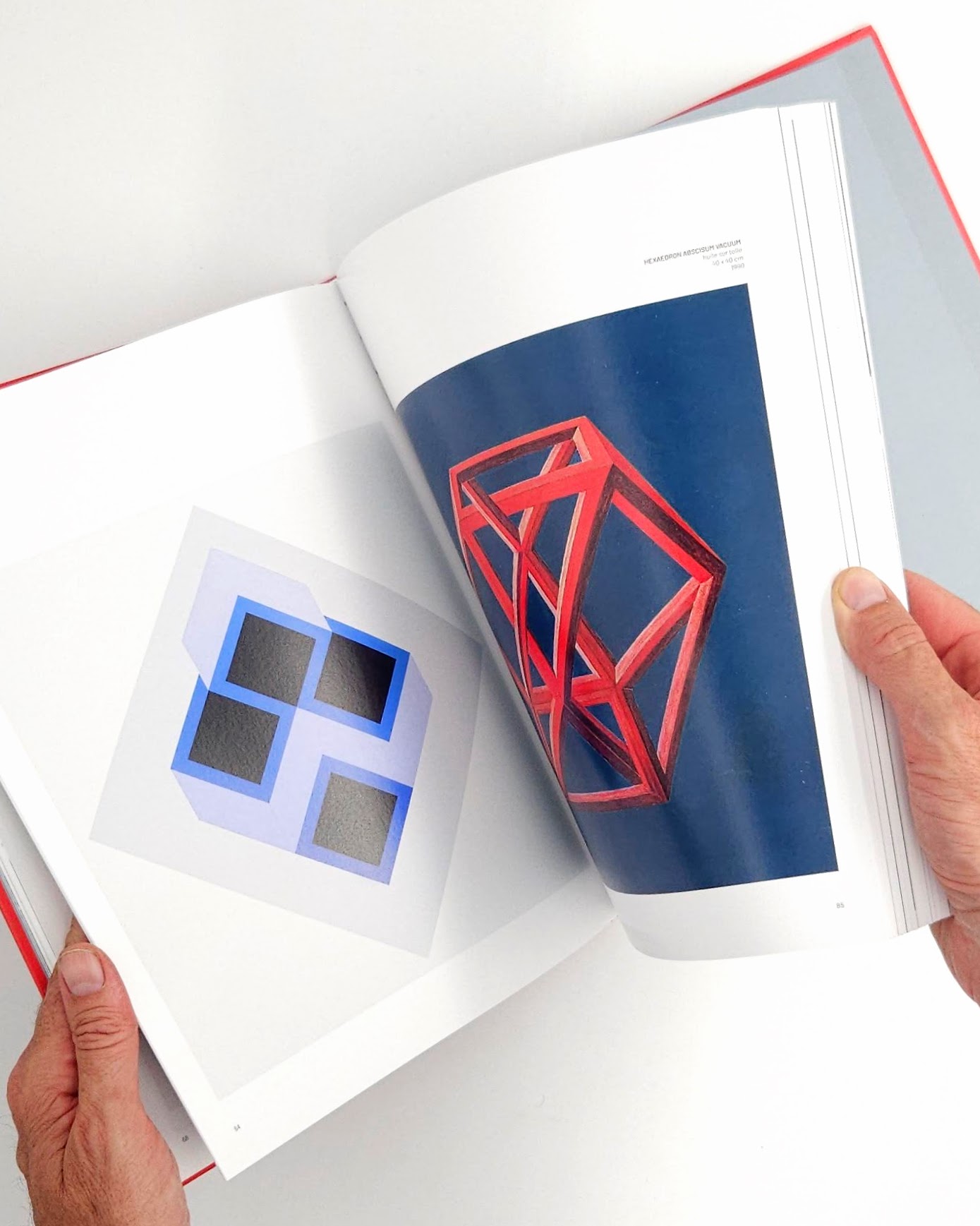
One of the publication’s greatest editorial achievements lies in its refusal to confine Belic within a stylistic label. Although geometry provides the thread running through his entire production, the volume makes it abundantly clear that geometry never functions merely as a formal vocabulary or an autonomous visual language. From the impossible architectures and metaphysical constructions of the early 1980s to the more recent investigations into hypercubes, spatial rhythms and kinetic structures, geometry remains consistently subordinate to a much broader question: how do we construct reality in the mind, and to what extent can the image reshape that construction?
This shift is essential to understanding Belic’s distinctive place within the history of European geometric abstraction. Too often, geometry has been interpreted through a narrowly formalist lens, as the progressive reduction of the image to relationships between lines, planes and proportions. Twentieth-century art offers countless examples of this tendency, from the rigour of Neo-Plasticism to certain strands of Minimalism. In Belic’s work, however, geometry is never an end in itself. It operates instead as a cognitive instrument—almost as a philosophical device—designed to challenge the perceptual conventions through which we organise our experience of the world.
The volume makes this conceptual continuity immediately apparent, even where the visual results seem to belong to very different moments in the artist’s career. Imaginary architectures, impossible columns, paradoxical objects, dynamic spaces and kinetic compositions all stem from the same central concern: to introduce a degree of perceptual instability capable of revealing that visible reality is considerably more complex than everyday perception ordinarily allows us to acknowledge. Representation consequently gives way to experimentation. The image ceases simply to depict an object and instead becomes an investigation into the very conditions of seeing.
One of the most compelling aspects of the volume is the way it demonstrates that Belic’s development is driven not by stylistic rupture but by continuous internal transformation. Many monographs divide an artist’s career into clearly differentiated periods, each replacing one visual language with another. Here, precisely the opposite occurs. The fundamental questions remain remarkably constant, while the means employed to investigate them evolve. The spatial paradoxes of the early impossible chairs, the suspended architectures and the columns that appear to metamorphose into one another already contain, in embryonic form, the concerns that would later find expression in the investigations into hyperspace, geometric rhythm and dynamic structures. The visual vocabulary changes; what endures is the pursuit itself.
This continuity is reinforced by the inclusion of Belic’s own writings, one of the volume’s greatest strengths. Far from serving as explanatory commentaries, these texts reveal the intellectual landscape from which his work emerges. Throughout them, references to classical philosophy, contemporary physics, visual perception, music, mathematics and the history of painting intersect to form an intricate network of ideas that resists reduction to any single discipline. Painting is presented as a point of convergence where seemingly disparate fields meet—a site at which philosophical questions acquire visual form and where the image itself becomes a means of knowledge.
Particularly revealing is Belic’s insistence that art should never be understood as the mere reproduction of reality. Painting, for him, constitutes an active interpretation of the world: a process through which the image does not replicate the visible but proposes new ways of perceiving it. This conviction, which runs throughout his theoretical writings, also explains the ambiguity of many of his compositions. His objects are never entirely impossible, nor entirely real. They inhabit an intermediate territory in which everyday logic begins to fracture without ever completely disappearing. The viewer recognises what is before them, yet simultaneously realises that recognition alone is no longer sufficient to explain what they see. It is precisely within that fissure that Belic’s work unfolds its greatest intellectual force.
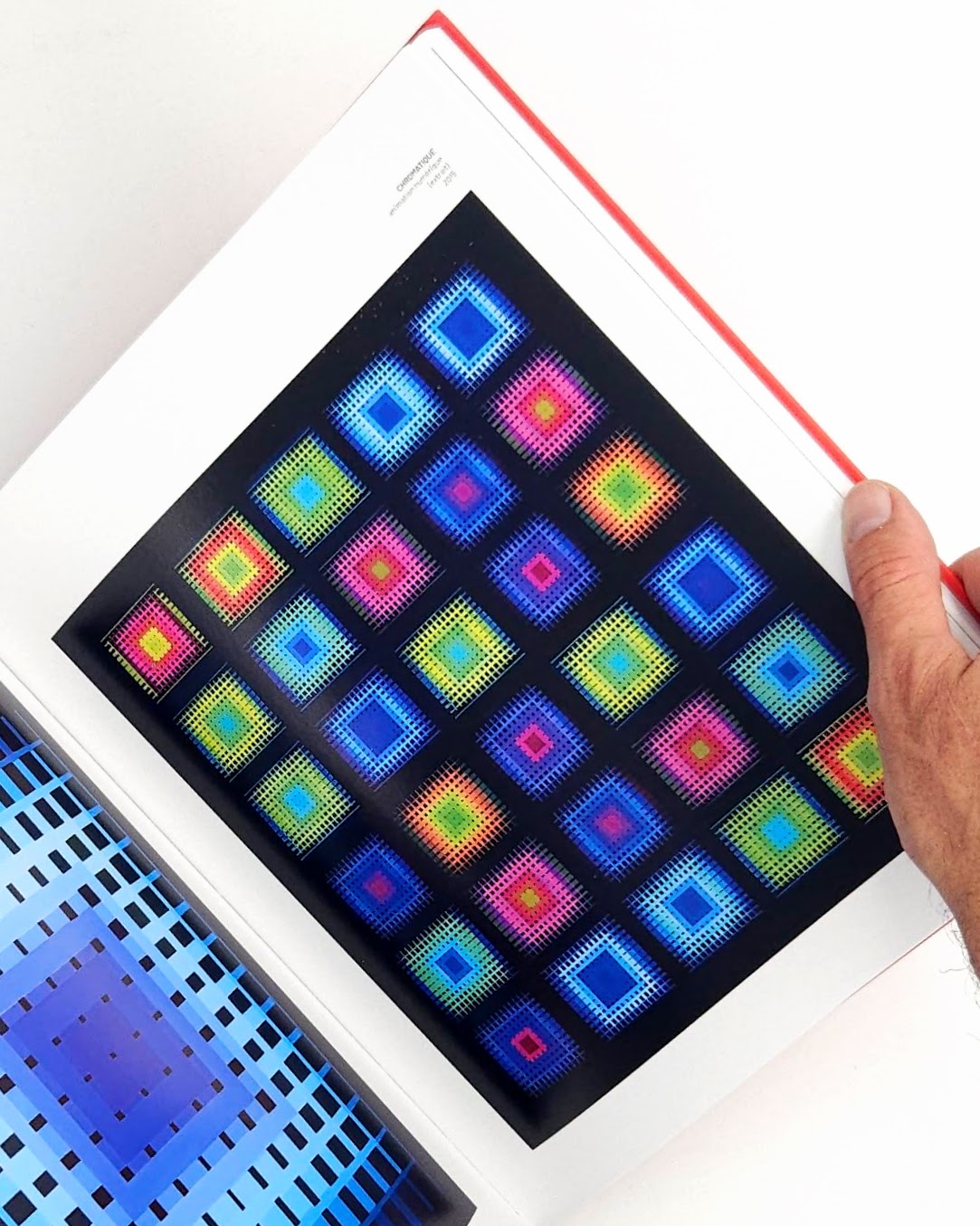
The publication demonstrates that this perceptual strategy remains constant even when figuration has all but disappeared. The more recent geometric compositions, seemingly far removed from the metaphysical architectures of Belic’s early years, continue to explore precisely the same questions through different visual means. Perception remains under scrutiny, challenged by rhythms, transparencies, chromatic interference and spatial configurations that appear to extend beyond the physical limits of the picture plane. Space is no longer conceived as a container within which forms are arranged, but as a dynamic phenomenon whose very existence depends upon the act of perception itself.
It is perhaps here that Belic’s most significant contribution lies. In contrast to much of the historical tradition of geometric abstraction—which was primarily concerned with the rational organisation of the pictorial surface—Belic shifts the centre of gravity towards the experience of the viewer. His paintings do not simply present structures; they generate perceptual events. The work does not end at the edge of the canvas but continues to unfold within the viewer’s consciousness, compelling it continually to reorganise the visual information it receives. Geometry thus ceases to be a stable construction and becomes an open mental process, subject to constant variation and inseparable from the duration of contemplation.
Faced with a body of work such as Belic’s, comparisons with some of the major figures of twentieth-century geometric art are almost inevitable. This volume establishes certain genealogies, recalling the importance of artists associated with Cubism, Constructivism, Neo-Plasticism and, above all, Kinetic Art. Yet a careful reading soon reveals that these references function less as direct filiations than as points of departure. Belic does not seek to prolong any of these historical movements. Instead, he appropriates some of their central questions and redirects them towards a profoundly personal territory.
The comparison that comes most readily to mind is with M. C. Escher, owing to Belic’s use of impossible architectures, ambiguous perspectives and spatial paradoxes. The resemblance, however, is only superficial. Whereas the Dutch artist made paradox the very subject of representation, constructing intricate mathematical puzzles designed to undermine spatial logic, Belic employs similar devices for an altogether different purpose. Impossibility is never the subject of his work; it is merely the means by which the stability of perception is brought into question. Where Escher fascinates through the brilliance of visual ingenuity, Belic invites reflection upon the very conditions of knowledge itself. Paradox ceases to be an intellectual spectacle and becomes instead a philosophical instrument.
A similar distinction applies to the inevitable comparison with Victor Vasarely. Both artists share an interest in perceptual transformation, geometry and optical illusion, yet their objectives differ profoundly. Vasarely sought to establish a universal visual language grounded in relatively objective and repeatable optical laws. Belic, by contrast, is less concerned with codifying a system than with exploring the uncertainties that such a system itself may generate. His compositions do not attempt to stabilise a geometric vocabulary; instead, they reveal its capacity to produce ambiguity. Even when working with the simplest forms, the visual experience remains open, unstable and continually receptive to new interpretations.
The same caution applies when considering Belic alongside Jesús Rafael Soto or Carlos Cruz-Diez. Movement, optical vibration and the incorporation of time into aesthetic experience are concerns shared by all three artists. Yet whereas the great Venezuelan masters progressively transformed painting into an essentially perceptual phenomenon, Belic consistently preserves a conceptual and symbolic dimension that places his work within a different intellectual horizon. In his paintings, time is not merely a retinal event but also a philosophical category. Dynamic perception continually points towards a broader meditation on the nature of space, the relativity of experience and the impossibility of reducing reality to a single point of view.
In this respect, the recurring presence of scientific references throughout Belic’s writings is especially revealing. Relativity, non-Euclidean geometry, hyperspace, higher dimensions and concepts drawn from contemporary physics appear repeatedly across the volume. It would nevertheless be a mistake to interpret these references as visual illustrations of scientific theories. Belic does not seek to translate mathematics into pictorial language, nor to produce aesthetic equivalents of physical models. What interests him is the profound intellectual transformation these theories have brought about in our understanding of reality. Since the beginning of the twentieth century, science has ceased to regard space as fixed, homogeneous and absolute. Belic’s painting begins precisely from this awareness, constructing a universe in which every apparent stability remains provisional.
This concern also explains architecture’s central place in his iconography. The columns, arcades, staircases and impossible constructions that dominate much of his early production never represent specific buildings. Instead, they function as metaphors for thought itself. These are structures in which stone seems to lose its weight, the boundaries between interior and exterior dissolve, and gravity no longer obeys familiar laws. Architecture ceases to be merely construction and becomes instead a form of spatial reasoning. It is perhaps for this reason that these spaces evoke such a curious sensation of simultaneous familiarity and estrangement. We recognise their constituent elements, yet the logic governing their relationships belongs to an entirely different order.
The volume demonstrates with remarkable clarity that this architectural investigation constituted the laboratory from which Belic’s later geometric series would emerge. At first glance, the metaphysical architectures appear to disappear, giving way to wholly abstract compositions. Closer examination, however, reveals that they never truly vanish; they become dematerialised. Columns are transformed into vectors. Walls dissolve into chromatic planes. Constructed spaces ultimately evolve into fields of force. Abstract geometry retains the memory of architecture in much the same way that the kinetic works retain the memory of the object itself.
This continuity represents one of the volume’s most valuable contributions, for it dismantles the notion of a linear artistic evolution based upon the gradual abandonment of figuration. In reality, Belic abandons nothing. Each new phase absorbs and transforms the previous one. Architecture remains latent within abstraction; spatial paradox survives within the kinetic structures; drawing continually nourishes painting; theory guides practice without ever imposing a rigid programme upon it. His artistic development therefore appears not as a succession of stylistic phases, but as a process of uninterrupted expansion.
Another aspect deserving particular attention is the extraordinary prominence accorded to drawing. Many monographs tend to treat drawings merely as preparatory material, valuable principally for explaining the genesis of later paintings. Here, the opposite is true. Drawing possesses complete autonomy and constitutes one of the fundamental pillars of the visual discourse. Ink drawings, pencil studies, watercolours and sketches are not ancillary to the paintings that follow; they participate fully in the same process of exploration. Indeed, they often propose spatial solutions even more radical than those eventually realised on canvas.
This emphasis on drawing reveals a method grounded in continuous exploration. Belic does not regard drawing as a preliminary step towards a definitive work but as an experimental field in which ideas may develop with greater freedom. Many of the structures that later appear on monumental canvases first emerge in these modest sheets through subtle variations, minute displacements and almost imperceptible transformations. The volume allows us to witness this gradual sedimentation of visual thought, demonstrating that creation advances not through sudden flashes of inspiration but through the patient accumulation of experiments.
From an editorial standpoint, this breadth of documentation is among the volume’s greatest strengths. The selection of works deliberately avoids constructing a narrative based solely on canonical masterpieces. Alongside the large-scale paintings appear studies, drawings, prints, serigraphs, digital works, collages and sculptures, all of which illuminate the complexity of Belic’s creative process. The reader encounters not only finished works but also the successive layers of investigation that made each series possible. The monograph thus transcends the role of a retrospective survey and becomes a genuine instrument of scholarship.
It is perhaps this documentary richness that allows one to perceive most clearly a quality that permeates Belic’s entire oeuvre yet is rarely articulated explicitly: the extraordinary coherence of an artistic project that has evolved continuously for more than four decades without ever relinquishing its identity. Few contemporary artists have managed to sustain such a consistent line of thought while simultaneously avoiding repetition. Each new series introduces previously unexplored questions, yet all seem to arise from a single governing concern: how can the image deepen our understanding of space, time and reality without sacrificing the poetic dimension that lies at the very heart of artistic experience?
If one concept runs through the monograph like an invisible thread, it is undoubtedly rhythm. Not simply because Belic himself has devoted a significant part of his theoretical work to this subject, but because rhythm functions as the organising principle of his entire production, even in works that initially appear perfectly static. His early architectural compositions seem suspended in complete silence; yet prolonged contemplation reveals that the columns begin to shift, the arches gradually transform into one another, and perspective itself starts to oscillate.
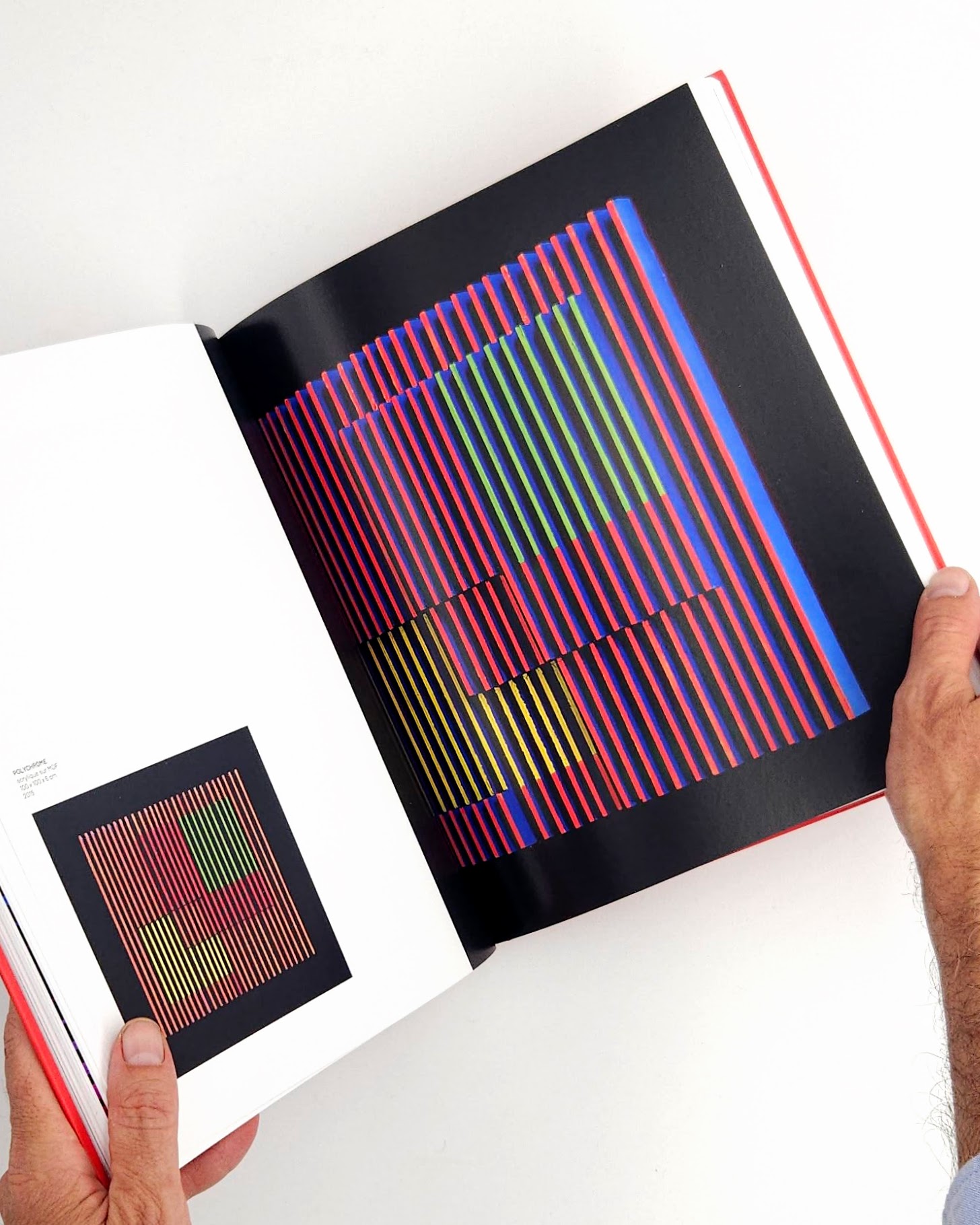
Later, as architectural references progressively disappear and geometric structures become increasingly distilled, this latent movement emerges as the true protagonist of the image. It is no coincidence that some of Belic’s most recent series are constructed through repetition, variation and the modulation of elementary forms. Repetition never produces monotony; it generates duration. Geometry begins to function less as a spatial construction than as a musical score unfolding over time.
This musical dimension is subtly suggested throughout the volume and represents one of the least immediately obvious keys to Belic’s work. The issue is not the familiar analogy between colour and sound, nor any superficial correspondence between painting and music. What interests the artist is the existence of shared structural principles. Just as a musical composition organises intervals, tensions, repetitions and silences, painting can organise spatial relationships whose true nature only reveals itself through sustained contemplation. The canvas ceases to be a static surface and becomes instead a sequence of perceptual events. The viewer does not merely observe a completed image but traverses it, reconstructs it and interprets it almost as one listens to a piece of music.
This becomes particularly evident in the works belonging to Belic’s kinetic period, where movement depends not only upon optical illusion but also upon the image’s capacity to activate the viewer’s gaze. Unlike certain historical manifestations of Op Art, whose visual effects could be exhausted once their perceptual mechanism had been deciphered, Belic pursues a markedly different objective. His compositions do not seek to astonish through spectacular visual effects; rather, they aim to keep perceptual experience permanently open. The longer one remains before the work, the richer the network of relationships that gradually emerges. The painting reveals itself as a dynamic organism whose complexity increases with the duration of observation.
This attitude also distinguishes Belic from much of the European Concrete Art tradition. From Max Bill to several exponents of Italian Programmed Art, geometry was frequently understood as the logical outcome of a rigorously defined rational system. Belic’s position is almost the reverse.
Rationality serves merely as the point of departure for a project whose purpose is precisely to expose the limitations of any excessively stable system. Geometry does not close down meaning; it multiplies it. Every structure contains the potential for perceptual reorganisation, generating new configurations without any physical alteration of its constituent elements. What ultimately matters is not the represented form itself but the way in which that form behaves within the consciousness of the observer.
One of the most intriguing aspects of the monograph is the extent to which Belic has remained remarkably independent of many of the dominant tendencies in contemporary art. While much artistic production over the past decades has gravitated towards autobiography, institutional critique, image appropriation or socio-political commentary, Belic has continued to pursue an exploration centred upon questions that might seem almost timeless: space, perception, form, rhythm and the structures of visual thought.
Such a position could easily be mistaken for isolation—or even anachronism. The volume demonstrates precisely the opposite. In an age characterised by the relentless proliferation of images and the accelerating pace of visual experience, Belic’s insistence on slowing perception and restoring complexity to the act of seeing acquires a striking contemporary relevance.
It is equally revealing that many of his most recent works incorporate digital procedures without fundamentally altering the questions that have guided his practice since the 1980s. The computer appears simply as another instrument within the creative process, never as an end in itself. Unlike artists captivated by the technological possibilities of the digital medium, Belic maintains a notable critical distance from technological enthusiasm. Digital processes do not replace pictorial thinking; they merely extend its possibilities. Digital prints, computer-assisted geometric investigations and spatial experiments all remain firmly anchored in the artist’s enduring concern with perception and with the intellectual construction of the image.
Once again, one of the volume’s principal achievements is its ability to reveal the remarkable internal unity of an oeuvre developed over several decades without ever lapsing into mechanical repetition. Each series introduces new questions, revises earlier solutions and expands the field of investigation, yet all appear to arise from the same intellectual impulse. Painting becomes an instrument of knowledge. It does not simply represent the world; it investigates the very conditions under which the world can be perceived.

For precisely this reason, reading the monograph gradually shifts one’s attention away from art history alone towards questions more commonly associated with the philosophy of perception and epistemology. The works cease to function merely as aesthetic objects and instead become experiments in the nature of visual experience itself. This dimension also explains Belic’s sustained engagement with concepts such as hyperspace, transparency, multidimensionality and dynamic structures. Rather than illustrating scientific theories, these notions operate as conceptual metaphors that expand the intellectual horizon of contemporary painting.
The intellectual ambition of the volume is equally reflected in its selection of essays, which together offer a remarkably coherent interpretation of Belic’s artistic development from a range of complementary perspectives. The publication deliberately privileges an approach centred on the internal evolution of his thought and practice rather than on an extended comparison with other contemporary movements. This is an entirely legitimate editorial choice. It allows the reader to engage deeply with the conceptual universe that underpins Belic’s work, while simultaneously leaving open fertile avenues for future research that might situate his contribution more fully within the broader international history of recent geometric abstraction. Far from constituting a limitation, this decision serves only to underscore the richness of an oeuvre that continues to invite fresh readings and new interpretations.
By the time one reaches the conclusion of this substantial monograph, it becomes evident that its greatest achievement lies not merely in the quality of its reproductions, the chronological breadth of its selection, or the scholarly authority of the accompanying texts. Its true accomplishment is to demonstrate that Milija Belic’s career constitutes one of the most coherent and intellectually sustained investigations into geometry undertaken over the past four decades. This coherence does not stem from the repetition of a recognisable visual language, but from an unwavering commitment to a small number of fundamental questions that the artist has reformulated repeatedly through ever-changing visual strategies. Such fidelity is perhaps one of the rarest qualities to be found in contemporary art, at a time when artistic careers are so often shaped by shifts in fashion, market pressures or the rapid succession of cultural trends.
The monograph also demonstrates that this exploration has never remained confined within the relatively narrow territory of painting alone. On the contrary, it maintains an ongoing dialogue with disciplines ranging from classical philosophy to contemporary physics, from music theory to mathematics, from the psychology of perception to the history of architecture. Yet one of Belic’s greatest achievements lies precisely in preventing this dense network of references from becoming little more than an exercise in erudition. A viewer entirely unfamiliar with the scientific theories, philosophical concepts or historical precedents informing Belic’s thought can nevertheless experience the perceptual disquiet generated by his works. Intellectual depth enriches interpretation, but never replaces aesthetic experience: above all else, the paintings continue to function simply—and profoundly—as paintings.
This is precisely why it is insufficient to interpret Belic exclusively within the traditions of Kinetic Art or geometric abstraction. Although both genealogies are indispensable for understanding certain aspects of his production, neither fully encompasses the complexity of his artistic project. His work occupies a fertile territory in which the European metaphysical tradition intersects with perceptual research, scientific thought and a deeply humanistic conception of artistic creation.
Geometry ceases to be a closed visual grammar and becomes a form of knowledge; space is transformed from a physical category into a mental experience; time is no longer measured by clocks but by the duration of looking. It is hardly surprising, then, that many of the essays in the volume return repeatedly to the notion of transformation: columns become spaces, spaces become rhythms, rhythms evolve into fields of energy, geometric structures become perceptual events. The viewer is never confronted with a definitive form but witnesses a process that continually reorganises itself without losing its identity. Each work proposes a hypothesis rather than a conclusion.
Engaging with Belic’s paintings therefore requires an attitude that has become increasingly uncommon within contemporary visual culture. Against the speed with which images are now consumed, he asks for slowness; against the immediacy of visual information, he proposes uncertainty; against instant recognition, he introduces doubt as an instrument of knowledge. His compositions unfold through the gradual accumulation of subtle perceptual discoveries that emerge only when the gaze is willing to linger. Ultimately, this is a body of work that demands time—and transforms time itself into one of its essential artistic materials.
Viewed from this perspective, the publication also possesses considerable historiographical significance. For decades, the exhaustion of geometric abstraction as a historical language has been repeatedly proclaimed. Belic’s work suggests that the real problem has never resided in geometry itself, but rather in the limitations with which it has so often been interpreted: once geometry ceases to be understood merely as a repertoire of forms and is instead recognised as a means of thinking about reality, it recovers an extraordinary capacity for renewal. Against historiographical narratives that present the evolution of abstract art as a succession of neatly defined movements—Constructivism, Concrete Art, Kinetic Art, Minimalism or Digital Art—Belic’s career suggests a far more complex continuity, in which perception, space, movement, rhythm and the relationship between art and science remain profoundly contemporary issues rather than concerns confined to the historical avant-garde.
One may finally ask what place a publication such as this occupies within the recent bibliography on geometric abstraction. More than a catalogue raisonné or an illustrated retrospective, this volume constitutes a genuine work of scholarship, enabling the reader to engage simultaneously with the formal evolution, theoretical writings and intellectual context of one of the European artists who has most consistently explored the nature of the image. Few monographs achieve so successful a balance between documentation, critical interpretation and editorial excellence, and none of this implies that the discussion has reached its conclusion—quite the contrary. If the volume accomplishes anything, it is to open new avenues of inquiry, inviting us to reconsider the relationships between abstraction and metaphysics, geometry and perception, theory and artistic practice, pictorial space and scientific thought.
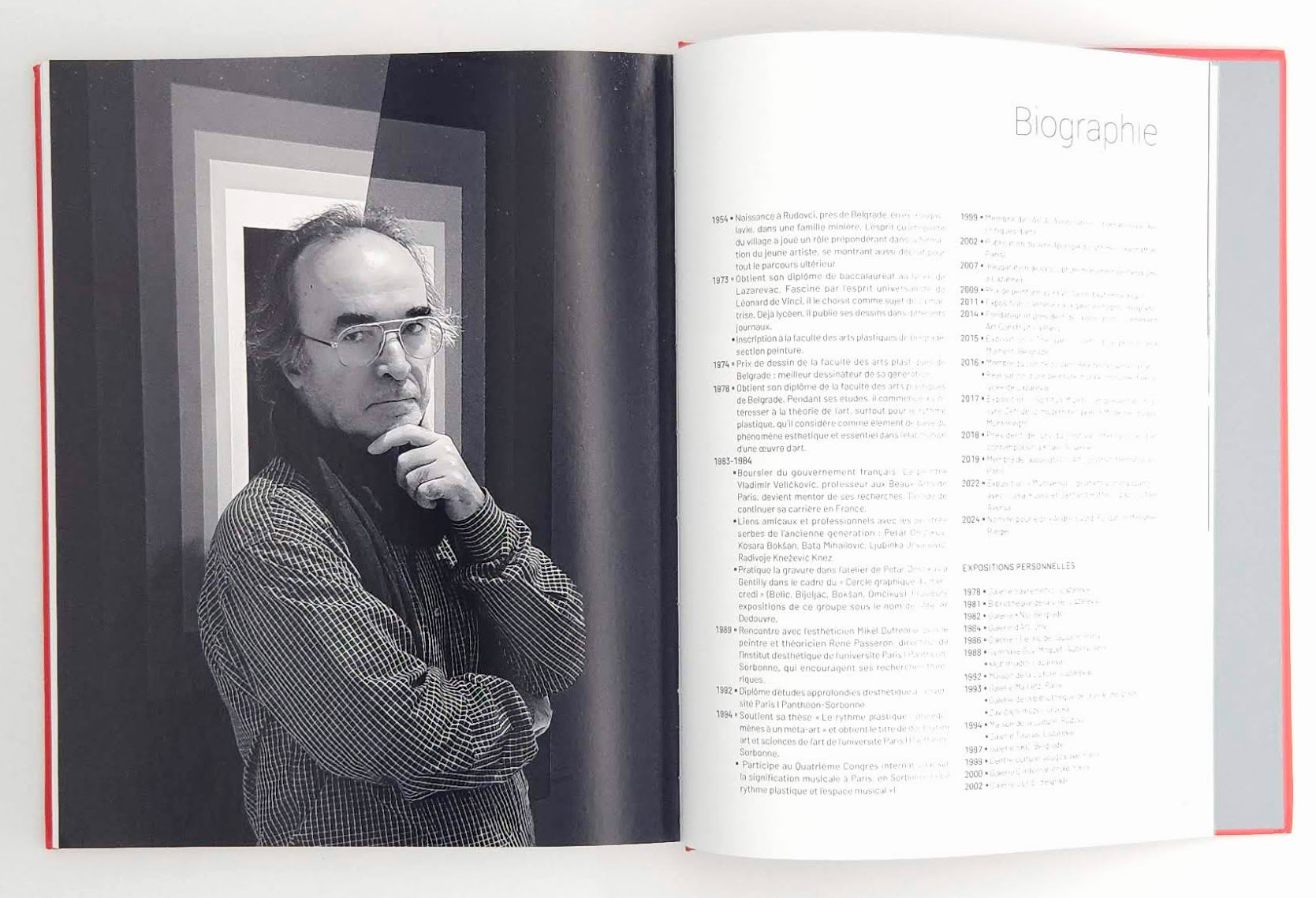
The monograph devoted to Milija Belic ultimately confirms that we are confronted with an artist whose significance lies not merely in the quality of his visual production but in the extraordinary intellectual coherence that has sustained it over time. Rather than merely documenting an artistic career, it succeeds in placing Belic precisely where he belongs within the recent history of European abstraction: not as the belated continuation of an established historical language, but as the author of a thoroughly contemporary investigation into the nature of space, time and perception. In an age dominated by the accelerated circulation of images, Belic’s work reminds us that looking remains an act of knowledge.